
Idea 1
Shifting the Source of Action
How do you lead transformation in a world marked by turbulence and complexity? Otto Scharmer’s Theory U: Leading from the Future as It Emerges argues that real change begins not with strategies or tools but with the invisible place from which attention and action arise. He names that place the blind spot—the interior source that shapes our perceptions, intentions, and decisions before we even act. Until you can see and shift this source, Scharmer warns, you will only reproduce the past, regardless of clever reforms or technologies.
The book unfolds as both a philosophy and a method for moving from habitual reactivity to creative presence. It maps a U-shaped journey that descends through observation and letting go, touches a deep point of connection to the future, and ascends through rapid experimentation and systemic embedding. Along the way, you learn to open three instruments—mind, heart, and will—that unlock deeper seeing and acting. This journey draws on decades of action research at MIT, case studies from business and social sectors, and philosophical roots in phenomenology and systems thinking.
The Blind Spot and the Fields of Attention
Scharmer begins with the discovery that our awareness has a structure. He describes four fields of attention: downloading (I-in-me), where we confirm what we already know; seeing (I-in-it), where we open the mind to disconfirming data; sensing (I-in-you), where we empathically connect with the system; and presencing (I-in-now), where we access and act from the highest future potential. Each level feels different in conversation, leadership, and collective action. Recognizing which field you and your team are in becomes a diagnostic and developmental key.
Bill O’Brien, former CEO of Hanover Insurance, summarized the principle that integrates all of Scharmer’s work: “The success of an intervention depends on the interior condition of the intervener.” The outcome you produce, in other words, mirrors the field of awareness from which you operate.
The U Process as a Journey of Transformation
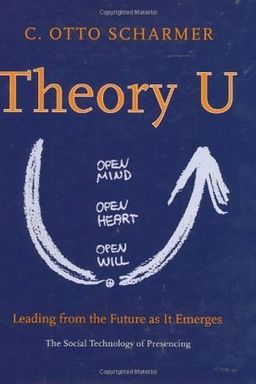
The heart of Theory U is the U-shaped process. On the left side, you move down by suspending judgment (open mind), redirecting attention (open heart), and letting go of control (open will). At the bottom, you experience presencing: a moment of stillness where you connect with the emerging future. The right side ascends through crystallizing (clarifying intent), prototyping (experimenting by doing), and performing (embedding new practices at scale). Francisco Varela, Brian Arthur, and Joseph Jaworski provided Scharmer with the experiential grammar for these shifts.
Examples anchor this arc: at Xerox PARC, Brian Arthur described innovators who observe deeply, retreat until an inner knowing emerges, then act in an instant. In the Patient‑Physician Dialogue Forum, hundreds of participants moved from defensive debate to collective presencing, creating a shared vision for health‑care reform. In these cases, transformation happened when the group began to see itself as a living system rather than isolated parts.
Learning from the Future
Traditional learning improves based on the past; presencing adds a new mode—learning from the future as it emerges. Scharmer identifies four levels of learning: reacting (from habit), redesigning (adjusting structures), reframing (changing assumptions), and presencing (connecting with future possibilities). In complex systems—characterized by ambiguity, multiple stakeholders, and fast change—past-based learning inevitably fails. The leader’s task becomes cultivating the capacity to perceive the not-yet-known and act from that insight.
Co‑Sensing and Co‑Presencing
Real-world innovation, Scharmer insists, happens through co‑sensing (observing reality together) and co‑presencing (connecting to collective source). Dialogue interviews, learning journeys, and silent retreats serve as “containers” where participants suspend habitual patterns and let a new future emerge. The Circle of Seven case illustrates how sustained group practice—ritual, silence, and deep listening—maintains a generative social field over years.
From Inner Work to Systems Change
The book’s argument extends from psychology to institutions and ultimately to civilization. Organizations like GlobalHealthCompany fail repeatedly not because of faulty strategy but because they operate from old interior structures of attention—secrecy, fear, denial. To change outcomes sustainably, you must shift the field of collective awareness. At the societal level, this means moving from hierarchical and market logics to ecosystemic co‑creation—redesigning democratic, economic, and cultural infrastructure for collective presencing.
A New Science of Becoming
Scharmer closes by proposing a new science that integrates first‑person awareness, second‑person dialogue, and third‑person data. This “science of the social field” draws from phenomenology and systems theory to study how the act of observing changes what is observed. The ultimate leadership practice, he concludes, is learning to “bend the beam of observation back upon its source.” When you cultivate open mind, heart, and will, you turn yourself and your organization into instruments for the future that wants to emerge.