
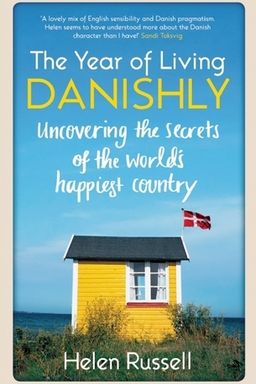
The Year of Living Danishly cover

The Year of Living Danishly

by Helen Russell

Explore the secrets of Denmark''s happiness in ''The Year of Living Danishly.'' Dive into Danish culture, discover the joy of hygge, balanced work-life, and supportive social systems, and learn why this small nation consistently tops global happiness charts.

The Danish Way to Live Well

The Danish Way to Live Well

What makes Denmark consistently rank among the world’s happiest nations? In The Year of Living Danishly, Helen Russell sets out to discover why — and what happens when you try to live according to those same principles. Her experiment begins with exhaustion and longing in London, where a glossy media job and fertility heartbreak leave her burnt out. Then an unexpected email about her husband’s potential job at Lego becomes the doorway into a radically different rhythm of life.

Over the course of a year in Billund, Russell investigates everything from trust and welfare to hygge and Danish design. She experiences the bureaucratic hoops of moving abroad, the shock of Nordic winter, and the systems that make everyday happiness possible. The result isn’t an idealized postcard of happiness, but a complex portrait of how institutions, culture and daily rituals combine to create contentment.

Leaving burnout behind

Russell opens with honesty about the London grind: endless work, adrenaline weekends and hollow socializing, compounded by the physical toll of fertility treatments. The idea of escaping to Denmark begins as fantasy but evolves into necessity — a chance to heal and think again. Her move becomes more than relocation: it’s an experiment in systems of happiness, an inquiry into why Danes thrive.

The Danish happiness formula

Russell’s research uncovers four major pillars supporting Danish happiness: trust, equality, welfare and time. In Denmark, over 70% of citizens believe that most people can be trusted — a statistic that runs through daily behaviors like unlocked bikes and prams outside cafés. The welfare state underwrites confidence by guaranteeing healthcare, education and unemployment protection, freeing citizens from fear of destitution. Culturally, Danes place modesty and fairness above competition, following Jante’s Law — the unwritten rule that no one should think they’re better than the rest.

Work, family and social balance

Russell contrasts British careerism with Denmark’s focus on balance and dignity at work. At Lego, she witnesses rituals that bind teams together — communal breakfasts, cake for birthdays, and early finishes. The concept of arbejdsglæde (“work joy”) frames work not as status but as participation. Shorter weeks and legal protections uphold flexicurity — a balance between employer flexibility and employee security. For you, the insight is practical: structure work around life, not the reverse.

Hygge and design for well-being

Russell dives into hygge — the Danish art of cosiness. It’s not just candles and blankets but an ethos of intimacy and simplicity. Danes design homes to feel safe and uncluttered, guided by architects like Arne Jacobsen and Poul Henningsen. Beautiful surroundings aren’t frivolous: research shows good design can lift dopamine and improve mood. You learn that comfort is cultivated deliberately — simplicity, light and shared space become acts of emotional care.

Belonging and bureaucracy

The move to Denmark isn’t all serenity. Russell encounters the CPR identity system, exacting banking rules and a social culture that prizes punctuality and norm-following. Integration, she learns, happens through clubs. Denmark hosts more than 80,000 associations ranging from choirs to sewing circles, and nearly 90% of Danes belong to one. Repetition and participation create community — a practical model for belonging anywhere.

Seasons and social coping

Russell learns that happiness depends as much on how you face darkness as on daylight. With only 44 hours of sunlight in November, Danes use hygge rituals — candles, dinners, shared shelter — to convert survival into celebration. Vitamin D supplements and dawn lamps help, but the deeper cure is social: connection and ritual sustain mood more effectively than gadgets. Winter becomes an annual challenge that renews communal resilience.

Family, parenting and equality

Later, Russell explores how Denmark supports children and parents. Universal childcare from six months of age, free schooling and stipends for students frame family life as collective priority. From egalitarian classrooms to extensive paternity leave, the system embeds equality early. Parenting becomes less fraught because care is public, predictable and affordable — proof that happiness is partly institutional.

Food, tradition and belonging

Russell’s immersion extends to food and ritual — from the New Nordic movement led by Noma’s René Redzepi to everyday pastries like kanelsnegle. Danish cuisine embodies community: shared meals signal inclusion. Even eccentric traditions such as Sankt Hans bonfires or Dancing Cow Day reveal how collective rituals create continuity. Through cows, candles and community singing, you see how Denmark’s happiness is not accidental but engineered through rhythm, fairness and trust. The lesson is clear: systems, not slogans, make happiness real.


Trust, Welfare and the Happiness Architecture

Trust, Welfare and the Happiness Architecture

What lies behind Denmark’s remarkable happiness scores? Helen Russell discovers that Danish well-being relies less on fleeting emotion and more on structural design. Happiness in Denmark operates like architecture — engineered through trust, equality and welfare systems that minimize fear and enable freedom of choice.

Trust as a daily foundation

Christian Bjørnskov’s research reveals an astonishing fact: over 70% of Danes believe that most people can be trusted. This faith manifests physically — prams left outside cafés, bikes unlocked, and smooth government transactions through NEM ID. When trust becomes habit, it reduces vigilance and emotional tension. Russell realizes that such assumed decency is a kind of invisible wealth.

Welfare as psychological security

Kim Splidsboel outlines the fiscal details: taxes that can exceed 50% of income, an 8% social contribution, and a 25% VAT. Yet most Danes accept these rates because the benefits are visible — healthcare, education and unemployment protection up to 80% for two years. The welfare net doesn’t just pay bills; it gives existential safety. Knowing the state has you frees mental bandwidth for relationships and creativity rather than anxiety. (Note: Russell compares this liberated mindset to Britain's fear-driven financial culture.)

Equality and the psychology of fairness

Low income inequality strengthens trust further. Peter Thisted Dinesen’s findings show that fair institutions increase civic faith. Through Jante’s Law — a cultural code discouraging arrogance — Danish equality becomes moral as well as economic. People work less to earn more communal stability. Russell calls this the subtext of happiness: when citizens feel society treats them fairly, cooperation replaces competition.

Time over consumption

Denmark’s shorter working week (around 34 hours) and emphasis on vacation time formalize the idea that well-being depends on time, not possessions. Bjørnskov quips, “A bigger car just brings a bigger tax bill.” In practice, people spend evenings with family or at clubs rather than chasing luxury. For readers, the translation is practical: happiness improves when economies reward stability, not accumulation. Russell’s insight is clear — trust plus welfare plus equality build an emotional architecture stronger than any fleeting pleasure.


Work Culture and Flexicurity

Work Culture and Flexicurity

When Russell studies Danish workplaces, she discovers a radical difference: work is designed around humanity, not heroics. The concept of arbejdsglæde — joy at work — permeates office rituals and policies. Lego’s culture typifies this: morning pastries, lunchtime community, flags for birthdays, and early finishes. Productivity exists, but it grows from mutual respect and autonomy.

Flexicurity defined

Denmark’s labour structure combines flexibility for employers with security for employees — hence “flexicurity.” Hiring and firing are easier, but generous retraining and welfare mean few fear job loss. Average workweeks hover near 34 hours, with five weeks’ paid holiday standard. This equilibrium supports real choice: people select jobs for meaning, not survival.

Modesty and collaboration under Jante’s Law

Aksel Sandemose’s Jante’s Law — “Don’t think you’re better than us” — curbs ego-driven hierarchies. In Russell’s Lego office, boastful self-promotion is discouraged. Leaders are expected to participate, not dominate. The system rewards collective success, tempering competitive stress common in Anglo-American workplaces. (Note: This social norm resembles Japanese humility but operates through equality rather than conformity.)

Stress and digital intrusion

Despite systemic balance, Russell notes a stress paradox: smartphones blur work boundaries, causing anxiety even in flexible systems. Unions and municipal programs respond with counseling and long-term sick leave options. Her personal experiment — shutting down the laptop early — shows that reducing availability reclaims calm. Denmark’s lesson: boundaries create sustainable productivity.

Practical takeaway

If you want to adopt Danish-style work joy, guard your breaks, cultivate ritual (shared coffee, communal lunches) and stop glorifying overwork. Balance is protective and productive at once.

Russell concludes that Denmark transforms employment from competition into participation. For you, this means designing work around dignity — shorter hours, collaborative rituals, respect for home life — and seeing boundaries not as a limitation but as liberation.


Hygge and the Design of Everyday Comfort

Hygge and the Design of Everyday Comfort

For Russell, discovering hygge is discovering a philosophy. The word may defy translation, but its emotional texture — cosy togetherness, soft light, shared ease — defines Danish living. Combined with functional design, hygge becomes a psychological technology against stress and winter blues.

What hygge feels like

Candlelight, communal meals, uncluttered spaces: hygge hinges on small efforts. Cultural coach Pernille Chaggar teaches that you can’t buy hygge — you earn it through presence. Danes burn more candles per capita than any nation, treating light as emotional nourishment. Where others flee winter, Danes aestheticize it.

Design as civic welfare

Anne-Louise Sommer from the Design Museum notes that Danish design began as public health policy in hardship years: beautiful, humane objects make life bearable. Arne Jacobsen’s chairs and Poul Henningsen’s lamps embody democratic aesthetics — design for all, not elite luxury. UCL research that Russell cites shows lovely objects trigger dopamine; well-being literally comes from form.

Creating a hygge home

Charlotte Ravnholt’s checklist distills the essentials: a solid wooden dining table for guests, one statement chair for grace, a designer lamp for light layering, a Kubus candleholder, and durable plates for dignified meals. Simplicity and tactility matter more than quantity. Even mundane rules — removing shoes indoors or bringing your own bulbs — reinforce respect for environment.

Design insight

“If our surroundings are nice, we feel cosy and safe,” says Sommer. The environment doesn’t just reflect mood; it creates it.

For you, hygge offers actionable guidance: clear clutter, emphasize light and texture, devote time to shared meals. Russell’s candlelit evenings and pastries taught her that comfort is both communal and deliberate — a reminder that emotional warmth is handcrafted, not purchased.


Integration, Community and Belonging

Integration, Community and Belonging

Russell’s arrival in Billund initiates a collision between romantic ideals and practical integration. Danish bureaucracy, language quirks and social patterns test her patience, but they also reveal how deeply belonging in Denmark depends on structure and participation.

Paperwork and citizen identity

The CPR number — date of birth plus gender-coded digits — controls access to nearly all services. Without it, you’re invisible. Banking strictness (Allan with two L’s denying her a credit card) embodies Danish fiscal prudence: live within your means. Such control systems are frustrating at first but ensure trust through predictability.

Language barriers and cultural politeness

Learning Danish proves harder than expected. With multiple vowels and soft consonants, even expats fluent in English stumble. Teachers shout “HVOR HEDDER DU?” (“What’s your name?”), and comic mispronunciations abound. Ironically, Danes switch to English to be kind, hindering true immersion. Russell learns that politeness can be a barrier to integration.

Clubs: the social circuitry

Sociologist Bjarne Ibsen’s observation — “When two Danes meet, they form an association” — proves true. With 80,000 registered clubs and over 90% membership, association life binds the country. From choirs to volleyball, each meeting enacts trust. When Russell joins, she experiences the civic rhythm firsthand: leisure becomes social scaffolding. Volunteering rates above 50% reinforce the social glue.

Integration principle

Join one club and stay. Belonging grows from repetition, not spontaneity.

Russell’s first year proves that Danish civic life values rhythm and reliability. Bureaucracy anchors fairness; community anchors emotion. Once you master the routines, you notice how predictable systems cushion loneliness. This is Denmark’s gift: happiness through habit.


Family, Childhood and Equality from Birth

Family, Childhood and Equality from Birth

Russell’s later chapters illuminate how Denmark engineers well-being from cradle to classroom. Childcare, education and parenting merge into a seamless ecosystem built on trust and equality — ensuring not just happy adults but secure beginnings.

Universal childcare and structure

Every child enters the system at six months. Russell details vuggestue (nursery), dagpleje (home daycare) and børnehaven (kindergarten). Costs average 2,200–3,500 DKK monthly, with 75% covered by the state. Staff are trained pedagogues, outdoor play is standard, and meals are organic. Childcare feels civic, not outsourced.

Schools and Jante’s equality

In folkeskole, hierarchy dissolves: no uniforms, first-name teachers, and a decade-long cohort. Karen Bjerg Petersen shows that social skills and citizenship eclipse grades. “Hygge hour” on Fridays and volunteer clubs embed collaboration early. Children learn equality experientially — an antidote to comparison-driven education elsewhere.

Midwifery and shared parenting

Russell’s own pregnancy reveals the same system-level care. Midwives joke candidly about placentas, natural pain relief and “princess epidurals.” Hospitals offer family stays via “Stork Hotels,” bridging home and ward. Paid paternity leave lets Lego Man stay home — cultural shorthand for gender equality. Post-birth communities deliver meals and gifts, merging state and neighborly support.

Long-term results

Critics mention “curling parents” who overprotect, but studies show lasting civic engagement and emotional resilience among Danish youth. Free higher education and stipends (up to 5,839 DKK monthly) reflect an ethos where growth matters more than debt. Russell sees this not as privilege but as coherence: happiness sustained systematically from birth.


Tradition, Ritual and Cultural Continuity

Tradition, Ritual and Cultural Continuity

Russell’s encounters with Danish cultural rites reveal how happiness sustains through rhythm and shared meaning. From cows released at spring to Sankt Hans bonfires and flag etiquette, Denmark’s calendar binds people through repetition and gentle patriotism.

Pragmatism and animal ethics

Bioethicist Peter Sandøe explains Denmark’s unflinching approach to animals — realistic, not sentimental. The Marius giraffe incident illustrates this pragmatism: shocking abroad, logical to Danes rooted in agricultural history. Welfare and practicality guide even tough choices.

Rituals of continuity

Annual traditions — confirmation season, midsummer bonfires, cow release day — provide collective rhythm. They may look whimsical but serve sociological purpose: predictable communal occasions strengthen identity across generations. For newcomers, joining such rituals transforms observation into belonging.

Flags and patriotism

Russell’s lesson in flag protocol shows civic seriousness about symbols. Dannebrog laws restrict foreign flag use without permission; neighbors laminate Ministry rules. Yet the patriotism is gentle — pride without aggression. Pernille summarizes: “Tradition is our religion.” Stability through ritual is the invisible pillar of happiness.

Through these customs, Denmark defines belonging as shared behavior, not ideology. Russell learns that even odd traditions carry civic optimism: each bonfire and flag ceremony reaffirms the same truth — happiness grows from continuity.

Dig Deeper

Get personalized prompts to apply these lessons to your life and deepen your understanding.

Go Deeper

Get the Full Experience

Download Insight Books for AI-powered reflections, quizzes, and more.