
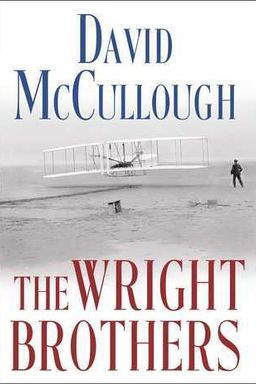
The Wright Brothers cover

The Wright Brothers

by David McCullough

The Wright Brothers by David McCullough narrates the captivating story of Wilbur and Orville Wright, who transformed their fascination with flight into reality. Through persistence, innovation, and teamwork, they overcame numerous challenges to achieve the first successful motorized flight, inspiring future generations and revolutionizing aviation.

The Wright Method and the Birth of Aviation

How do two bicycle mechanics from Dayton solve what the world’s leading engineers and governments could not? The story of Wilbur and Orville Wright is not just about the first powered flight; it’s about the culture, habits, and method that made that flight possible. Through disciplined learning, observation, and relentless testing, the Wrights turn curiosity into a new science—the engineering of controlled, powered flight.

From Dayton to Discovery

The Wright brothers’ achievement begins in a deeply intellectual home in Dayton, Ohio, where their father Bishop Milton Wright and mother Susan instill critical reading, self-discipline, and mechanical curiosity. Their house, filled with books ranging from Darwin to Dickens, becomes a lifelong classroom. This family environment teaches Wilbur and Orville to trust their own reasoning and learn by doing—preparing them to tackle a challenge no classroom could yet teach: human flight.

Their complementary temperaments translate family virtue into teamwork. Wilbur’s precision with words and Orville’s mechanical intuition balance one another, while their sister Katharine provides steady emotional and logistical support. These domestic bonds and shared modest routines—joint bank accounts, mutual trust, long evenings with blueprints—transform their bicycle shop into an incubator of scientific progress.

Turning Curiosity into Cause

The brothers’ fascination with flight begins with a simple toy helicopter from their father—a French model by Alphonse Pénaud. That childlike wonder grows into lifelong investigation when, as adults, they combine reading with systematic experimentation. Wilbur’s 1899 letter to the Smithsonian Institution marks their transition from hobbyists to researchers. They read Otto Lilienthal’s studies, Octave Chanute’s correspondence, and Louis Mouillard’s bird observations, recognizing that previous inventors had chased lift and power but neglected control.

Their insight, drawn from observing birds and reading scientifically, reframes the problem: flight isn’t merely staying aloft—it’s maintaining control in three axes (pitch, roll, yaw). This insight anchors their entire method. By 1900, you see them at Kitty Hawk with gliders, testing systematically and recording results with scientific precision.

Experiments as a Way of Life

When early field tests fail, they respond not with frustration but with better experiments. Their creation of a small, homemade wind tunnel in 1901 embodies the Wright method: reduce the problem to measurable parts, test systematically, and rely on data, not authority. Their careful measurements of airfoils and pressures expose the errors in existing lift tables and lead them to redesign both wings and propellers from first principles. Their little shed becomes a scientific laboratory that outperforms the world’s leading institutions.

Control—embodied in wing warping, linked rudders, and responsive elevators—becomes their decisive innovation. They learn to bank and steer deliberately, integrating pilot skill with aircraft design. This blend of theoretical insight and embodied practice transforms flight from guesswork to mastery.

From First Flight to Global Phenomenon

On December 17, 1903, at Kitty Hawk, they achieve four flights—the longest lasting less than a minute but proving controlled, powered flight is possible. The 1903 Flyer shows that control and power can coexist. Yet their triumph is quiet and local; few notice. The next stage, at Huffman Prairie near Dayton, turns proof into practice. There they develop the catapult to launch without ocean winds, fly longer and more stable runs, and evolve from experimenters to pilots.

By 1908–1909, public demonstrations in Le Mans, Fort Myer, and Pau transform their reputation. Wilbur becomes a European hero, his controlled circles winning over skeptics and kings. Orville demonstrates for the U.S. Army, setting endurance records but also suffering tragedy with the Fort Myer crash that kills Lieutenant Selfridge. Katharine emerges as the connector—nurse, translator, and public diplomat—binding technological achievement with human grace.

Legacy and the Shape of Modern Innovation

After fame comes complexity: corporations, patents, and lawsuits. The Wright Company attempts to commercialize aviation, while rivals like Glenn Curtiss and Louis Blériot advance competing designs. Yet even amid disputes, the Wrights maintain their identity as methodical, ethical inventors. Wilbur’s death in 1912 and Orville’s long battles with institutions like the Smithsonian reveal how fragile credit and recognition can be in technological revolutions.

When you step back, the Wright story becomes a parable about innovation: great advances arise from disciplined curiosity, humble craftsmanship, and an ability to merge imagination with verification. Their journey—from a Dayton workshop to the skies over Le Mans—shows that mastery emerges not from grand visions but from families, habits, and a relentless devotion to learning by doing.


Roots of Character and Early Curiosity

If you trace genius backward, you find ordinary circumstances treated in extraordinary ways. The Wrights’ upbringing in Dayton, Ohio, shows that innovation begins in homes that value self-reliance, reading, and moral steadiness more than material wealth. Bishop Milton Wright’s broad-minded parenting, his endless letter writing from the road, and his insistence that his children seek truth rather than status shape Wilbur and Orville’s intellectual independence. Their mother Susan Koerner’s mechanical skill—she made household tools and toys herself—creates a domestic workshop where curiosity carries no stigma.

Dayton, a practical, industrious city of small factories and machine shops, reinforces those habits. Local culture prizes thrift, experimentation, and technique. In this modest setting, the Wrights’ bicycle business becomes an informal research and development lab, teaching them precision, balance, and power transmission. When you read about the first flight, remember it rests on bearings honed in a bicycle lathe.

Complementary Talents

Wilbur’s concentration and clarity of expression combine naturally with Orville’s restless mechanical creativity. Their partnership functions like a continuous feedback loop: Wilbur defines hypotheses; Orville builds trials. Each trusts the other absolutely, letting frustration dissolve into practical progress. Katharine’s role as teacher and household manager ensures the brothers can remain absorbed in study. Their family dynamic—steady, rational, emotionally cohesive—makes their technical perseverance sustainable.

From Toy to Theory

The brothers’ fascination with flight begins with the simple Pénaud helicopter toy from childhood, reappearing decades later as a mental model. When Wilbur, after an injury, immerses himself in reading scientific works by Lilienthal and Mouillard, he links play to research. That intellectual habit—treating curiosity as serious labor—becomes the root of their innovation. In effect, their childhood games mature into a philosophy of sustained experimentation.

So when you encounter the precision of their wind tunnel or the elegance of their wing-warping system, see it not as miracles of inspiration but as extensions of an educational ecosystem—family reading, mechanical work, moral discipline—that prepares two young men to think differently when faced with old ideas that had stalled.


Learning from Air, Birds, and Books

The Wrights’ discovery path blends reading, observation, and practical building in equal measure. They regard knowledge as progressive—books give starting points, birds reveal living principles, and experiments confirm truth. This multimodal approach defines their genius: theory without flight is useless; flight without theory is blind.

Birds as Professors

Wilbur’s fascination with bird flight leads him to spend hours watching gulls at Kitty Hawk, sketching how they restore equilibrium mid-gust. He notices that birds don’t flap symmetrically; they twist their wings. Translating that observation into engineering language gives birth to wing warping—the core of modern lateral control.

Those insights are not guesses but studied empirical readings. Wilbur and Orville bridge biological observation and mathematical logic, exemplifying how cross-domain curiosity generates invention. Their understanding of the bird’s flexible wing structure transforms the flyer from an unsteerable glider into a graceful air machine that responds to pilots like an extension of the body.

From Theory to Experiment

Their self-education draws on diverse sources: Etienne-Jules Marey’s photography of locomotion, Bell Pettigrew’s anatomical studies, and Mouillard’s poetic musings on the empire of air. Each provides partial truths, but the brothers’ strength lies in synthesis—they combine mathematics, mechanics, and muscular intuition.

Wilbur’s maxim that one must both study and mount the machine captures their method: think, then test; redesign, then test again. By writing lucid letters to figures like Octave Chanute, they invite critique, ensuring their progress stays grounded in dialogue and data. If scientific modernity means measurable rigor linked to empirical iteration, the Wrights’ wind tunnel and field tests embody it fully.

In this synergy of reading and doing, the Wrights bridge theory and practice better than any contemporary experimenter. They learn from air itself—and their humility before it becomes their greatest strength.


Engineering Flight Control

Ask what truly distinguishes the Wright Flyer from other early attempts, and the answer is not power or luck—it is control. The brothers dissect the problem of flight into three motions—pitch, roll, and yaw—and invent a means to master each through coordinated mechanisms. This focus on balance marks aviation’s defining leap.

Wing Warping and Aerodynamic Insight

Inspired by birds, they devise wing warping: twisting opposing wingtips in opposite directions to induce roll. It’s operated by a cradle the pilot shifts with his hips—a physical connection translating instinctive movement into aerodynamic control. This principle later evolves into the airplane aileron system still used today.

Integrating Control Systems

Equally critical is how the Wrights treat control not as independent axes but as a unified system. By linking the rear rudder to wing warping, they counteract adverse yaw—the tendency of an aircraft to twist opposite its intended direction during turns. The forward elevator handles pitch, ensuring smoother climbs and descents. Their genius lies in understanding that turning safely means coordinating these three axes through an integrated design responsive to human input.

Testing and Refining the Science

When lift data from Lilienthal prove unreliable, their 1901 wind tunnel provides definitive measurements. By analyzing airfoils under controlled conditions, they establish accurate lift and drag coefficients. These data guide the construction of gliders and later powered Flyers. What began as empirical tinkering turns into a disciplined, data-driven science of aerodynamics.

Key Lesson

The Wrights’ success rests on an engineering philosophy of incremental mastery: test small, measure carefully, and refine continuously. They pioneer what we now call iterative design, decades before the term exists.

By mastering control and validating it scientifically, the Wrights transform flight from fascination to function. Their Flyer is no stunt—it’s an instrument, the first machine that a pilot can truly steer.


Power, Propellers, and Practical Flight

Control alone doesn’t secure the sky. The Wrights face two physical hurdles: generating sufficient power and transmitting it efficiently to the air. Here they enlist Charlie Taylor, the quiet craftsman who builds their 12-horsepower, 152-pound engine in six weeks. His aluminum crankcase—a first—keeps weight low without sacrificing strength. With this engine, the Wrights achieve their required thrust-to-weight ratio on a shoestring budget.

Even more remarkable is their insight into propellers. Realizing that an airplane propeller is a rotating wing, they calculate and carve their own from laminated spruce, shaped by hand. Twin counter-rotating propellers cancel torque and maximize efficiency. Their tests show that no existing data could predict results—they must derive fundamentals firsthand. Once again, building becomes thinking.

From Experiment to Endurance

After 1903, the Wrights’ work at Huffman Prairie refines power and control into repetitive success. They create Flyer II and III, increasing stability and testing numerous flights in one day. Their invention of the weighted catapult, a true systems-engineering solution, frees them from reliance on strong winds. They practice turns, landings, and restarts until flight becomes routine—a major psychological and technical transition.

In this phase, the brothers demonstrate that invention is endurance: progress emerges through debugging as much as ingenuity. Each repaired strut and recalibrated propeller brings them closer to reliable human flight.


Triumphs, Tragedy, and Public Proof

By 1908 the Wrights emerge from secrecy to perform for the world. Wilbur’s flawless turns over Le Mans astonish skeptics; France, once dismissive, crowns him a hero. His flights at Camp d’Auvours and Pau demonstrate smooth figure eights and sustained control under public scrutiny, revealing that the airplane is no longer experimental but operable.

These events ripple outward into culture—Paris runs headlines, songs appear, and even fashion adapts (Paul Poiret’s ankle-tied skirt originated from Edith Berg’s flight adaptation). Aviation becomes social spectacle and symbol of modernity. Awards like the Aéro-Club de France Gold Medal formalize recognition, turning craft into science, and science into civic pride.

The Ordeal of Fort Myer

While Wilbur conquers Europe, Orville faces trials at home. At Fort Myer he sets endurance records for the U.S. Army, flying over an hour and performing controlled figure eights before national spectators. Yet triumph turns to tragedy when a broken propeller kills passenger Lieutenant Selfridge. The crash, aviation’s first fatality, underscores the danger of public demonstration. Orville survives with grave injuries, and Katharine’s weeks of nursing restore him physically and emotionally.

Public Validation and Emotional Cost

Together, Le Mans and Fort Myer confirm the Wrights’ supremacy but also reveal the toll of fame. Both brothers now operate within media cycles, military contracts, and moral scrutiny. Their technology passes from private control to institutional agendas. The paradox of success—recognition mixed with vulnerability—marks the price every pioneer must pay.

Katharine’s strength through these events binds the legacy: she humanizes genius, proving that empathy and endurance stand beside intellect at the heart of great innovation.


Legacy, Innovation, and Modern Lessons

The final chapters trace how invention matures into industry, law, and legend. The Wright Company forms to manufacture Flyers, sparking early battles over patents and credit. Wilbur, weary from disputes, dies in 1912, leaving Orville to defend their priority against rivals like Glenn Curtiss and skeptical institutions such as the Smithsonian. Even as lawsuits dominate headlines, they secure contracts that help institutionalize aviation’s commercial future.

Competition and Expansion

By 1909–1910, the field explodes. Glenn Curtiss introduces ailerons; Louis Blériot flies across the English Channel; Reims hosts vast air meets drawing global crowds. The Wrights’ method inspires competitors and accelerates progress. Aviation quickly becomes both entertainment and strategic tool—militaries envision reconnaissance and combat uses, while inventors chase altitude and speed.

Fame and Institutional Memory

The Wrights receive medals from President Taft and accolades from France, but disputes about Langley’s claims and the Smithsonian’s stance color the later narrative. Only decades later does the institution formally honor them, reuniting history with fact. Monuments at Kitty Hawk and Le Mans cement their global status. When Neil Armstrong carries a piece of the Flyer fabric to the moon, their dream completes a cosmic arc—from bicycle shop to space exploration.

Continuing Lessons

The Wrights’ story endures because it teaches process over myth. Innovation is not a flash; it’s a habit—iterative, moral, human. Their ethos—start small, test thoroughly, share credit wisely—remains a blueprint for creators in every field.

From Dayton’s quiet workshops to the roar of modern jets, the brothers’ method guides engineers and dreamers alike. Their greatest invention may not be the airplane itself, but the disciplined way of thinking that allowed it to fly.

Dig Deeper

Get personalized prompts to apply these lessons to your life and deepen your understanding.

Go Deeper

Get the Full Experience

Download Insight Books for AI-powered reflections, quizzes, and more.