
Idea 1
Outsmarting Anxiety by Doing the Opposite
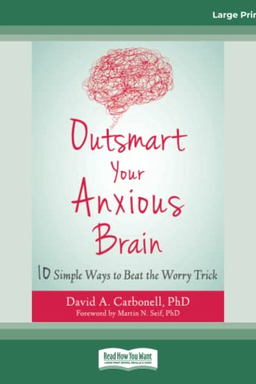
Have you ever noticed that the harder you try to stop worrying, the more worried you become? In Outsmart Your Anxious Brain, clinical psychologist David A. Carbonell argues that anxiety plays a sneaky game with your mind—it tricks you into treating discomfort like danger. The book’s central insight is that what feels intuitive in anxious moments, such as trying to calm down or fight the fear, is actually the very thing that keeps you stuck. Carbonell challenges you to do something completely counterintuitive: stop resisting anxiety and start working with it instead of against it.
Carbonell draws on decades of clinical experience to reveal the psychology behind chronic anxiety. Through humorous examples, empathetic explanations, and practical exercises, he shows how panic, worry, obsessive thoughts, and phobias are all symptoms of the same underlying trick. What unites them, he explains, is a pattern of mistaking harmless internal experiences for catastrophic threats and then reacting as though you’re in danger.
The Core Paradox of Anxiety
According to Carbonell, anxiety is a counterintuitive problem because your natural instincts—to avoid, escape, or control—make it worse. He compares this to chasing a runaway puppy: if you chase it, it runs faster, but if you turn away, it comes back to you. Similarly, if you resist anxiety, it grows stronger. Anxiety is not an external enemy to be fought but an internal discomfort to be experienced and understood. The more you resist, the more power you give it. The harder you try to avoid anxiety, the more persistently it stays with you.
This is why people with chronic anxiety often feel trapped in a loop: they anticipate future anxiety, fear its symptoms, and do everything in their power to prevent it—only to become more anxious. Carbonell reframes anxiety not as a danger to eliminate but as a false alarm your brain mistakenly treats as life-threatening.
The Rule of Opposites
A key concept introduced early in the book is what Carbonell calls the Rule of Opposites. He urges you to recognize that your first reaction to anxiety is usually 180 degrees wrong. Your gut says, “fight or flee,” but the right move is to relax, stay, and allow. If you feel you must take a deep breath, the wiser move is actually to exhale. If you want to escape a crowded room, it’s more helpful to stay and ride the wave. If your instinct says to distract yourself, the opposite—observing your fear calmly—will bring relief faster.
Carbonell illustrates this through stories of real clients, like Eleanor, who was terrified of fainting while driving at night, and Owen, whose panic attacks were fueled by struggling to breathe. Both learned to let their anxiety happen instead of resisting it, discovering in the process that fear eventually fades when you stop fighting it. His message is simple but radical: recovery comes not from control, but from acceptance and willingness.
Why We Get Fooled by Anxiety
Carbonell explains that anxiety keeps you hooked with what he calls “safety behaviors.” These are the rituals, support people, or objects that give short-term comfort but maintain long-term fear. Avoidance, reassurance-seeking, and mental checking are all examples. They make you believe you’re safer, but they also tell your brain that danger really exists. Over time, you learn only that you can’t handle things without your safety behavior—and that’s the real trap.
In addition, Carbonell identifies thought patterns—like “what-if” thinking—that pull you into endless cycles of worry. Each “What if I panic?” or “What if something goes wrong?” becomes bait on a hook. The trick, he argues, is not to stop thinking these thoughts but to recognize them as mental noise. Learning to notice the hook before biting it is how you break free from anxiety’s vicious loop.
Ten Simple Ways to Beat the Worry Trick
In the rest of the book, Carbonell translates these insights into ten practical steps for retraining your anxious brain. These range from specific behavioral exercises—like belly breathing and exposure practice—to mental approaches such as humoring your worries, observing instead of distracting, and accepting feelings while controlling actions. Each technique builds the same skill: resisting the urge to control anxiety and instead responding in ways that promote calm and confidence over time.
What makes Carbonell’s book stand out is his warmth and humor. He frequently uses metaphors—the runaway puppy, the rope-a-dope of boxing, the “attic of your mind”—to make complex psychological ideas intuitive. Much like Jon Kabat-Zinn’s mindfulness teachings or Claire Weekes’s classic “float through fear” method, Carbonell’s message is grounded in acceptance and self-compassion rather than control or perfection.
Why This Matters
We live in what Carbonell calls the “age of anxiety,” where our brains confuse discomfort with threat faster than ever. The modern world rewards doing, escaping, and fixing—but anxiety recovery requires the exact opposite. The wisdom of this book lies in its paradox: peace begins when you stop trying to be peaceful. By doing the opposite of what fear demands, you outsmart the tricks of your anxious brain and reclaim your life piece by piece. The rest of Carbonell’s guide shows you exactly how.