
Idea 1
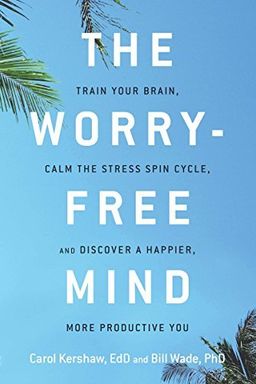
The Science and Practice of a Worry‑Free Mind
Have you ever lain awake at 3 a.m., your mind racing from one anxious thought to another, unable to shut it off? In The Worry‑Free Mind, clinical psychologists Carol Kershaw and Bill Wade argue that while the world may be filled with uncertainty, the constant worrying that keeps you up at night isn’t an inevitable part of life—it’s a learned pattern that you can unlearn. They propose that our brains become trapped in a repetitive stress cycle, but through specific brain‑training tools, you can rewire the mental circuitry that feeds anxiety, fear, and rumination.
Drawing from decades of clinical experience and cutting‑edge neuroscience, the authors invite readers to move from a reactive, fear‑based state to one of calm awareness and curiosity. Worry, they explain, is not only psychological—it is physiological. By mastering the relationship between your brain, body, and emotions, you can end your mind’s obsessive spin cycle and live with clarity, energy, and peace. As Tim Ferriss famously remarked (quoted in the opening), “You don’t have to be Superman to get Superman results; you just need a better toolkit.” This book offers that toolkit.
Why We Worry—and Why It’s Not Your Fault
According to Kershaw and Wade, worry is an ancient survival mechanism. Early humans survived by erring on the side of caution—better to mistake a rock for a lion than a lion for a rock. Our brains are still wired this way, operating on a built‑in “negative bias” that makes us focus on what could go wrong. Even in modern life where physical danger is rare, the brain still reacts to emotional threats as if they were life‑and‑death events. This primitive alarm system, once useful in the wild, now floods us with stress hormones that keep us trapped in a chronic state of alertness.
This negative bias becomes even more powerful when reinforced by modern pressures—work deadlines, financial fears, relationship strains—leading the mind to operate in a constant loop of “what‑if” scenarios. Over time, those thoughts form hardwired pathways in the brain, making worry your mind’s default mode. But thanks to breakthroughs in self‑directed neuroplasticity, the authors emphasize that these thought patterns can be changed. Your brain can literally learn new habits of peace.
The Neuroscience of Calm
Kershaw and Wade build their system on the principle that your mental state—calm or anxious—is linked to specific brainwave frequencies. When fear takes hold, high‑frequency Beta waves dominate, keeping the mind reactive and tense. But when we slow our brain activity into the slower Alpha and Theta frequencies, we naturally access relaxation, creativity, and perspective. By learning how to shift between those states intentionally, you can control the thermostat of your emotional life.
Their methods—rooted in neuroscience, biofeedback, hypnosis, and mindfulness—help you regulate the “stress spin cycle” by engaging both hemispheres of the brain in harmony. As you cultivate greater awareness of your internal state, you train the mind to spend more time in calm, high‑functioning states rather than survival mode. This is the path to what they call the Whole Brain State—a balanced, worry‑free mindset that allows you to live in flow.
From Fear to Flow
The authors structure their book as a journey. In Part I (“Place Your Worry Mind on Hold”), you understand how worry is wired into the human brain and begin to interrupt the internal “B‑movie” of worst‑case scenarios. Part II (“The Brain’s Superpowers”) builds on this foundation by teaching how to reshape concentration and mental associations—essentially, how to change your brain’s soundtrack. Part III (“Train Your State”) focuses on emotional reconditioning, giving you the tools to switch from fear, rage, or panic into curiosity, care, and play at will. Finally, Part IV (“Ignite Your Life”) shows how to sustain that new calm through the Whole Brain and Flow States—moments of total immersion where your mind and body sync into effortless performance and joy.
This progressive sequence echoes other modern mind‑body frameworks—such as Jon Kabat‑Zinn’s mindfulness‑based stress reduction and Joe Dispenza’s work on neuroplasticity—but Kershaw and Wade combine clinical precision with a conversational style, using real‑life stories and guided exercises that make neuroscience both practical and personal. You meet people like Marie, a chronic insomniac who literally worried herself awake, and Rachel, an executive paralyzed by fear of making decisions. Through applying the book’s tools, they learn to reclaim control over their internal states, proving that the mind can be retrained.
The Core Promise
Ultimately, The Worry‑Free Mind promises something bold: that you can actually inoculate your brain against worry. The key isn’t to eliminate risk or uncertainty but to build a resilient nervous system that can stay calm, flexible, and open regardless of circumstance. The authors present eight brain‑change tools—including deep relaxation, bilateral stimulation, future visualization, and attention shifting—that train this resilience like a mental muscle. Over time, these tools recondition your perception of reality itself, allowing you to replace fear with curiosity, exhaustion with energy, and stress with presence.
As Kershaw and Wade put it, your mind doesn’t have to be a bad neighborhood you avoid—it can become a home you love to live in. By combining neuroscience with ancient wisdom traditions and practical exercises, they show that peace of mind isn’t a mystical gift but a measurable, learnable state of consciousness.
“When you’re able to calm your brain’s stress patterns,” Kershaw and Wade write, “you don’t just think differently—you perceive a different world.”
By the end of the book, readers are left with both scientific insight and a set of daily rituals that move them progressively from worry to flow, from survival to mastery. The world may not slow down, but your mind can—and that, say the authors, changes everything.