
Idea 1
A World Without Us
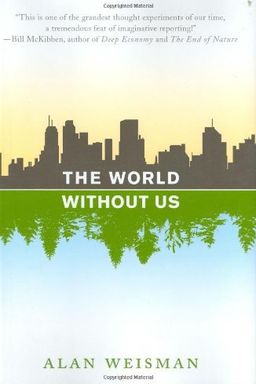
What happens if you suddenly vanish? Alan Weisman invites you to perform that imaginative experiment: remove humans from Earth and watch what remains. His book unfolds as both science and allegory — a portrait of human presence seen most clearly once it’s gone. You begin by picturing Homo sapiens gone tomorrow and tracing how cities, ecosystems, and even atoms reorganize themselves in your absence.
The thought experiment and its purpose
Weisman’s premise isn’t nihilistic fantasy but a disciplined look at human traces: roads, farms, plastics, genes, monuments. He asks how quickly the built environment would erode, how long materials would endure, and whether nature could restore pre-industrial conditions. You learn to think in timescales far beyond your lifetime — centuries for forests, millennia for metal corrosion, and tens of thousands of years for radioactive decay.
Ecology meets engineering
From New York to Chernobyl, Weisman blends field interviews with scientists, engineers, and ecologists. His inquiry crosses boundaries: hydrology explains how subways flood without pumps; microbial succession describes how soils rebuild; physics tells you how bronze and stone resist for ages. You quickly see that nature isn’t passive — it’s an active force that infiltrates human designs once supervision ends.
Global perspective and moral reflection
This is not only about decay but interconnection. A single industrial choice — like Ford’s demand for rubber — reshaped indigenous lives and forests in the Amazon. The book uses such stories, like Ana María Santi’s fading Zapara culture, to remind you that ecological chains link factory belts to remote rivers. Humanity’s disappearance would not erase those linkages instantly; it would reveal how deeply they run.
Scientific and ethical implications
The experiment also forces ethical vision. By imagining absence, you grasp the consequences of presence. It’s a new ecological literacy — measuring not what you build but what outlasts you. Concrete cracks, metals corrode, plastics persist indefinitely, and engineered genes keep copying themselves. Radiation and heavy metals stay as chemical bookmarks of your era. But forests, coral reefs, and wildlife often rebound if pressures cease, revealing both ruin and resilience.
The book’s journey
Across chapters, Weisman moves from the city without humans to the countryside, the oceans, and even outer space. He examines agriculture’s legacy at Rothamsted, the petrochemical sprawl of Houston, rewilding in the Korean DMZ, and nuclear persistence at reactors worldwide. Each domain shows a different logic of decay and recovery — mechanical, chemical, biological, and cultural. The pattern reveals a continuum: the faster the human maintenance stops, the faster natural equilibrium reasserts itself.
Key theme
Human achievement is temporary in material form but enduring in its residues. By framing extinction as a lens, Weisman lets you see the deep planet-scale consequences of ordinary life — an ecological x-ray of civilization itself.
Ultimately, The World Without Us teaches humility. You realize that cities and chemical networks are just transient states between earth and air. Yet it also gives hope: ecosystems heal, air clears, and rivers reroute once your hands release them. By imagining the world without you, you learn how it might live better with you.