
Idea 1
Lessons from Traditional Societies and the Shape of Modern Life
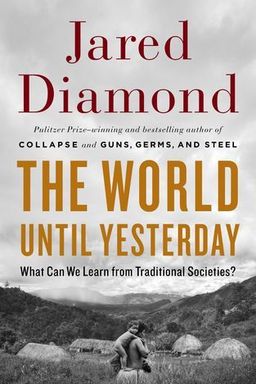
Why do people in industrial societies live so differently from those in small-scale traditional ones, and what can we learn from those contrasts? In The World Until Yesterday, Jared Diamond argues that the defining features of modern life—peaceful travel among strangers, markets, states, writing, and bureaucracy—are exceedingly recent, occupying only the last tiny fraction of human history. For nearly all of Homo sapiens’ 300,000 years, people lived in small bands or tribes without centralized authority, money, or formal institutions. Understanding their worlds, Diamond suggests, helps you see modernity in perspective and recognize alternative ways to solve enduring human problems.
Two clocks: biological and cultural
Diamond asks you to keep two timelines in mind. On the evolutionary scale, humans split from chimpanzees around six million years ago; on the cultural scale, agriculture began only 11,000 years ago, writing 5,400 years ago, and global industrialization within the last two centuries. Thus most of our biology and psychology evolved for life in small, kin-based groups. The Port Moresby airport scene—the 2006 crowd of New Guineans boarding flights while their grandparents had once fought outsiders with stone axes—demonstrates how swiftly societies have transformed.
Why study traditional societies?
Traditional peoples are not time capsules but living experiments in human social organization. Diamond insists you should study them both to satisfy curiosity and to recover practical insights: how to resolve disputes without courts, raise children within networks, care for elders, manage risk, and maintain community cohesion without police. Equally important, studying them prevents you from romanticizing the past—traditional life was not idyllic and involved high infant mortality, warfare, and famine—but it offers perspectives you can adapt for modern challenges.
A typology of societies
To map social diversity, Diamond adopts Elman Service’s fourfold classification: bands (small, egalitarian foragers), tribes (village farmers or herders, usually guided by a persuasive “big man”), chiefdoms (thousands under hereditary hierarchy and redistribution), and states (dense populations with laws, bureaucracies, and warfare monopoly). Environmental richness, domesticable species, and population pressure drive the shift from band to state. Yet the path isn’t linear—collapse can reverse complexity, and all four forms can coexist in a region.
Environment and inequality
Environment underlies much cultural variation. As Diamond explored in Guns, Germs, and Steel, regions lucky with domesticable plants and animals (the Fertile Crescent, China, Mesoamerica) generated food surpluses that sustained hierarchies and bureaucracies. Others, like New Guinea, had equally intelligent people but lacked those ecological foundations, leaving them at tribal scales longer. That ecological perspective avoids racist or genetic explanations for differing rates of development.
The relevance to you
Viewing modernity through this deep-time lens changes how you read your own habits. Many modern practices—formal schooling, solitary childcare, fast food, or anonymous urban life—are mismatched with Pleistocene-era instincts for cooperation, face-to-face negotiation, and constant vigilance. That mismatch creates both opportunities and stresses. Diamond’s overarching aim is not nostalgia but selective borrowing: by observing how other societies rear children, settle arguments, prevent overconfidence, and maintain social bonds, you can design institutions that better fit human nature.
Central insight
Modern society represents a blink in humanity’s long story. By studying the still-diverse small-scale societies of the world, you rediscover both what is universal—our need for trust, meaning, and fairness—and what is contingent—our cities, bureaucracies, and technologies. The challenge is to keep the best of modern comfort while recovering the wisdom evolved over millennia of small-community living.