
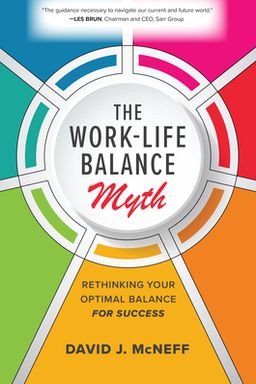
The Work-Life Balance Myth cover

The Work-Life Balance Myth

by David J McNeff

The Work-Life Balance Myth challenges conventional balance notions, presenting the Seven-Slice Method for stress-free living. By embracing harmony across seven life areas, readers can achieve a fulfilling and integrated lifestyle.

The Myth of Work-Life Balance and the Pursuit of Harmony

Have you ever chased the elusive idea of a perfect work-life balance—only to find yourself more stressed and dissatisfied? In The Work-Life Balance Myth: Rethinking Your Optimal Balance for Success, executive coach David J. McNeff argues that the very idea of work-life balance is a trap. He proposes that balance, as popularly conceived, is both impossible and misleading. Instead of trying to divide our days evenly between work and personal life, McNeff suggests embracing the Seven-Slice Method: a framework designed to help you find harmony by attending to all dimensions of your life, not just the competing categories of work and home.

According to McNeff, stress is not merely the result of overwork but of neglect—specifically, the neglect of vital parts of who we are. When we pour all our energy into just two slices—our professional and family lives—we starve the other five aspects of our being: personal, physical, intellectual, emotional, and spiritual. This disproportionate focus makes us fragile, reactive, and prone to burnout when life inevitably throws multiple challenges our way.

The book emerged from McNeff’s decades of coaching executives and teams who appeared successful on paper but were privately unraveling under stress. His observations led him to conclude that the culprit was not work itself but the illusion that balance could be achieved between just two arenas of life. Harmony, not balance, became his north star: a continual, adaptive state of wholeness attained by consciously touching all seven areas of one’s life, even if only briefly, every day.

From Balance to Harmony: A Paradigm Shift

The shift from balance to harmony is more than semantic. Balance suggests a static, measurable equilibrium—like two objects on a scale. It implies that if you give more time to work, you must take time away from home. McNeff argues that this binary view fails because real life is complex, dynamic, and multidimensional. Some days, your work may require most of your energy; other days, your personal or spiritual side might need nourishing. Harmony, by contrast, acknowledges the interplay of these elements—your goal is not equal weight but a congruent rhythm, much like the instruments in an orchestra playing in sync under the guidance of the same conductor: you.

The metaphor is powerful. Just as a symphony requires all its instruments—not just strings and percussion—to achieve fullness, McNeff contends that we cannot function optimally by tending only to our professional and family obligations. Our other slices—those that reflect mind, body, and spirit—are equally vital. When they are ignored, stress builds in the dominating slices until, like an overloaded circuit, they blow.

The Seven Slices of Life

To move from burnout to harmony, McNeff introduces the Seven-Slice Method, a simple yet transformative self-diagnostic tool:

  • The Family Slice represents your closest relationships and their emotional bonds.
  • The Professional Slice encompasses your career, work responsibilities, and ambitions.
  • The Personal Slice holds your individual pursuits—your hobbies, interests, and moments of self-care.
  • The Physical Slice involves the care of your body through diet, exercise, and rest.
  • The Intellectual Slice concerns curiosity and learning beyond your occupation.
  • The Emotional Slice focuses on recognizing and managing feelings and fostering relational awareness.
  • The Spiritual Slice addresses your search for meaning, whether through faith, nature, philosophy, or mindfulness.

Each slice represents a domain of potential restoration. The Seven-Slice Method teaches you to assess your current investments (as percentages of time and energy) and then rebalance them—not by taking away from overloaded areas but by adding micro-moments of engagement in neglected slices. You might take a quiet walk after work (physical), read a book for pleasure (intellectual), or call an old friend (emotional). These moments don’t require hours; their power lies in intentional touch.

Why Work Isn’t the Enemy—Time Is

McNeff makes a provocative claim: your job is not what’s ruining your life—your relationship with time is. Most people aren’t overworked as much as they are over-concentrated in two areas. They live like trapeze artists swinging endlessly between work and home, forgetting there are other nets that can catch them. When difficulties accumulate in both major slices, everything collapses. Expanding into your dormant domains disperses stress across multiple supports—no one slice has to shoulder it all.

The author reinforces his argument with real-world stories from stressed professionals like “Richard,” a high-achieving executive who fled corporate chaos only to find equal turmoil when personal, familial, and health crises struck simultaneously. Only when Richard applied the Seven-Slice Method—actively engaging his physical and spiritual sides while restructuring his work—did he regain a sense of calm and clarity. Such narratives illustrate McNeff’s assertion that stressful circumstances rarely vanish; what changes is your ability to metabolize them through fuller participation in life.

Harmony as a Daily Practice

Harmony is not a one-time achievement; it’s a habit of awareness. The practice involves three ongoing phases: assessment (honestly evaluating your current slices), reflection (understanding your choices and feelings about them), and action (making tangible changes that add, not subtract, from your life). Small, intentional actions—such as setting aside ten minutes daily to meditate, read, write, or move—can gradually reorient your experience from pressure to peace. As Emerson famously said—McNeff’s epigraph—“Nothing can give you peace but yourself.”

In essence, The Work-Life Balance Myth gives readers a roadmap for navigating complexity with grace. Rather than striving for an unrealistic equation of hours spent, McNeff invites you to sculpt a life of congruence—one that values inner alignment over external perfection. The result is not simply stress reduction but a deeper sense of meaning, energy, and joy drawn from all seven slices of your being. In an achievement-obsessed culture that glorifies burnout, that shift is nothing short of revolutionary.


Why Work-Life Balance Was Always a Myth

McNeff begins by dismantling one of the modern workplace’s greatest illusions: the idea that if you can just organize your schedule or meditate enough, you’ll achieve balance. The numbers alone contradict this. Studies show that 76% of American workers feel burned out, and nearly one-third are “always” burned out. Heavy workloads, long hours, unrealistic expectations, and the endless flood of digital demands have turned stress into a cultural default.

But McNeff’s argument is deeper. He says the problem isn’t stress itself—it’s the way we’ve been told to manage it. The popular concept of work-life balance assumes that “work” and “life” are two separate opposing forces that can be measured, negotiated, and stabilized. In reality, they are intertwined parts of a singular existence. Trying to achieve mathematical parity between them sets us up for failure and guilt.

The Unrealistic Promise of Balance

Balance, McNeff argues, is a comforting fantasy that thrives on binary thinking. It reduces life’s complexity into two enormous categories, ignoring the many smaller yet vital aspects of human experience. Most balance advice directs you to spend less time at work and more with family—but what about your need for rest, community, reflection, or creative play? The attempt to balance only two slices ignores the five others that define a rich human life.

This is where the author turns the cultural narrative upside down. The issue is not the quantity of time you spend but the diversity of the places you live your time from. When you attend only to two worlds—work and family—you create an “accumulation problem.” Stressors pile up in those domains until one small event, like a delayed meeting or family argument, triggers a disproportionate collapse. Broader engagement in more slices disperses that load.

The Enemy Isn’t Work—It’s Time

One of McNeff’s most counterintuitive insights is that work itself isn’t the villain. For centuries, humans have worked to sustain themselves and their communities. What’s changed is the tempo of time. The 24-hour always-on culture, intensified by technology, has made people feel enslaved to their schedules. When individuals say they need work-life balance, what they often mean is that they’ve lost control of their time and attention.

McNeff suggests reframing the question from “How do I balance work and life?” to “How do I distribute the limited time I have among all the dimensions that make me whole?” Seen this way, the Seven-Slice Method becomes a radical act of reclaiming authorship over your own time.

Coping vs. Living

To illustrate how imbalance manifests, McNeff introduces “Jerry,” a mid-forties CFO whose stress causes tremors and insomnia. His chosen “coping device”—alcohol—numbs his anxiety but deepens his dysfunction. McNeff’s insight is that coping devices, even the seemingly harmless ones, keep you trapped in the slices that are suffocating you. True relief comes not from escaping stress but from redistributing it across your whole life.

In short, the work-life balance myth persists because it promises something easy and symmetrical in a world that is neither. The Seven-Slice Method doesn’t eliminate pressure but teaches you to move fluidly among life’s domains so one area never bears the full weight of stress. As McNeff writes, the goal isn’t balance—it’s breathing space.


Attending to All Seven Slices

Once McNeff demolishes the myth of balance, he introduces the antidote: attending to all seven slices. These facets—Family, Professional, Personal, Physical, Intellectual, Emotional, and Spiritual—represent your entire life landscape. Simply visualizing your life in seven sections already brings awareness that balance isn’t about time equality but energy diversity. Harmony begins the moment you recognize that you possess untapped dimensions capable of soothing the overworked parts of yourself.

The Family and Professional Slices

Most people live almost entirely in these two domains. The Family Slice teaches love, trust, and socialization—skills that shape your emotional responses in adulthood. It’s also where stress often burns hottest, as McNeff shows in Gwen’s case story: an executive juggling health scares, teenage parenting battles, and relationship strain. By quantifying how little time she spent on her other slices (only 1–3% in most), Gwen realized her emotional volatility wasn’t a character flaw—it was exhaustion from living almost exclusively in two roles. Gaining awareness allowed her to rebuild resilience.

Similarly, in the Professional Slice, purpose and production dominate but can become toxic if they consume identity. McNeff reminds readers that work provides meaning and stability—but its rewards become hollow without the grounding of the other six slices. As he quips, when executives tell him they’ll focus on life “after retirement,” he asks: “What will you live on then—because you’ve spent nothing living it now?”

The Personal, Physical, and Intellectual Slices

These three are the bridges back to vitality. The Personal Slice is your space of freedom—time you control purely for you. Whether that means gardening, volunteering, painting, or walking the dog, McNeff insists it isn’t self-indulgent; it’s essential maintenance. Jack, a stressed-out sales executive, rediscovered his sense of self only after reclaiming quiet morning walks and reading for pleasure. In doing so, he also revived his Physical and Intellectual Slices—showing how interconnected they truly are.

The Physical Slice, often ignored until crisis hits, governs your body’s ability to sustain your ambitions. McNeff combines scientific insight with empathy, noting that constant stress floods us with adrenaline and cortisol, undermining immunity, heart health, and digestion. The fix doesn’t require marathons: a few minutes of daily motion or mindful breathing restores energy and perspective.

Finally, the Intellectual Slice rekindles curiosity. Lifelong learning refreshes the brain’s dopamine circuits and counters stagnation (as neuroscientists like Charan Ranganath affirm). Whether you read novels, learn guitar, or explore astronomy, curiosity combats monotony and fosters joy—the opposite of stress.

The Emotional and Spiritual Slices

McNeff argues that emotional literacy and spiritual depth are the ultimate stress diffusers. The Emotional Slice means learning to identify and manage feelings rather than letting them govern you. Executives like Karen, whose blunt communication style strained her teams, found peace by cultivating awareness and empathy through emotional work. The Spiritual Slice—often neglected in productivity culture—anchors meaning and faith. For Michael, reconnecting with church and reading faith-related books reignited his confidence and steadiness at work. McNeff clarifies that spirituality need not be religious; it’s any practice that helps you perceive a larger context for your life.

Together, the Seven Slices form a resilient ecosystem. When one area falters, others can compensate. Harmony, then, is not perfection—it’s cohesion. As the author writes, “When you live the whole pie, life feels whole.”


Integrating the Seven Slices into Daily Life

Knowing the Seven Slices is only half the equation; integration is where harmony takes shape. McNeff structures the process into three actionable phases—Assessment, Reflection, and Action—each designed to transform awareness into practice. The beauty of this approach lies in its simplicity: instead of overhauling your life, you can start by redirecting your attention, even for minutes a day.

Phase 1: Assess Honestly

Start by mapping your current life pie. Assign percentages to each slice until they equal 100. Most people initially exaggerate family time and underreport work. The act of measuring reveals where energy—and identity—are concentrated. McNeff often watches clients laugh at the results, admitting, “No wonder I’m exhausted.” This step is not about self-judgment but self-seeing. As author Stephen Covey also taught, awareness precedes choice.

Phase 2: Reflect Without Judgment

Once you’ve mapped your slices, sit with what you see. What surprised you? Which parts of your life feel starved? Reflection reveals causes: neglect might stem from fear, habit, or even success. Often, your very strengths—ambition, dedication—create blind spots. The reflection stage invites curiosity, not criticism. Ask yourself McNeff’s signature questions: What do I want to feel more often? Who am I when I’m at peace? What’s missing when I’m stressed?

Phase 3: Take Intentional Action

Action, McNeff insists, is the real differentiator. Yet it’s not about grand gestures. Think micro. Ten minutes of yoga, one weekly dinner with friends, fifteen minutes of reading before bed. He calls this addition, not subtraction: you don’t need to cut work hours to restore harmony; you simply add nourishing activities elsewhere. When Rosa, one of his clients, set aside twenty minutes each morning to read spiritual literature over coffee, her anxiety decreased, and her patience at work improved. Consistency, not intensity, creates transformation.

Setting Boundaries and Building Rhythms

Integration also means learning to say no—and knowing when to say yes. Boundaries aren’t barriers; they’re energy guards. By auditing your time, you automatically surface hidden opportunities. A commute can become a meditative space, and exercise can double as emotional release. McNeff’s example of Asim, an overstressed executive who reclaimed sanity by turning plane rides into reading time, proves how subtle shifts yield big returns.

Ultimately, integrating the slices helps you evolve from survival mode to flow. Life stops feeling like compartmentalized boxes and starts to resemble a symphony, where distinct instruments alternate lead yet serve one cohesive score. As McNeff writes, “Harmony begins when you start conducting your own orchestra.”


Harmony vs. Balance: Rethinking Success

What does success look like after shedding the balance myth? For McNeff, it’s a state of harmony—an alignment among all slices, even amid disorder. Harmony, unlike balance, adapts dynamically to circumstance and acknowledges that different aspects of life will come to the foreground at different times. It transforms stress from an adversary into a teacher.

Harmony as Flow, Not Equilibrium

McNeff illustrates harmony using musical metaphors. Balance is like forcing every instrument to play at the same volume; harmony is allowing each to alternate prominence while staying attuned to the whole. In practical terms, this means recognizing when your professional slice needs acceleration and when your physical or emotional slices need replenishment. The key is intentional rotation, not equal distribution.

Case Studies of Real-World Transformation

The book’s later chapters reinforce this idea through integrated case histories. James, a pharmaceutical executive, learned to defuse his “everything-at-once” stress spiral by classifying stressors as issues, problems, crises, or catastrophes—then activating neglected slices instead of overanalyzing work and family. Karen, a medical officer facing illness and workplace friction, restored emotional grace by returning to exercise, friendships, and reading. Asim, the overstretched president of a search firm, used flights as intellectual renewal time and prayer as spiritual anchor. In each story, harmony didn’t mean fewer problems; it meant more capacity to handle them.

Harmony also embraces imperfection. Life’s rhythm includes tension and release. Even in survival moments—health scares, layoffs, grief—leaning on multiple slices provides emotional shock absorbers. When one instrument falters, others keep the music alive.

Redefining Achievement

In a culture fixated on performance metrics, harmony reframes success from external validation to internal coherence. McNeff borrows from behavioral science, asserting that happiness is a decision arising from harmony, not a reward for achievement. You are successful not when you do more but when your actions and values move as one.

His closing image lingers: life as an orchestral performance for which you are both conductor and audience. Your seven instruments—family, career, mind, body, heart, intellect, spirit—respond to your direction. If even one goes quiet too long, the music suffers. But when you let them play together, imperfectly but authentically, you don’t just function—you flourish.

Dig Deeper

Get personalized prompts to apply these lessons to your life and deepen your understanding.

Go Deeper

Get the Full Experience

Download Insight Books for AI-powered reflections, quizzes, and more.