
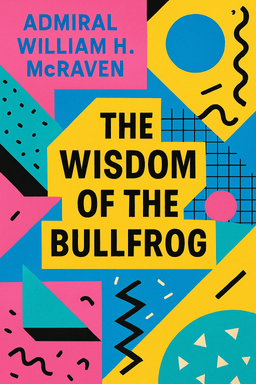
The Wisdom of the Bullfrog cover

The Wisdom of the Bullfrog

by Admiral William H McRaven

Drawing from 40 years of decisive naval leadership, Admiral William H. McRaven shares timeless wisdom on leading with integrity, courage, and effective communication. Learn how to inspire your team and master the art of leadership through compelling stories and practical insights.

Simple Wisdom for Difficult Leadership

How do you lead honorably when life and work test every fiber of your integrity? Admiral William H. McRaven’s The Wisdom of the Bullfrog begins with that question, inviting you to reflect on leadership not as a title, but as a daily act of moral courage. Drawing on nearly four decades as a Navy SEAL and commander of U.S. Special Operations, McRaven argues that while leadership is rarely easy, it is never complicated. It depends on a handful of timeless principles—tested in battle, refined through hardship, and applicable to anyone responsible for others.

McRaven’s nickname, “the Bullfrog,” signifies the longest-serving active SEAL. The term itself, and the book that bears it, capture a mix of toughness, humility, and wisdom accrued from service. His central argument is simple but profound: success in leadership depends less on charisma or technical skill and more on living with integrity, courage, endurance, humility, and accountability. Every chapter offers one key maxim—seventeen in total—that distills a lifetime of lessons into actionable guidance, illustrated by stories ranging from the beaches of Coronado to the raid on Osama bin Laden’s compound.

The Heart of the Bullfrog Philosophy

At its heart, The Wisdom of the Bullfrog rests on the belief that leadership is a moral undertaking. McRaven defines leadership as “getting the job done with the people and resources you have while maintaining the integrity of your institution.” In other words, completing the mission matters—but how you do it determines whether your legacy endures. This simple definition extends beyond the military: it applies to CEOs, teachers, parents, doctors, or anyone leading a team under pressure.

McRaven insists that the most fundamental element of leadership is character. Through his opening maxim, “Death Before Dishonor,” he underscores that integrity isn't about moral perfection—it’s about courageously choosing what’s right when it’s hardest. From the Navy SEAL Ethos to West Point’s Honor Code, he shows that organizations flourish when their leaders live by a consistent code of conduct. Without it, even the most talented teams crumble.

Lessons Forged Through Service

McRaven organizes his book around 18 key sayings—each a touchstone for different aspects of leadership. For instance, “When in Command, Command” champions decisiveness and confidence; “The Only Easy Day Was Yesterday” explores stamina and resilience; and “Run to the Sound of the Guns” calls on leaders to face crises head-on. From these, he weaves together a philosophy of what it takes to lead when the stakes are high and the way forward uncertain.

One of his more poignant lessons, “We All Have Our Frog Floats,” uses humor to ground humility: as a young officer, he was tasked not with a daring operation but with building a parade float—a moment that taught him to take pride in small tasks. Another, “Hope Is Not a Strategy,” highlights the importance of detailed planning—a motto that echoes across both military operations and the boardroom.

Why These Ideas Matter Now

In an age where leadership often feels transactional, McRaven’s “Bullfrog wisdom” is refreshingly human. He admits that even great leaders stumble, grow cynical, or make poor decisions—but what defines them is the discipline to return to their principles. His advice strips away the jargon of “management science” and returns us to core values: honor your people, communicate relentlessly, work hard, and never quit when the job is tough.

“Leadership,” he writes, “is simple to understand, but hard to execute.”

The simplicity is deceptive. Throughout the book, McRaven’s stories—from commanding SEAL teams to managing university systems—show how easy principles demand extraordinary discipline. When he describes facing combat setbacks, difficult conversations, or national scrutiny, he demonstrates that even the toughest leaders rely on humility, empathy, and teamwork as much as on courage or skill.

A Framework for Every Leader

By the book’s end, McRaven distills his philosophy into 18 simple imperatives that span the full arc of leadership: from building trust ("You Can’t Surge Trust") and enforcing accountability ("Expect What You Inspect") to persevering through setbacks ("The Only Easy Day Was Yesterday"). Together they form a moral and operational framework adaptable to any context. He reminds us that leadership rarely requires genius; it demands constancy of purpose, empathy, and relentless hard work.

You can think of The Wisdom of the Bullfrog as a field manual for the soul of leadership—hard-earned lessons delivered with the directness of a commander and the humility of a teacher. Whether you lead a company, a classroom, or your own family, McRaven’s message rings clear: leadership will test you, but if you stay true to core values, communicate openly, and act with courage, you’ll earn not just success but respect.


Honor as the Bedrock of Leadership

In McRaven’s world, everything starts—and ends—with honor. The first chapter, fittingly titled Death Before Dishonor, revisits the timeless idea that character is the foundation of leadership. Drawing from diverse traditions—Greek Stoicism, Roman generals, Japanese samurai, and the U.S. Marine Corps—McRaven reminds you that real leaders would rather face hardship or even personal loss than compromise their integrity. Honor, he writes, is not a sentimental relic. It is the unseen contract that sustains both institutions and individuals.

The Modern Leader’s Code

When McRaven addressed West Point cadets, he stood beneath the academy’s Honor Code: “A cadet will not lie, cheat, steal, or tolerate those who do.” He saw this not as an old-fashioned rulebook, but as a living compass. In a world full of moral gray zones, that simple code provided clarity. It defines what it means to “live above the common level of life,” a phrase that captures the calling of every leader who strives to do what’s right even when no one is watching.

He warns that it’s easy to pay lip service to honor until you face a test—when doing the right thing hurts your friends, your career, or your reputation. Great leadership demands a personal standard of ethics strong enough to withstand those pressures. As McRaven says plainly, “You always know what is right. It’s just hard to do it.”

Culture Mirrors the Leader

Your moral example ripples through every level of your organization. A culture of honesty and fairness must start at the top. McRaven recalls that when leaders cut corners, those below take it as permission to do the same. Whether you run a platoon or a tech startup, your behavior sets the boundaries of acceptable conduct. The opposite is also true: fairness, transparency, and humility spread quickly when modeled consistently.

He parallels this with West Point’s own mission—to “produce leaders of character.” For the Admiral, success without integrity is failure. This principle aligns with others like Stephen Covey’s “character ethic” and Brené Brown’s advocacy for “wholehearted leadership.” Each insists that trust arises only where values are embodied, not preached.

Honor doesn’t require heroism—it requires humility. Admit mistakes quickly, correct them, and return to the code that defines you.

McRaven’s lived experience gives this lesson weight. As a young SEAL who watched comrades uphold integrity under fire, he saw firsthand how honor bonds teams. Without it, loyalty and competence collapse. His takeaway is simple but non‑negotiable: the best leaders are people of principle first and professionals second. If you fail your moral code, every victory will eventually ring hollow.


Building Trust That Can’t Be Surged

Trust, McRaven argues, is the invisible architecture of leadership. You can’t buy it, fake it, or suddenly manufacture it in a crisis. In the chapter You Can’t Surge Trust, he illustrates this through his partnership with CIA Director Leon Panetta during the years leading up to the raid on Osama bin Laden. That trust was not built overnight—it grew from years of collaboration, shared risks, and quiet reliability under strain.

How Trust Is Earned

McRaven credits the strength of that relationship to small, consistent acts: showing up early, keeping promises, owning mistakes, and sharing hardships. Over time, his SEAL teams and intelligence partners learned that he would always tell the truth and never hide failure. When Panetta later had to choose which unit would attempt the bin Laden mission, he chose McRaven’s because that credibility had already been proven.

He reinforces Stephen Covey’s concept from The Speed of Trust: credibility rests on two pillars—character and competence. You might be virtuous but ineffective, or skilled but unprincipled; either way, people won’t follow you far. True leaders cultivate both. For McRaven, that means constant attention to detail, reliability in small things, and patience. Trust takes years to build and moments to destroy.

Applying It Beyond the Battlefield

When he became Chancellor of the University of Texas System after retirement, McRaven discovered the same dynamic in academia. Faculty and staff didn’t automatically trust a former admiral. To overcome skepticism, he applied the same military discipline: show up early, work hard, deliver on promises, and admit when you err. Over time, trust grew—not because of rhetoric, but because people saw consistent behavior.

“When the stuff hits the fan,” Panetta once told McRaven, “you won’t have time to build trust.”

This applies equally to business or family life. When crises erupt, whether it’s a failed product launch or a personal loss, you’ll lean entirely on the trust previously built. That’s why McRaven advises you to invest in relationships before you need them. Leaders who focus on short‑term gains or optics lose the social capital that sustains them when stakes rise. Trust isn’t a surge—it’s a slow burn that lights every success you’ll ever lead.


Courage Means Running to the Guns

One of McRaven’s most striking lessons—Run to the Sound of the Guns—comes directly from the ethic of combat. In war, when gunfire erupts, instinct tempts you to duck or flee. True leaders do the opposite: they move toward the crisis. That principle, though born in battle, applies wherever chaos reigns—companies facing scandal, families facing loss, or nations facing disaster.

Facing Crises, Not Avoiding Them

McRaven illustrates this with brutal honesty. On the eve of a long‑awaited trip to Paris to reunite with his wife, a report of civilian casualties reached his desk in Afghanistan. Rather than delegate or deflect blame, he canceled his leave and confronted the issue personally. Though emotionally gutting, that decision preserved his credibility with subordinates and superiors alike. A leader’s presence, he emphasizes, is often the first solution.

He contrasts this behavior with corporate scandals like the Deepwater Horizon oil spill, where executives remained comfortably distant as catastrophe unfolded. Their failure wasn’t only technical—it was moral cowardice masquerading as management. In contrast, leaders who “run to the guns” absorb dread so their teams don’t have to.

A Historical Echo: The 20th Maine

To show what courage looks like in another era, McRaven tells the story of Colonel Joshua Chamberlain and the 20th Maine Regiment at Gettysburg. Outnumbered and outflanked, Chamberlain didn’t retreat; instead, he ordered a bayonet charge that turned the tide of battle. His instinct to advance rather than withdraw saved the Union flank—and possibly the Union itself. That, McRaven writes, is the template for every crisis leader: act decisively, even under fire, because hesitation multiplies harm.

Great leaders are not fearless—they act despite fear, transforming panic into purposeful motion.

In your work, running to the guns might mean facing a dissatisfied client, owning a failed project, or stepping into conflict within your team. The point is not dramatic heroism; it’s presence. McRaven’s counsel is to lean in quickly, assess the situation firsthand, and communicate openly. Problems left alone rarely improve; those faced courageously often dissolve into opportunities for trust and strength.


Who Dares Wins: The Calculated Risk

Borrowed from Britain’s famed Special Air Service, the motto Who Dares Wins captures McRaven’s belief that boldness—backed by preparation—is essential to progress. It’s not about recklessness; it’s about disciplined audacity. Nowhere did this principle shine brighter than during the 2011 raid on Osama bin Laden’s compound in Abbottabad, Pakistan.

The Anatomy of a Risk

When President Barack Obama authorized that mission, intelligence was only 50% certain that bin Laden was actually inside. Yet McRaven’s team had spent months preparing contingencies—165 detailed steps covering logistics, communications, and extraction. When a Black Hawk helicopter crashed inside the compound, the SEALs didn’t freeze; they executed Plan B instantly. This moment, McRaven notes, proves Moltke’s old adage: “No plan survives first contact with the enemy.” Preparation converts daring into disciplined adaptability.

Obama’s decision itself exemplified courage: a calculated risk in the face of uncertainty. When asked later how he justified acting on 50% confidence, he said he had 100% confidence in the people executing the plan. That distinction—between uncertainty and distrust—is crucial in leadership. Leaders must dare boldly not because success is guaranteed, but because failure to act often costs more.

Making Boldness Practical

McRaven insists that “daring” doesn’t belong only to commandos—it’s also for entrepreneurs, teachers, and change‑makers. Taking on a new product line, speaking truth to a board, or pursuing a creative vision all require risk tempered by forethought. His advice: mitigate through deep preparation, then move. Over‑analysis kills opportunity, but so does unthinking bravado. The winners are those who combine the courage of vision with the discipline of detail.

“For every bold success,” McRaven writes, “there are ten failures—but each try strengthens the muscle of courage.”

If “run to the guns” is about reaction, “who dares wins” is about initiation. It reminds you that leadership seldom rewards timidity. To grow, an organization—and a person—must take smart risks that expand their reach. In every domain, the principle stands: fortune favors the prepared brave.


Expect What You Inspect

Accountability, McRaven says, is the discipline that turns good intentions into results. In Expect What You Inspect, he traces this idea back to Baron von Steuben, the Prussian officer who imposed order and inspection on Washington’s ragtag Continental Army at Valley Forge. Inspections, far from being bureaucratic rituals, are signs that leaders care.

The Discipline of Attention

Von Steuben’s relentless oversight transformed farmers into soldiers through rigor and repetition. Likewise, McRaven shows that high standards only matter if leaders verify them. In the Vietnam raid on the Son Tay POW camp, meticulous inspection of every weapon and detail ensured no American lives were lost. In contrast, corners cut in processes—from maintenance checklists to classroom protocols—signal decay.

In modern workplaces, leaders often fear appearing overbearing. Yet McRaven argues inspection isn’t micromanagement; it’s mentorship. It communicates priorities. People need to know their work will be seen and valued. Structured attention fosters pride and mastery. The lazy alternative—assuming things run fine—invites chaos.

A Culture of Real Accountability

From elite squads to corporate teams, accountability must be built into rhythm. Regular reviews, honest feedback, and leader visibility convey commitment. McRaven recalls inspecting equipment line by line—because if it mattered enough to order, it mattered enough to check. Excellence, he teaches, isn’t an aspiration; it’s a practice of repeated scrutiny. As Peter Drucker similarly noted, “What gets measured gets managed.”

When leaders stop inspecting, organizations stop caring. Attention communicates value more loudly than praise.

For you, “expect what you inspect” might mean reviewing client reports before sign‑off, visiting the shop floor, or checking in personally on small projects. In leadership, presence is inspection. Your consistency shows that standards aren’t slogans—they’re culture. Over time, teams rise to the same level of care you demonstrate.


Always Have a Swim Buddy

True to his SEAL roots, McRaven ends with a principle that’s both practical and poetic: Always Have a Swim Buddy. Every SEAL learns early that no mission, no dive, no jump is ever executed alone. Your “swim buddy” is your mirror and your support—someone who checks your gear, pulls you from danger, and keeps you humble. Translated into everyday life, it’s a reminder that no leader succeeds solo.

Leadership Requires Partnership

During his command years, McRaven’s closest partner was Sergeant Major Chris Faris, his senior enlisted advisor. Faris anticipated his moods, challenged his blind spots, and kept him grounded. When McRaven was diagnosed with cancer while deployed in Afghanistan, it was Faris who refused to let him wallow, insisting: “We still have a mission.” That tough love pulled McRaven out of self‑pity and back into purpose.

Every leader needs someone like that—an honest mirror who can deliver both encouragement and correction. Whether it’s a spouse, colleague, or mentor, your swim buddy reminds you that leadership’s strength lies in reciprocity, not isolation. Even generals, he admits, need to be told when to rest, when to fight, and when to laugh.

Humility Through Dependence

Needing help doesn’t undermine authority—it humanizes it. McRaven learned that realizing you can’t do it all alone is itself an act of strength. When leaders pretend invulnerability, they alienate their teams. When they model partnership, they inspire loyalty. Having a swim buddy is both a safeguard and a signal: “I trust you enough to be real.”

Leadership, McRaven concludes, is not a solo swim—it’s a synchronized stroke powered by trust and shared endurance.

To live this lesson, find your own allies and be one for others. Leadership is lonely only if you make it that way. The greatest strength any commander—or human being—possesses is not independence, but interdependence.

Dig Deeper

Get personalized prompts to apply these lessons to your life and deepen your understanding.

Go Deeper

Get the Full Experience

Download Insight Books for AI-powered reflections, quizzes, and more.