
Idea 1
The Psychopath Inside Us
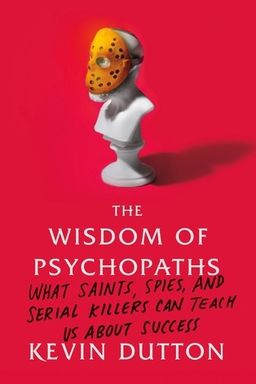
Kevin Dutton’s The Wisdom of Psychopaths invites you to rethink one of psychology’s most feared labels. Instead of picturing psychopaths solely as killers or criminals, Dutton argues they reveal something evolutionary and psychological about all of us: a latent potential for fearlessness, focus, and ruthlessness that—if modulated carefully—can become fuel for excellence rather than destruction.
Psychopathy, Dutton contends, is not a disease but a spectrum of traits running through humanity, from criminals to CEOs to surgeons. By mapping these traits and understanding how they can function positively, you learn not only how to recognize danger but also how to channel some of its power productively. His central argument is that traits like fearlessness, charm, and emotional detachment—so often condemned—can, in balance, make us more resilient, decisive, and effective when stakes rise.
Psychopathy as a Spectrum
Psychopathy isn’t binary. Using the metaphor of a “mixing desk,” Dutton explains that traits such as fearlessness, charm, impulsivity, and lack of empathy slide up and down rather than switch on and off. Turn all dials high, and you get a remorseless predator; nudge some moderately—say, fearless dominance and stress immunity—and you may get an extraordinary surgeon or bomb-disposal expert. The lesson: trait mixture determines outcome. (Robert Hare’s PCL-R and Scott Lilienfeld’s PPI scale illustrate that difference—one focused on forensic pathology, the other on ordinary life.)
Why We Need Psychopaths
Through evolutionary game theory, Dutton shows why psychopathic traits persist. They serve as rare strategies that thrive when most others are cooperative. In Axelrod’s Prisoner’s Dilemma tournaments, Tit-for-Tat proved optimal—a blend of kindness and toughness. Psychopathy, as a psychological strategy, can pay off when scarce, offering boldness, risk-taking, and exploitation at low frequency. Nature, in short, keeps some psychopaths around intentionally.
Empathy, Cold and Hot
Dutton distinguishes hot empathy—the visceral feeling of another’s pain—from cold empathy—cognitive understanding without shared emotion. Psychopaths excel at the latter, making them master manipulators. They see your emotional patterns but don’t feel them. Experiments from Joshua Greene’s trolley problems to Angela Book’s gait studies reveal how this dual empathy structure allows refined social prediction and exploitation. Yet, paradoxically, that same cool focus can yield heroism under pressure when emotional panic would cripple others.
The Adaptive Edge—and Its Risk
In extreme contexts—operations, surgery, war, trading—psychopathic traits can confer an adaptive advantage. Fearless surgeons, disciplined soldiers, and decisive traders all show neural patterns similar to “supersanity” or flow, where anxiety vanishes and attention narrows to the task. But balance is crucial: when detachment crosses into callousness or impulsivity, social order breaks down. Kent Kiehl warns that real psychopaths can’t switch fearlessness off—it’s contextual rigidity that turns aptitude into pathology.
Ethics, Genes, and Manipulation
The book complicates moral blame. Genetic and epigenetic insights (Caspi and Moffitt’s MAOA study, the Överkalix famine data) show behavior emerging from gene-environment interplay. Even moral cognition can be modulated—Dutton tested this with transcranial magnetic stimulation (TMS), dulling his own moral response temporarily. The implications stretch from courtroom neurolaw (the Waldroup case) to future bioethics: responsibility must now account for biology and technological interventions.
Cultural Contradictions
Dutton juxtaposes Pinker’s decline in physical violence with Bob Hare’s fear that society is getting more psychopathic. Headlines, social media, and reality TV normalize callousness even as homicide rates fall. The paradox: less murder, more meanness. Modern institutions amplify instrumental cruelty—in business, politics, even entertainment—creating nonviolent arenas of psychopathic behavior. You therefore learn that civility depends less on biology than on cultural incentive structures.
The Psychopath Toolkit
Dutton ends with pragmatism: the “Seven Deadly Wins” (ruthlessness, charm, focus, mental toughness, fearlessness, mindfulness, and action). Each trait, when dosed correctly, helps you make better decisions under pressure. The goal isn’t to become psychopathic, but to borrow their precision and calm while keeping empathy intact. You can learn to dial up focus and fearlessness during crises and dial them down in relational life—a mental soundboard for balance.
Core Message
Psychopathy, seen through Dutton’s lens, becomes less a pathology and more a mirror—showing how traits that terrify us can, when managed ethically, unlock courage, clarity, and mastery. The line between madness and greatness is not categorical. It’s a matter of balance, attention, and restraint.