
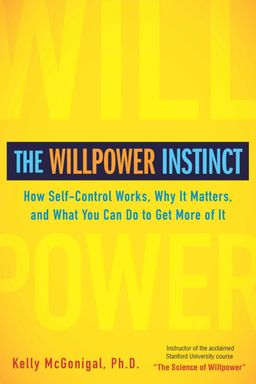
The Willpower Instinct cover

The Willpower Instinct

by Kelly McGonigal

The Willpower Instinct by Kelly McGonigal explores the science of self-control, offering practical advice to overcome bad habits, resist procrastination, and manage stress. Discover how meditation, understanding your brain''s reward system, and harnessing your social environment can transform your willpower and lead to a more fulfilling life.

The Science and Practice of Self-Control

Why do you choose what’s good for you one day and sabotage yourself the next? In The Willpower Instinct, psychologist Kelly McGonigal argues that self-control isn’t a single virtue but a complex set of physiological and psychological systems that can be trained, managed, and replenished. Willpower, she writes, is the skill of making choices aligned with your long-term values despite short-term emotions, impulses, and fatigue.

The three powers of choice

McGonigal breaks willpower into three cooperating capacities: I will (the ability to act on important goals), I won’t (the ability to resist temptation), and I want (the ability to remember why your choices matter). These powers live in different regions of the prefrontal cortex, and together they balance motivation and inhibition. Under stress or fatigue, that system falters; when trained or supported physiologically, it improves dramatically.

Biology of control

Modern neuroscience shows that the prefrontal cortex is the brain’s control center, while older limbic regions drive pleasure-seeking and fear responses. You can’t just will your way out of impulses; you must shift your body from fight-or-flight mode into pause-and-plan mode. Calm and deliberate states allow thoughtful choice, while stress and sleep deprivation push you back into automatic, short-term reactions. Heart-rate variability (HRV)—the measure of flexibility in your heartbeat—turns out to be a strong biological predictor of self-control. When HRV is high, you have a larger physiological reserve; when it's low, you’re running on fumes.

Why willpower fails

Self-control collapses not from lack of morality but from predictable brain phenomena. You discount the future (choosing a small reward now over a greater one later), give yourself moral licenses after progress (“I worked out, so I deserve dessert”), or fall into guilty spirals (“I blew it, so what the hell”). Each involves shifting emotional and cognitive states that hijack the prefrontal cortex. Dopamine circuits, which promise reward rather than deliver satisfaction, compound the problem by keeping you chasing anticipation rather than fulfillment.

The trainable system

McGonigal’s practical claim is that willpower behaves like a muscle: use it mindfully and it grows stronger, overuse it and it tires. Experiments by Baumeister and others show temporary depletion after effort but also measurable gains through small daily self-control practices—holding your tongue, sitting up straight, or resisting trivial temptations. These small workouts build global self-regulation, improving unrelated areas like spending and eating.

Self-compassion, awareness, and acceptance

The paradoxical insight of the book is that beating yourself up for losing control ensures that you lose more control. Research by Adams and Leary shows that forgiving a lapse cuts indulgence dramatically. Acceptance—not suppression—is the antidote to compulsive cycles. Instead of saying “don’t think about chocolate,” you notice and observe the craving until it passes. In this way, mindfulness converts willpower struggles into opportunities for awareness training.

Social influence and the future self

Your environment shapes your energy and goals. You mirror people around you, so habits spread socially; change your context and you change your behavior. Precommitment strategies—from disabling apps to previewing your older self in virtual reality—keep decisions aligned with long-term goals by making the future more vivid. Accepting help, enlisting accountability, and using pride instead of shame all transform discipline into shared support.

Core takeaway

Willpower is not a single heroic act—it’s a set of interconnected responses controlled by both mind and body. Learn how your brain chooses, care for your physical reserves, and practice curiosity rather than criticism, and you’ll not only resist temptation—you’ll reshape the systems that decide who you become.


How the Brain Manages Choice

At the heart of McGonigal’s model sits the prefrontal cortex—the brain’s control tower—balancing impulses and long-term intentions. She describes its three specialized circuits: one helps initiate difficult tasks (I will), another inhibits temptations (I won’t), and the third holds abstract goals in awareness (I want). When they work together, you can act deliberately rather than reactively.

Meet your two minds

Each choice reflects a conflict between your impulsive mind and your reflective one. The impulsive includes your cravings, procrastination, and comfort-seeking habits; the reflective mind is goal-driven and can delay gratification. McGonigal encourages naming these characters (“the cookie monster,” “the procrastinator”) to increase self-awareness and make them visible when they take charge. (Note: Daniel Kahneman’s Thinking, Fast and Slow describes a similar split between System 1 and System 2 thinking.)

Pause and plan

Willpower depends on physiology. The pause-and-plan response replaces fight-or-flight. Under threat, your sympathetic nervous system sends adrenaline to act instantly; under temptation, you need to do the opposite: calm down so your prefrontal cortex can think clearly. Slow breathing or stepping away for a moment activates the parasympathetic system, increases HRV, and restores deliberate control. Studies by Segerstrom show high HRV predicts resisting cookies, confirming that calm, flexible bodies support disciplined minds.

Training through meditation

Meditation directly trains the circuits of willpower. Noticing distractions and returning focus to breath strengthens attention and impulse control. Participants like Andrew in McGonigal’s classes discover that even frustration becomes useful—the act of refocusing is the workout. Phineas Gage’s famous accident reminds us what happens when these circuits break; meditation is the antidote, strengthening awareness and calm without trauma.

Key idea

A well-regulated physiology and an observant mind cooperate to produce willpower. You don’t fight impulses; you manage the body and train the brain to choose calmly.


The Energy Behind Self-Control

Willpower draws from both psychological and physical reserves. McGonigal introduces heart-rate variability (HRV) as a bodily index of self-control and a measure of flexibility between stress and calm. High HRV signals readiness to plan; low HRV predicts impulsivity. You can influence your reserve deliberately through breathing, exercise, sleep, and relaxation.

Build and refill your reserve

Slow breathing, especially focusing on prolonged exhalation, raises HRV and quiets stress hormones. Nathan, a physician’s assistant, used this before stressful shifts and found decisions clearer. Exercise and sleep provide a long-term reserve: studies by Oaten and Cheng revealed that moderate physical activity improved self-control across domains—from smoking cessation to work performance. Sleep deprivation, conversely, mimics mild brain injury, damaging prefrontal circuits and eroding discipline.

Willpower as muscle

Roy Baumeister’s metaphor of willpower as a muscle makes this physical reality intuitive. Strength grows through use and recovery. People who practice daily self-regulation—using their nondominant hand, controlling language, or monitoring spending—see global gains. Yet overtraining breeds depletion; McGonigal stresses balanced cycles of challenge and rest to avoid burnout. (Note: later research debates the pure depletion model but agrees that sustained effort demands replenishment.)

Recover with purpose

Relaxation is not laziness; it’s maintenance. Restorative practices such as brief naps or muscle relaxation restore HRV and prefrontal strength. In McGonigal’s equation, caring for your physiology is self-control in action—not indulgence.

Practical takeaway

Treat willpower as a resource you can actively manage: breathe deeply, move daily, sleep consistently, and recover regularly. Then, when temptation calls, your body will have fuel for reason.


The Emotional Traps of Progress and Stress

Two emotional traps undermine self-control: moral licensing and the what-the-hell effect. Both arise from your relationship to guilt, progress, and stress. Understanding them turns setbacks into data instead of doom.

Moral licensing

After doing something virtuous, you may unconsciously feel entitled to indulge. Experiments by Monin and Miller show that expressing moral virtue (like rejecting prejudice) can license biased decisions later. In dieting and spending, this means rewarding yourself for discipline—by undoing it. Progress itself becomes temptation. The remedy is to remember why you made a good choice. See it as commitment, not permission, and the effect disappears.

Stress and guilt spirals

Stress and shame amplify cravings. Under pressure, dopamine-driven reward systems flare, seeking relief through food, screens, or shopping. The what-the-hell effect (Polivy and Herman) kicks in when guilt intensifies indulgence: once you “break” the rule, self-criticism multiplies the urge. McGonigal’s lab examples—and Claire Adams and Mark Leary’s doughnut experiment—prove self-forgiveness curbs relapse. The emotionally generous path is the disciplined one.

Emotional regulation as discipline

Replacing shame with curiosity—asking “what happened and how can I learn?”—keeps progress alive. Plan stress-relief strategies that restore control: exercise, nature, creative hobbies, or social connection. These regulate mood before willpower is tested.

Key point

Self-control is emotional management: guilt, stress, and pride must be leveraged intentionally. Compassion and recovery strengthen control, while shame and panic deplete it.


Making the Future Powerful

Why do you choose a smaller reward now over a larger one later? Economists call this delay discounting. McGonigal uses vivid examples—from chimps outperforming Harvard students on waiting tasks to Mischel’s marshmallow test—to show that humans rationalize impatience better than they regulate it. The fix is to manipulate how you experience the future.

The ten-minute rule

Temptations lose intensity quickly. Instituting a mandatory ten-minute wait before any impulsive act allows the brain’s urgency circuits to cool and the prefrontal cortex to evaluate. Keith, a smoker, used this rule to study cravings, gaining a sense of mastery that led to reduction and eventual quitting. Delay, observation, and repetition recalibrate the value of patience.

Precommitment

Since your future self often betrays your plans, restrict their freedom. Thomas Schelling’s concept of precommitment—burning ships to prevent retreat—works at every scale. Disable apps (like Franzen), prepay memberships, or use services like Stickk to impose penalties for failure. Behavioral interventions like Advisor-Teller Money Manager for addicts confirm that structural constraints make long-term rewards more visible.

Meet your future self

Hal Ersner-Hershfield’s VR studies reveal that interacting with a future version of yourself doubles savings rates. Pictures, letters, or imagined scenes can strengthen the sense of continuity. Amina’s photo of herself as a future surgeon made procrastination feel like betrayal of a present identity, not a distant dream.

Essential idea

Make the future emotionally real: delay temptation, precommit structures, and form an emotional bond with who you want to be. When the future feels close, self-control feels natural.


Social Influence and Acceptance

Willpower isn’t just personal—it’s contagious. Christakis and Fowler’s research proves that behaviors like obesity and happiness spread through social ties. This social dimension means your discipline improves not just by effort but by environment and emotional modeling.

Mirror, belong, and align

Mirror neurons echo others’ actions and cravings. Watching someone resist or indulge primes the same pathways in you. Thus, cultivating social proof—making discipline visible—converts private effort into group norms. When energy-saving campaigns cited majority behavior rather than moral appeals, compliance soared. Norms, not just values, guide the human mind.

The right public emotion

Anticipating pride boosts control; anticipating shame may deter but often backfires when experienced. Programs that pair accountability with encouragement outperform those based on guilt. Make your successes visible enough to inspire pride, not panic.

Acceptance, not suppression

Daniel Wegner’s white-bear experiments and subsequent studies by Erskine and Bowen demonstrate that suppressing thoughts or cravings strengthens them. Acceptance—mindfully observing inner experience—reduces rebound. “Surf the urge,” Bowen says: watch the wave rise, breathe, and let it pass. Acceptance increases prefrontal activity and emotional stability (Goldin’s research), proving that surrender to awareness is a form of control.

Final synthesis

Surround yourself with supportive, disciplined people, make pride a public motivator, and practice acceptance instead of denial. Willpower flourishes not in isolation but in connected, compassionate awareness.

Dig Deeper

Get personalized prompts to apply these lessons to your life and deepen your understanding.

Go Deeper

Get the Full Experience

Download Insight Books for AI-powered reflections, quizzes, and more.