
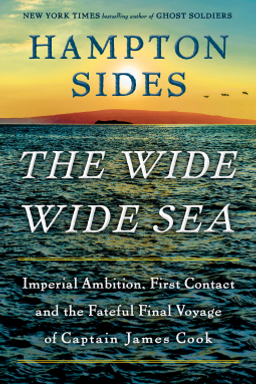
The Wide Wide Sea cover

The Wide Wide Sea

by Hampton Sides

The author of “On Desperate Ground” depicts Captain James Cook’s final voyage and the controversies surrounding its legacy.

Exploration as Science and Empire

How can you read a single voyage as both experiment and conquest? In this book, the author argues that Captain James Cook’s third voyage fuses Enlightenment science with imperial statecraft. The expedition returns the Polynesian traveler Mai with pomp, while secretly hunting the Northwest Passage—a corridor that could upend world trade. You follow a story where maps are as potent as muskets, and where rituals, diseases, and timekeepers shape fate as much as storms and ice.

You see a layered mission from the start. Daines Barrington provides the theory that polar seas may be navigable; Lord Sandwich supplies funds and political cover; Cook brings reputation, seamanship, and a hard-won public-health regimen (sauerkraut, wort of malt, and inspissated lemon juice). The ships—Resolution and Discovery—sail like floating laboratories: casks, carpenters, astronomer William Bayly’s observatory kit, artist John Webber’s portfolio, and Kendall’s K1 chronometer ticking Greenwich time across the world’s blank spaces.

Sci-tech meets strategy

Navigation is not neutral. When Cook fixes latitude and longitude precisely, he turns remote coasts into repeatable coordinates other powers can find. He disproves myths (negative discovery of a southern continent) and draws new lines of attraction (the “Sandwich Islands,” Alaska’s coast, Nootka Sound). K1 becomes a political instrument as much as a clock; the published charts are invitations to merchants, missionaries, and whalers. (Note: This echoes how later hydrographic surveys under FitzRoy and Darwin made South American waters legible for empire.)

Contact, exchange, and misreading

Where Europe sees private property, many Polynesians practice communal use and ritual reciprocity. Metal—scarce ashore, abundant afloat—reorders values. Nails and cleavers vanish; red feathers become currency. Small thefts ignite large reprisals because each side imports its rules as universal law. At Moorea, Cook’s men burn canoes and homes over a stolen goat; at Grass Cove in New Zealand, a provoked shot spirals into massacre and cannibalism. The lesson for you: incompatible property systems and honor codes, left unmediated, scale quickly to violence.

A captain changing at sea

You meet Cook as the supreme practical technician—humane discipline, immaculate logs, and relentless cleanliness. But on this third voyage, strain and illness harden his manner. Floggings increase; punitive spectacles grow harsher. He still reads the sea uncannily (sleeping through fog that terrifies others), yet he misreads people. The old tactic of detaining chiefs to retrieve stolen goods, once effective, turns suicidal when he tries to abduct Kalani‘ōpu‘u in Hawai‘i. Leadership, you realize, requires recalibrating methods as contexts change—especially where ritual and politics entwine.

Mai’s parable of contact

Mai—Raiatean refugee turned London celebrity—embodies the personal scale of empire. He eats with lords in Mayfair, meets King George III, and returns with a cargo of dreams: firearms, a barrel organ, portraits, and garden plans. In Huahine, those gifts cannot overwrite genealogy and mana. Without strategic marriage alliances, his imported wealth isolates him; disease completes the tragedy. His short life distills the ambivalence of British “hospitality” and the costs of cultural display.

Ice, soft gold, and unintended worlds

Northward, Cook tests Barrington’s hypothesis and meets a wall of pack ice near Icy Cape—empirical refutation that shifts imperial hopes. Southward, a different discovery explodes: sea otter pelts in Nootka and Prince William Sound—“soft gold” in China—ignite a trans-Pacific rush that will unravel ecosystems and societies. Meanwhile, King George’s “Noah’s Ark” of animals and the rats lashed ashore reshape island ecologies for centuries. You grasp how a single expedition catalyzes lasting biological and economic cascades, far beyond any captain’s intention.

Core claim

Cook’s third voyage converts first contact into durable connection—through maps, trade goods, rituals, and violence—binding the Pacific into global circuits that science enabled and empire exploited.

By the time you leave Kealakekua Bay—Makahiki rites misread, Watman’s funeral witnessed, and Cook dead on the beach—you understand the book’s central point: exploration changes the world not just by adding knowledge, but by making that knowledge actionable for states, markets, and microbes. The price is paid in forests of masts and kelp, in charts and scars, in pelts and graves.


Patronage, Logistics, and Mission Design

The voyage begins long before anchors lift. You watch an alliance of intellect and office transform a hunch into a global mission. Daines Barrington, convinced the Arctic isn’t sealed by permanent ice, persuades Lord Sandwich to fund a Pacific-side assault on the Northwest Passage. The Admiralty’s secret instructions (July 8, 1776) hide strategic aims behind a humane facade: return Mai to Tahiti and deliver livestock from King George III, but also “search for and explore such rivers and inlets” along North America that might slit the continent open.

Ships as tools and constraints

You picture two Whitby-built colliers—Resolution and Discovery—rugged, capacious, and slow. They’re ideal for cargo and careening but suboptimal for ice. The Resolution leaves Deptford leaky in her upper works; refits are rushed; costs and American-war distractions bite. Onboard are officers John Gore, master William Bligh, astronomer William Bayly, surgeon William Anderson, and artist John Webber. Charles Clerke commands Discovery while fighting tuberculosis, a foreshadowing of succession strain if Cook falls.

A floating ark and laboratory

King George’s menagerie—cows, horses, goats, peacocks, sheep, and poultry—turns decks into a barnyard. Fodder competes with water casks; pens foul air; sailors detest the noise. Yet this “Noah’s Ark” signals intent: export English agrarian modernity as soft power. Alongside the animals go gifts and instruments—K1 chronometer (the “trusty friend”), sextants, telescopes, and Bayly’s observatory gear. The ship doubles as science station and diplomatic mission, a mix that complicates every anchorage.

Dual-purpose orders, dual expectations

Officially, you’ll deliver Mai gloriously, plant gardens, and cement goodwill with chiefs like Tu. Unofficially, you’re a spearpoint: outflank France and Spain, chart coasts Russia claims loosely, and locate a passage worth £20,000. The duality shapes choices at sea—staying offshore to control venereal disease and barter, keeping instruments safe while currying favor ashore, and rationing iron tools that islanders value more than trinkets.

Politics in the background hum

You sail amid the American crisis. Sandwich needs good news; Parliament dangles prizes for passage. Spanish viceroys watch anxiously from Mexico and Peru, readying ships to intercept. Benjamin Franklin drafts a “passport” urging American captains not to molest Cook—an extraordinary nod to science above war. What you chart will enter the imperial chessboard instantly through Admiralty charts and the published Voyage to the Pacific Ocean.

Logistics drive strategy

Leaky timbers and waning rigging dictate wintering in Hawai‘i. Re-caulking at Nootka, mast replacements, and the ever-present need for fresh water and timber turn survey plans into repair calendars. A two-inch gash near the Resolution’s waterline demands emergency bailing; the foremast splits in the ʻAlenuihāhā Channel. You realize how “grand plans” rely on mundane carpentry and ropework. The best chart in the world is useless if a sprung mast forces you into the nearest bay.

Why it matters

Grand strategy sits on logistics. The third voyage’s ambitions—return Mai, find a passage, project British goodwill—survive or fail with shipwright skill, fodder stores, and the chronometer’s heartbeat.

For you, mission design isn’t a memo; it’s an ecosystem of constraints. When you see Cook trim schedule for scurvy prevention, hold offshore to regulate trade, or retreat from ice at 70°44′, you’re watching a leader translate political orders into practical sequences under stress. That translation—uneven, improvisational, and gear-limited—explains the voyage’s zigzags as much as its triumphs.


Cook’s Evolving Command

You first meet Cook as the paragon of practical authority. He modernizes naval health: daily swabbing, deck smoking, sauerkraut and wort to fend off scurvy, and zeal for cleanliness that saves lives. He guards instruments like lives depend on them—because they do. K1 is wound with ritual care; Bayly’s observations validate fixes; charts are drawn with cold precision. Discipline is firm yet often measured; on earlier voyages, he avoids lash where counsel suffices.

Competence as consent

Men follow Cook because his calculations keep them off reefs and his routines keep them out of sickbay. He can sleep while fog shrouds shoals—calm born of mastery. He enforces quarantine logic ahead of his time, limiting shore leave to curb venereal disease, and keeps trade orderly by staying offshore around Maui and Hawai‘i. You see leadership that converts data into protection, and protection into trust.

A harder edge appears

On the third voyage, stress, chronic pain (sciatica is suspected), and possible medication effects shadow his temper. Floggings become sharper and more frequent. When thefts occur—nails, cleavers, even a goat—punishments escalate from humiliations (half-shaved heads) to burning canoes and homes in Moorea. The moral math shifts: protecting English property justifies collective punishment ashore. Officers notice a peremptory tone replacing earlier patience.

Policing by hostage-taking

Cook often detains chiefs or priests to ransom stolen items—an expedient that once worked in Tahiti or New Zealand. But techniques travel poorly across cultures and seasons. In Hawai‘i, after a cutter is stolen, he tries to abduct Kalani‘ōpu‘u at Kealakekua. The bay is no longer an adoring stage but a charged polity. Crowds gather; a shot kills a chief (Kalimu) at the shoreline blockade; stones fly; the beach erupts; Cook falls.

Judgment under fatigue

Navigation demands stamina; so does ethnography-by-necessity. Cook reads iceblink but misreads Makahiki. He shows restraint after Grass Cove in New Zealand—recognizing an Englishman fired first—yet later embraces severe reprisals in Moorea over property. You witness how prolonged danger, illness in senior ranks (Clerke consumptive, Anderson dying), and ship deterioration narrow a commander’s cognitive bandwidth.

Leadership lesson

Procedural excellence can’t substitute for political sensitivity. Command at the edges of empire requires updating methods as rituals, seasons, and power balances shift.

For you, Cook offers a double image: the life-saving technician whose routines made the voyage possible, and the strained commander whose recycled coercion failed in Hawai‘i. The contrast doesn’t cancel either side. It teaches that expertise travels only as far as its assumptions fit the ground—and that every leader must know when their best habit has become their worst reflex.


Contact, Exchange, and Misunderstanding

What Europeans called “theft” often reflected different property logics ashore. You track a pattern: sailors miss nails or tools; islanders view abundant ship-iron as shareable wealth for kin networks. Red feathers in Tahiti and neighboring islands rise as high-value currency; a handful can buy a hog, flipping English price expectations. Trade and ritual interlace: gifts cement alliances; genealogies and mana govern status. When the logics misalign, frictions scale into crises.

Metal hunger and new currencies

Iron transforms economies overnight. In Tahiti, forged nails become tools and fishhooks; in Nootka Sound, “nothing would go down but metal”—pewter plates and iron spike the market. The crews themselves adapt: men barter personal items for pelts, and officers struggle to police private trade. You witness a spontaneous monetization where old valuables (feathers, bark cloth) coexist with imported metals, confusing both sides’ sense of “fair price.”

Ritual reciprocity, political calculus

Chiefs expect reciprocity that signals rank. Animals, portraits, and tools function less as commodities than as tokens of alliance (Cook gifting horses and cattle to Chief Tu). Fail the ritual, and you risk insult; succeed too well, and you destabilize hierarchies. Mai’s English largesse—guns, armor, a barrel organ—lifts him materially but not genealogically. His refusal of arranged alliances with Tu blocks the social mechanism that would legitimize his fortune.

Flashpoints that teach

  • Grass Cove (New Zealand): a bread dispute, an Englishman’s rash shot, and a retaliatory massacre underscore how single acts can cascade under conflicting honor codes.
  • Moorea goat incident: severe reprisals—burning villages and canoes—protect English property but punish communities collectively, deepening mistrust.
  • Nootka Sound: Mowachaht bargain shrewdly, charge for wood and water, and insist on metal, revealing robust local property norms rather than “naïve barter.”

Practical cross-cultural reading

If you treat exchange as mere price, you’ll miss the social script. Gifts may need to match rank, timing, and ritual form (kava, pig sacrifices, prostrations in Hawai‘i). Detaining a priest or chief as leverage treats persons as negotiable property—an affront that some polities can absorb and others will fight. The same misalignment appears in the Arctic, where sea-otter pelts shift from warmth to hard currency once Chinese demand is recognized.

Takeaway

Exchange systems rest on hidden norms. Unless you learn them—titles, kin obligations, ritual closures—your “fair trade” can read as insult, and your policing can read as war.

For you today—whether in diplomacy, business, or community work—the book’s Pacific encounters offer a vivid rule: match your incentives to the other side’s moral economy. Where Cook did, harbors opened; where he didn’t, fires rose.


Mai’s Journey, Fame, and Return

Follow one life to see empire’s human face. Mai begins as a Raiatean refugee, dispossessed by Bora Bora’s conquest. Wounded during Wallis’s cannonade at Tahiti, he boards Tobias Furneaux’s Adventure and reaches Britain in 1774—the first Polynesian to set foot there. In London he becomes sensation and specimen: living at Joseph Banks’s Mayfair home, inoculated for smallpox by Dr. Thomas Dimsdale, presented to King George III, painted by Joshua Reynolds, and paraded through country estates.

Celebrity and apprenticeship

Mai learns fast. He rides, shoots, and hosts barbecues where the Polynesian umu delights English guests. He internalizes England’s lessons: firearms equal redress; goods signal status; portraits project presence. Banks and Lord Sandwich showcase him—a living emblem of curiosity and paternalist hospitality. Yet his status is liminal: neither chief nor commoner in English terms, and a novelty whose agency is both celebrated and managed. (Note: The “human pet” framing captures the unsettling mix of care and display.)

The homecoming experiment

In 1776 he sails back with Cook, bearing guns, armor, red feathers, a barrel organ, and a small globe—portable power from the world’s core. Cook tries to plant him safely: first at Tahiti under Chief Tu’s eye, then at Huahine with a European-style house (with a lock), garden plots, and animals. But imported wealth is system-incompatible. Genealogy and mana—transmitted through kin and ritual—still determine authority. Without strategic marriages (he spurns proposals tied to Tu), Mai’s cachet breeds envy, not legitimacy.

Unraveling and loss

Mai’s spending of precious red feathers, social gaffes, and the alien spectacle of a lockable house mark him as out of joint. His goods attract pilferers and predators. Within a few years (circa 1780), he dies—likely from diseases vectored by the very ships that lifted him. His animals perish; the house is dismantled. The arc from London salons to Huahine’s dismantled homestead compresses the promise and peril of contact into a single biography.

Symbol and warning

Mai is more than a tragic figure; he’s a diagnostic instrument. His life shows how cultural capital travels poorly without translation into local forms—kin alliances, ritual roles, and obligations. Gifts can colonize expectations as much as landscapes. The book asks you to see Mai’s odyssey as a parable: technology and prestige do not erase the grammar of belonging, and outside sponsorship can evaporate the instant the ship departs.

Human-scale insight

Empires move through people. When their cargo is status without station, the landing is hard, and the departure is fatal.

If you work across cultures, Mai’s story gives you a script-check: before importing “solutions,” map the local routes to legitimacy. Without them, you build locked houses in open societies, and call the creak of the key security when it is isolation.


Instruments, Maps, and Imperial Power

Treat K1 as the voyage’s secret engine. Longitude—once guesswork—becomes calculable time. John Harrison’s chronometer idea, executed in Kendall’s K1, gives Cook portable Greenwich. William Bayly’s shore observatories validate it repeatedly. With that, islands turn from rumors into dots you can refind. The practical effect is profound: charts become reliable, and reliable charts become imperial infrastructure.

Cartography as claim

Cook names the Hawaiian chain “Sandwich Islands” after his patron; he records “New Albion” in continuity with Drake. Not every bay gets a flag, but every name writes a memo to rivals. Spain scrambles in alarm, readies ships from New Spain; Russia’s earlier coastlines (Müller’s narratives, Stählin’s map) crumble under Cook’s precise lines. When he fixes Cape Prince of Wales, he pins one jaw of the Bering Strait to the map with numbers that ministers can cite.

Publishing as power projection

After Cook’s death, Charles Clerke’s reports and letters (one carried overland by von Behm) and the Admiralty’s A Voyage to the Pacific Ocean circulate the discoveries to courts and counting-houses. Benjamin Franklin’s wartime “passport” asking Americans to let Cook pass unmolested shows an Enlightenment exception: knowledge earns a special neutrality even as it arms empires the next year. You see how data becomes diplomacy and how atlases become arguments.

Negative discovery matters

Cook’s earlier southern sweeps dissolved Terra Australis; on this voyage, ice-lines replace fantasies of an easy Northwest Passage. Absence, measured and mapped, reorients strategy better than rumor. Ministers now know what not to fund; merchants learn where fortunes lie instead (sea-otter pelts at Nootka, not quick routes to Hudson Bay).

Maps as invitations

The book insists that charts don’t just record; they beckon. When Cook charts Hawai‘i, New Zealand, or Prince William Sound with precision, he turns them into waypoints for whalers, missionaries, and settlers. That precision accelerates contact into settlement and markets into extractive regimes. The same lines that keep ships off reefs guide fleets toward resources.

Key idea

A chronometer is a colonial hinge: it swings open remote worlds by making them punctual to empire.

For you, the translation is modern: whenever measurement reduces friction—GPS for logistics, satellites for weather—opportunity and exposure rise together. Cook’s K1-era lesson holds: tools that compress uncertainty also concentrate power, and power seldom travels alone.


Testing the Northwest Passage

Think of this as an Enlightenment field experiment. Barrington’s hypothesis says polar seas are seasonally navigable because much ice is river-born. The Admiralty’s bet is that a Pacific-side approach might slip across. Cook takes the hypothesis to sea—charting Alaska’s coast, probing Prince William Sound and Cook Inlet, then pushing north to the limits of prudence.

From armchair to ice-edge

Past Cape Prince of Wales, the water grows milky with ice sediment; “iceblink” stains the sky with the reflection of a pack you haven’t yet met. When he meets it—an immense, shifting wall near 70°44′ off Icy Cape—the Passage turns from theory to obstacle. He runs its edge westward for hundreds of miles, logging floe dynamics, currents, and shoals. Russian maps (Müller, Stählin) prove dangerously imprecise; his soundings and fixes overwrite them with lived geometry.

Negative results, positive value

Cook doesn’t declare victory; he refines the question. If a passage exists, it is not practical for merchant traffic given pack behavior and seasonal windows. He plans a second season’s attempt earlier in the year—prudent science—but dies before he can sail north again. The work still pays: safer charts for future navigators, a reality check for investors, and a redirection of imperial focus from chimeras to tangible ventures.

What testing looks like

  • Define the claim (Barrington’s optimism), pick the right instrument (K1, sextants), and choose the right season.
  • Record anomalies (iceblink, shoaling near Icy Cape) and adapt plans to conditions rather than wishes.
  • Turn back when the data says stop, and convert the retreat into mapped knowledge.

Scientific ethic

Disproving a profitable idea is more useful than confirming a bad one.

For you, the Passage story is a caution against elegant theories that outpace field conditions. Bring your models to the ice-edge, measure, and be ready to pivot. You might not open a new route—yet you can still close a century of speculation and free resources for what the world actually offers.


Hawai‘i: Ritual, Politics, and Death

Kealakekua Bay, January 1779, is the voyage’s hinge. You arrive at Makahiki’s height—the season of Lono, god of peace and fertility. Priest Koa leads Cook through rites: pig sacrifice smashed on rock, kava drinking, anointing with chewed coconut. Some Hawaiians prostrate and chant “Lono.” Cook, needing water, timber, and order, steps into a cosmology he doesn’t know, while chiefs and priests—Kalani‘ōpu‘u prominent among them—maneuver within it.

Three overlapping scripts

Ritual form frames behavior (sacred precincts, heiau processions, seasonal closure). Political interest drives choices (welcoming powerful strangers can bolster a ruler or priesthood). Practical exchange hums underneath (iron for provisions, sexual contact, disease control). Cook tries to keep ships offshore to manage trade and health, but Hawaiians expect a presence ashore that aligns with ritual belonging.

Ambiguity as lubricant—and trap

Anthropologists split: Marshall Sahlins argues Hawaiians sincerely cast Cook as Lono; Gananath Obeyesekere reads the “god-talk” as strategic flattery. Either way, the ambiguity buys goodwill initially but seeds expectations about seasonality and comportment that naval needs violate. Watman’s funeral punctures illusions of white immortality; Shore tensions rise; thefts and reprisals begin to spiral.

The fatal misstep

After a cutter is stolen, Cook applies an old tactic: seize a paramount chief to ransom the boat. He summons Kalani‘ōpu‘u toward the shore, keeping the plan from Captain Clerke. Crowds swell; a chief (Kalimu) dies in the fray at the shoreline blockade; stones rain; musket fire cracks; Cook is struck and killed. The method that once extracted compliance misreads an island where collective honor and ritual timing trump a captain’s procedural logic.

Ritual closures and pragmatic needs

Makahiki’s end prescribes motions across the island; Cook’s second arrival disrupts that script. You watch how seasons, theology, and supply chains collide: anchoring where the calendar expects departure, bargaining where sanctity expects distance, policing theft where people expect reciprocal gift. The mismatch proves lethal.

Enduring lesson

Read the calendar and the cosmology, not just the coastline. A wrong season can be deadlier than a wrong soundings line.

Cook’s death doesn’t end the enterprise; Clerke continues, ill to the end, and dies in 1780. But Kealakekua recasts the voyage in memory: a master of ice and longitude undone by a failure to read ritual politics ashore.


Soft Gold and Market Cascades

At Nootka Sound and Prince William Sound, a local luxury becomes a global algorithm. Sea otter pelts—waterproof, lustrous, and rare—fetch astronomical prices in China. Cook’s crews trade iron and pewter for “sea beaver” initially for warmth; midshipmen note their value; chiefs gift and bargain shrewdly. News of abundance sails home in logs and gossip, and a Pacific fur rush follows: Russians expand south from Alaska, British and American traders converge from the south, and Spanish interests bristle.

How the market knits

  • Commodity: slow-breeding sea otters with high Chinese demand (“soft gold”).
  • Currency: metal trumps trifles; iron nails, pewter plates, and brass gain traction in trade.
  • Channels: coordinates from Cook’s charts lower search costs; merchant ships follow with predictable precision.

Ecologies unravel, orders shift

Hunting intensity meets reproductive limits. Within decades, sea otter numbers crash; kelp forests and urchin dynamics shift; coastal food webs reconfigure. Guns, alcohol, and pathogens arrive as trade side-effects, making warfare deadlier and communities more brittle. Chiefs who master new trade logics accumulate arms; others are marginalized. The book lets you see this as an early, fully global commodity chain whose profits and costs are geographically unbalanced.

Cook’s role: trigger, not trader

Cook doesn’t build a fur company; he documents facts and departs. Yet his accurate maps and logs—plus the crew’s pelts sold later in Macao—circulate intelligence that investors act on. The moral is uncomfortable: observation can be enough to start the gears turning. As with later guano and sandalwood booms, knowledge itself primes exploitation.

Pattern to remember

Discovery + precise location + distant luxury demand = rapid extraction and local destabilization.

For you, the Nootka episode is a template: when field observations connect to metropolitan tastes, expect fast-moving networks that outrun regulation. The spreadsheet fills before the treaty drafts.


Ecology, Weather, and Human Cost

Treat the voyage as an ecological and engineering trial. Animals sail as gifts and tools of “improvement”: horses, cows, goats, sheep, pigs, and chickens from King George. Many die; others survive to alter islands irrevocably. Rats and cockroaches stow away in timbers; at Moorea, sailors even lash spars ashore so ship rats abandon the hull—seeding invasive predators that will devastate birds for centuries. Gardens of potatoes, pumpkins, and grape slips sprout and fail, contested by climate and conflict.

Extraction in passing

At Kiritimati (Christmas Island), crews harvest hundreds of green turtles—a short-term bounty that hints at how quickly island resources buckle under naval appetites. These ecological moments, small in a log, add up across voyages to long arcs of loss.

Ships under siege

The Resolution and Discovery are valiant but frail. Leaks plague upper works; rot creeps; rigging frays. A hurricane-force gale shreds the jib; fog near Oregon nearly grounds the ship; the foremast splits in the ʻAlenuihāhā Channel; a two-inch gash near the waterline demands round-the-clock bailing. At Nootka, both ships careen for re-caulking and spar replacement—repairs that dictate wintering in Hawai‘i and reshape survey calendars.

Illness and attrition

Even with scurvy largely checked by diet and cleanliness, the human toll is relentless. William Anderson, the gifted surgeon-naturalist, dies of tuberculosis in August 1778; Captain Clerke, consumptive from the start, succumbs in 1780. Accidents break bones; surgeons brew spruce beer and jury-rig hospitals ashore (Kealakekua). Morale strains surface in duels, pelts-fueled desertion talk at Macao, and heat around discipline.

Maintenance as strategy

K1’s steady tick is as mission-critical as any cannon. When the chronometer falters, mapping slows; when carpenters are overwhelmed, plans bend to the adze. You see how seamanship—reefing in time, heaving-to in fog, spotting iceblink—converts survival into science. Cook’s calm amid weather terror isn’t romance; it’s the operational backbone that lets knowledge accumulate despite entropy.

Bottom line

Great discoveries ride on small repairs. Empires lean on caulking, clean decks, and a clock that doesn’t stop.

For you, the voyage re-centers heroism: less in flags planted, more in pumps manned, masts scarfed, and diets enforced. The ecological unintended consequences—rats ashore, turtles gone, livestock feral—remind you that every fix you import carries a carry-on of new problems.

Dig Deeper

Get personalized prompts to apply these lessons to your life and deepen your understanding.

Go Deeper

Get the Full Experience

Download Insight Books for AI-powered reflections, quizzes, and more.