
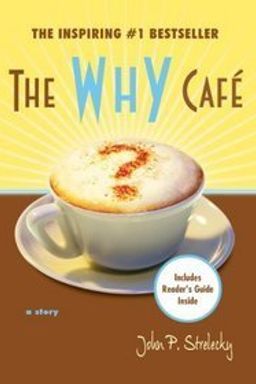
The Why Cafe cover

The Why Cafe

by John P Strelecky

The Why Cafe takes readers on a philosophical journey to discover profound life questions. Through a chance encounter at a unique cafe, protagonist John learns to uncover his true purpose, offering readers insights into breaking free from societal norms and finding genuine fulfillment.

Living with Purpose: The Core of Fulfillment

Have you ever caught yourself thinking that life is just “fine” — you have friends, a job, and perhaps even some financial stability, but deep down you feel that something essential is missing? The book Finding and Embracing Your True Life Purpose invites you to confront that uneasy thought and offers a profound insight: a good life isn’t necessarily a fulfilling one. Its author argues that the difference lies in purpose. Without a clear sense of why we exist and what truly matters to us, we risk drifting through life as spectators rather than participants.

At the heart of the book sits a deceptively simple setting — The Why Café — and three life-defining questions printed on the back of its menu: “Why are you here?”, “Do you fear death?”, and “Are you fulfilled?” These questions become the gateway into the book’s exploration of self-awareness, purpose, freedom, and courage. Through John’s conversations with café regulars like Casey, Anne, and Mike, we learn how misguided definitions of success, inherited expectations, and fear keep us from living authentically. Each story acts as a mirror, reflecting ways we unknowingly paddle against the current of our natural desires.

The Hunger for Meaning

The book opens with a universal tension — the feeling that something is absent from everyday satisfaction. We might have comfort but lack connection. The author challenges the notion that external achievements — like promotions or possessions — can replace the internal clarity that comes from understanding one’s purpose. Through John’s journey at the café, readers begin to see fulfillment as a state of alignment: when what we do, think, and feel are moving in the same current, life feels simpler, freer, and more meaningful.

This pursuit of purpose isn’t about grand transformations; it’s about uncovering the truth that already lives within us. Casey’s story about the green sea turtle exemplifies this lesson. The turtle doesn’t fight against the waves — it glides with them, moving forward naturally. Similarly, people who live with purpose align with life’s rhythm, conserving their energy and enjoying progress. Those who resist their inner calling, however, exhaust themselves trying to reach a destination that may not even fulfill them.

The Influence of Illusion

One of the most persuasive obstacles to authentic living is the illusion of happiness crafted by advertising. Anne, a former executive in that world, explains how consumer culture sells desire disguised as fulfillment. A luxury car or an expensive home becomes a stand-in for happiness — a distraction that makes us forget to ask deeper questions like “What really makes me come alive?” The book reveals this cycle: chasing material satisfaction leads to constant work, which demands more money, which leads to buying more things — all while genuine joy slips further away. The realization is liberating once we see that many of life’s “necessary” constraints are only mental—imposed by fear or comparison.

Freedom from Expectations

Beyond the grip of advertising lies a subtler form of captivity: the expectations of others. Parents, peers, and communities often define success long before we form our own ideas. The book illustrates how living by these borrowed standards breeds anxiety and fear, especially the fear of death. When you realize you’ve never lived for yourself, the end of time becomes terrifying. In contrast, a self-determined life alleviates that fear; when you’ve expressed your full potential, you can meet mortality without regret. The story of the golfer trapped in his recurring dream shows how liberation can begin by simply choosing a different position — a metaphor for reclaiming agency.

Discovering Purpose in Practice

Finding your purpose isn’t an intellectual puzzle — it’s a process of experimentation, reflection, and emotional resonance. The café’s characters illustrate diverse paths to clarity. Some meditate, others travel, create art, or engage in conversation. The point isn’t the method itself but the openness to exploration. When an activity lights you up — when joy or deep satisfaction unmistakably arises — you’ve likely found your direction. The author reminds us to notice these sparks: fulfillment reveals itself in moments of authenticity rather than abstract ideals.

Living the Purpose

Once you grasp your purpose, the next step is living it — both freely and confidently. Mike’s story of the fisherman and the businessman illustrates the diversity of fulfillment. The businessman projects a future defined by ambition and success; the fisherman embodies peace and presence. The contrast teaches that meaning isn’t measured by scale but sincerity. You can find purpose while fishing, writing, nursing, coding, or parenting; what matters is alignment between effort and desire. Living with purpose has a magnetic pull — it attracts opportunities, clarity, and contentment because energy is no longer wasted on resistance or doubt.

Why These Ideas Matter

The lessons from Finding and Embracing Your True Life Purpose matter because they help you bridge the gap between existing and living. In a society defined by external benchmarks — career titles, possessions, reputations — the book invites a countercultural shift: to define success through fulfillment rather than accumulation. It doesn’t promise quick fixes or instant clarity, but it offers practical ways to reconnect with what you deeply want. Like John, you come to see that meaning is not found through endless striving but through conscious being — letting yourself move with life’s current rather than against it.


Flow Like the Green Sea Turtle

Casey’s story about the green sea turtle captures a transformative truth — fulfillment comes when you stop fighting the current and start flowing with it. While scuba diving, she noticed how the turtle conserved its energy: it used each wave to drift naturally forward rather than constantly pushing against it. This revelation became a metaphor for how many people live their lives — exhausting themselves by paddling against circumstances instead of working with their innate direction.

Recognizing Your Inner Current

Every individual has an internal current — a combination of desires, talents, and values that define how fulfillment feels. When you ignore this current by pursuing goals imposed by others, resistance builds and energy drains. Living like the turtle means recognizing where effort feels natural rather than forced. The author reminds us that our lives become lighter when we pursue paths aligned with joy, not obligation.

The Cost of Constant Resistance

Many people mistake endurance for success. We keep paddling harder, thinking perseverance alone guarantees reward — yet emotional exhaustion and dissatisfaction reveal misalignment. (Psychologist Mihaly Csikszentmihalyi’s concept of “flow” mirrors this: real achievement emerges when action feels effortless, energized, and meaningful.) By learning from the turtle, we stop confusing struggle with value and start finding peace in movement that matches our essence.

Key Insight

When you align with the natural rhythm of your purpose, life’s waves propel you forward instead of knocking you back. The goal isn’t to control the ocean — it’s to learn how to ride it.

Ultimately, Casey’s turtle becomes not just a symbol but a guide. It shows that fulfillment is less about winning the race and more about finding the grace within motion. Once you stop fighting and start flowing, meaning arises effortlessly.


Escaping the Illusion of Happiness

Advertising shapes more of our worldviews than we admit. Anne, the former ad executive, exposes this subtle manipulation: products are sold not as items but as emotional promises. A face cream becomes a gateway to youth, a car to adventure, a chocolate bar to familial warmth. Over time, these coded messages trick us into believing that happiness can be bought. The author unveils how this deception clouds our pursuit of genuine fulfillment.

The Vicious Cycle of Consumption

The story’s central warning is about the habit loop created by consumer culture. You work to buy happiness, you buy to cope with work frustration, and the loop continues. Each cycle deepens dependence on external validation. When decisions revolve around paychecks instead of passions, you end up emotionally bankrupt—even if financially stable. The book calls this the “consumption treadmill.”

Breaking Free Through Awareness

Awareness is the starting point of liberation. By asking, “Why am I making this purchase?” or “What am I compensating for?” you begin to uncover patterns of avoidance. You can then reframe success not as accumulation but alignment. (This echoes ideas from authors like Marie Kondo and Cal Newport, who advocate simplicity and meaningful engagement over excess.) Remember Anne’s advice: most shackles are imaginary. Freedom begins when we recognize that wealth is not synonymous with worth.

Key Insight

Material comfort can enhance life but cannot replace purpose. True happiness is an inner condition—not a product of consumption but of connection.

Anne’s awakening reflects a universal truth: when we detach from the illusion of manufactured happiness, we regain the energy and time to build real fulfillment. The café becomes a sanctuary where this awareness can flourish.


Choosing Freedom Over Approval

Social expectations—the invisible web of “shoulds” woven by family and community—often dictate our life choices. The book explores how deeply these forces can entangle us, leading many to live for others rather than themselves. John’s conversation at the café reveals a crucial realization: fulfilling social norms may keep the peace but often leaves the soul restless.

Breaking the Chains of Convention

The author uses a powerful metaphor—the golfer who dreams repeatedly of a stuck ball. When he eventually decides to pick it up and move it, he discovers freedom. That act of self-permission represents the transformative choice to reposition oneself according to intrinsic values rather than external judgment. Once you stop worrying about others’ opinions, creativity and courage emerge naturally.

How Freedom Diminishes Fear

This narrative connects directly to the fear of death. People who live by others’ standards often face existential anxiety because they’ve never expressed their unique selves. On the other hand, those who live intentionally—who’ve “played their shot”—can meet death peacefully. (This echoes existentialist themes from Viktor Frankl’s Man’s Search for Meaning, where meaning transforms suffering into purpose.)

Key Insight

Approval is comforting, but authenticity is liberating. When you stop performing for others and begin acting for yourself, fear loses its power.

Choosing your own path doesn’t mean defiance—it means alignment. And alignment, once achieved, grants you peace both in life and in its final moments.


Multiple Pathways to Purpose

The book dismantles the myth that there’s only one correct way to find purpose. Instead, it celebrates diversity in personal discovery. Whether through solitude, meditation, travel, conversation, or art, each individual must experiment and listen closely to what resonates within.

Experimentation as Self-Discovery

John learns that purpose emerges through trial, not theory. Each attempt—whether learning a skill, engaging with new people, or exploring unfamiliar environments—creates data about what feels fulfilling. Even false starts have value, as they refine our understanding of what matters. (Writer Elizabeth Gilbert advocates a similar approach in Big Magic: follow curiosity instead of waiting for revelation.)

Recognizing Authentic Resonance

Fulfillment isn’t abstract; it manifests physically and emotionally. Goosebumps, excitement, deep peace—these sensations often signal alignment with your true calling. The author urges you to notice them and treat them as guidance. If creating music makes you feel euphoric, or working on cars gives you quiet satisfaction, that’s not coincidence; it’s message.

Key Insight

The journey to purpose is personal and experimental. The more you explore with openness, the clearer your direction becomes.

Ultimately, discovering your purpose isn’t about finding a single answer—it’s about deepening your relationship with yourself. Once awareness emerges, planning how to live that purpose becomes the next step in the journey.


The Magnetic Power of Purposeful Living

When purpose moves from idea to practice, life changes dramatically. The book’s final message celebrates the freedom that comes once you start living with intention. Whether your fulfillment arises from family, creativity, exploration, or simplicity, the secret is recognizing your autonomy in shaping your daily life.

Fulfillment Without Comparison

Mike’s story of the fisherman and the businessman embodies this lesson. The businessman, fueled by ambition, outlines a long path to wealth and eventual relaxation. The fisherman smiles, explaining that he’s already living that dream—spending time with loved ones, doing meaningful work, enjoying peace. The moral is clear: contentment isn’t about future potential but current presence.

Cultivating Confidence and Courage

Living your purpose often demands bravery. Fear whispers about risks and failures, yet optimism propels progress. The author encourages assuming the best possible outcome—it fuels momentum. (Positive psychology researcher Barbara Fredrickson calls this broaden-and-build thinking: positive emotions expand possibility.) The act of believing in favorable outcomes magnetizes opportunities aligned with your purpose.

Key Insight

Purpose transforms your environment. When you start living by it, synchronicities appear, peace deepens, and success becomes a natural consequence rather than a desperate chase.

In the end, the café’s message reverberates: you are free to design a meaningful life right now, without waiting for permission or perfection. Living purposefully isn’t about grand gestures—it’s about consistent authenticity.

Dig Deeper

Get personalized prompts to apply these lessons to your life and deepen your understanding.

Go Deeper

Get the Full Experience

Download Insight Books for AI-powered reflections, quizzes, and more.