
Idea 1
How Culture Shapes the Mind
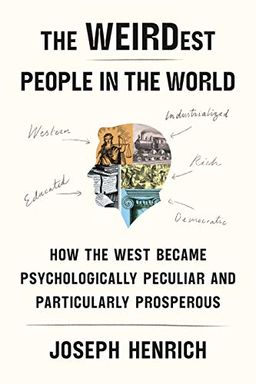
Why do people in different societies reason, judge, and cooperate so differently? Joseph Henrich’s The WEIRDest People in the World answers that question by tracing how centuries of cultural evolution—in particular the Western Church’s Marriage and Family Program (MFP), literacy, markets, and institutions—remade human psychology. Henrich’s core argument is that the Western, Educated, Industrialized, Rich, and Democratic (WEIRD) mind is not a human universal; it is a historically unusual psychological configuration shaped by specific social changes that dismantled kin-based networks and fostered individualism, analytic thinking, and impersonal trust.
The puzzle of psychological diversity
Henrich begins with the observation that much of psychology has been built on WEIRD samples—often American undergraduates. But these people are psychological outliers: they define identity through traits, favor individual choice, weigh intentions more than outcomes, and prefer guilt over shame. In contrast, people from regulated-relational societies organize identity around kinship and roles, depend on reciprocal obligations, and enforce norms through shame and reputation. These are deep, cross-cultural differences that have shaped how societies function.
Culture as a selective environment
Henrich defines humans as a cultural species. Our intelligence depends on social learning—copying successful or prestigious models and accumulating knowledge across generations. This cumulative cultural evolution explains why humans produce technologies and institutions far beyond individual ingenuity. Cultural environments select not only ideas but psychological traits: societies that rely on impersonal norms reward analytic reasoning and impartial fairness, while kin-based societies reward loyalty and obedience. Over millennia, this cultural selection created different psychological packages.
The Church’s program and the dismantling of kinship
The Western Church systematically disrupted the kin-based institutions that dominated the ancient world. Through synods and canon law, it banned cousin marriage, levirate marriage, polygyny, and adoption. Beginning around the third century and continuing for centuries, these prohibitions replaced lineage-controlled marriage with individual consent. This forced family lines to fragment and created nuclear households. Over generations, this made people more mobile and opened space for voluntary associations—guilds, universities, monastic orders—all based on contract and choice rather than kin obligations.
(Note: This slow historical shift parallels the effects of China’s twentieth-century Marriage Laws, which banned polygamy and cousin marriage in a rapid, state-driven version of the Church’s program.)
From kinship to impersonal institutions
When intensive kin networks weakened, cities and markets rose. Magdeburg and Lübeck Law spread legal ideas emphasizing personal rights and impartial courts. Guilds standardized trade; universities systematized law and schooling; Protestantism diffused literacy and self-investigation through biblical reading. These institutions rewarded analytic thinking, fairness toward strangers, and cooperation beyond kin. Over centuries, cultural learning embedded new psychological patterns: trust in contracts, belief in rule-based justice, and comfort with impersonal interactions.
The cumulative cascade
Church prohibitions reduced kin intensity; markets and cities amplified impersonal norms; literacy rewired brains; competition and warfare further selected for civic cooperation. Each factor reinforced the others. The emerging WEIRD psychology—individualistic, guilt-driven, analytical, fairness-oriented—proved adaptive for building large-scale societies. Meanwhile, elsewhere, ecological features like rice cultivation maintained intensive kinship and holistic, role-based cognition (as shown in Talhelm’s paddy-rice studies across China).
The larger meaning
Henrich’s thesis rewrites the history of modernity: the Western mind evolved not from innate superiority but from cultural processes that changed social incentives and molded cognition. Psychology is not separate from institutions; it is their product. To understand the modern world—and to design societies that cooperate at scale—you must see minds as cultural artifacts shaped by history, religion, ecology, and learning. The WEIRD world is not universal; it is one of culture’s most extraordinary experiments.