
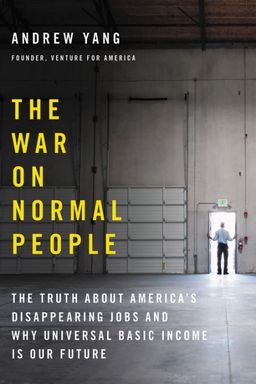
The War on Normal People cover

The War on Normal People

by Andrew Yang

Andrew Yang''s ''The War on Normal People'' uncovers the looming threat of mass unemployment due to automation and AI. He proposes a transformative vision of Universal Basic Income to rescue the economy and empower individuals, advocating for a shift towards human-centered capitalism.

The Great Displacement: Technology’s Assault on Normal America

What happens when the future arrives and it doesn’t have room for you? Andrew Yang’s The War on Normal People poses this unsettling question. The entrepreneur-turned-presidential candidate argues that America is on the brink—or perhaps already in the middle—of what he calls the Great Displacement: an economic and social upheaval driven by automation, artificial intelligence, and the market’s relentless thirst for efficiency. According to Yang, this revolution threatens to erode not just our jobs but the very meaning of work, family, and community that once held the country together.

He contends that technological progress—long believed to generate broadly shared prosperity—is now hollowing out the middle class, leaving millions of “normal Americans” jobless, disconnected, and despairing. These are the truck drivers across the Midwest, the retail clerks in dying malls, and the professionals—doctors, lawyers, accountants—who still believe their white-collar credentials make them safe. The uncomfortable truth, Yang warns, is that automation no longer only threatens factory workers. It’s coming for nearly everyone.

A Boiling Pot Called the Market

Yang begins by painting the contemporary economy as a boiling pot in which the water—automation and market consolidation—is slowly rising, while workers, like unwitting frogs, remain unaware they’re being cooked alive. The market rewards efficiency, not humanity, and companies are “paid to perform tasks, not to employ people.” As AI improves exponentially—thanks to advances in computing power, machine learning, and big data—tasks once reserved for specialized humans are being devoured by algorithms.

Yang grounds these predictions in vivid anecdotes: a radiologist defeated by a computer that sees tumors invisible to the human eye, a financial analyst replaced by Kensho software producing 40-hour reports in minutes, and 600 Goldman Sachs traders replaced by just two supported by 200 engineers. Even creative and therapeutic fields—music composition, art, and psychotherapy—are now seeing their human edge shrink as machines simulate emotional engagement. “Throw AI at the problem,” Yang’s peers now say, encapsulating the market’s new reflex.

From Factory Floors to Data Clouds

Yang traces today’s crises back decades, revealing how technology, globalization, and corporate financialization reshaped the U.S. labor landscape. Beginning in the 1970s, productivity skyrocketed while wages flatlined. Pensions and unions evaporated. Wall Street’s dominance and shareholder primacy ushered in a ruthless era where companies existed “not to employ people but to maximize profit.” Globalization offshored millions of jobs; then automation came for what remained. The result: a bifurcated society of cosmopolitan elites clustered in six dynamic cities and a faltering “normal America” of shuttered factories and fading Main Streets.

He describes the human cost through “regional depression” stories like Youngstown, Ohio, where the collapse of steel mills triggered decades of decay, addiction, and corruption—a haunting preview of what jobless futures can do to any town. Yang also identifies the new geography of success: the coasts and global cities where capital and talent concentrate, sucking oxygen from struggling regions that now serve mostly as backdrops for nostalgia or despair.

When Work Disappears, So Do We

Yang insists that the moral and psychological losses from job disappearance may even outweigh the economic ones. Work, he writes, is more than a paycheck—it’s purpose, identity, community, and structure. Citing studies showing unemployment’s devastating effects on happiness, social cohesion, and even longevity, he warns that millions of Americans are already “adrift and broken,” as seen in surging opioid deaths and “deaths of despair.” The decline of work has destabilized masculinity, marriage, and family (themes expanded later in the book), while video games and virtual worlds now provide the sense of mastery and belonging once found in real economies.

In essence, the displacement is not just technological—it’s existential. If automation strips work of value, Yang asks, what will give people meaning? Quoting Yuval Harari’s Homo Deus, he notes that “the challenge of the 21st century will not be exploitation, but irrelevance.”

Human-Centered Capitalism

To transcend the market’s domination of human life, Yang proposes what he calls Human-Centered Capitalism, an updated system that measures well-being, health, and community alongside GDP. The state’s role, he argues, must expand beyond managing markets to preserving social fabric. His central economic remedy—the Freedom Dividend, a $1,000 monthly universal basic income for every American adult—aims to cushion the transition into a post-work society and anchor dignity in a new moral economy.

But Yang’s vision isn’t merely about redistribution. It’s about redefining value itself. “Humanity is more important than money,” he writes. This principle drives his sweeping proposals to modernize education, healthcare, and civic life so they cultivate compassion, resilience, and creativity—the very qualities machines can’t replicate. Echoing thinkers like Rutger Bregman (Utopia for Realists) and Martin Ford (Rise of the Robots), Yang insists that automation’s threat can also be its gift: freeing people from drudgery to rediscover meaning beyond labor.

Why This War Matters Now

Yang closes his opening argument with a warning and a call. The U.S., he writes, has “a 1960s-era government facing 2030s-era problems.” Without bold reform, the coming automation wave will bankrupt not only budgets but belief in democracy itself, as communities collapse and populism curdles into chaos. Yet he offers faith that collective imagination and empathy can still rewrite the rules before crisis strikes. “The revolution,” he writes, “will happen either before or after the breakdown of society. We must choose before.”

Yang’s central message is powerful in its simplicity: automation is inevitable, but human collapse is not. Whether America succumbs to despair or reinvents itself around dignity and shared prosperity depends on what we do next.


How Technology Is Erasing Work

Andrew Yang dismantles the persistent myth that technological advances only threaten low-skill or manual labor. In chapter after chapter—from “Factory Workers and Truck Drivers” to “White-Collar Jobs Will Disappear, Too”—he argues that automation’s real fault line is not between blue- and white-collar work, but between routine and nonroutine tasks.

The Fall of Routine Labor

Automation, Yang explains, devours any job that can be reduced to predictable steps. A machine doesn’t need to be intelligent in a human sense; it only needs to perform a task faster, cheaper, and more consistently. This logic is already eliminating millions of roles across multiple industries. Machines have replaced most bank tellers, cashiers, warehouse pickers, drivers, clerks, and paralegals. Radiologists—once among the safest high-skill careers—now compete with AI image analyzers that detect cancers invisible to human eyes. Narrative Science, an AI company, already writes earnings reports for Forbes and sports recaps for fantasy leagues—“intellectual manual labor,” as Yang calls it, performed by bots that don’t rest or unionize.

He reminds us that companies pursue profit, not employment. The firms that embrace automation first enjoy lower costs and higher efficiency, forcing competitors to follow or die. The market, Yang observes, “will see human employment as inefficiency.” While we may feel sentimental about cashiers or journalists, shareholders don’t.

Blue Collar, White Collar—Same Story

Yang walks readers through the domino effect that began in manufacturing. When America lost five million factory jobs after 2000—mostly to automation, not trade—millions of men with high school degrees didn’t find new work; 44% left the workforce entirely. Many turned to disability benefits, creating what Yang calls the “permanent shadow class.” Next will come transportation: self-driving trucks threaten 3.5 million drivers, one of the most common jobs in the U.S. The ripple effects extend to the 7.2 million workers who feed, house, and service them at truck stops. Just one autonomous fleet could erase $17.5 billion in rural spending and destabilize entire regional economies.

What makes this wave different, Yang cautions, is speed. The Industrial Revolution took generations to displace farmers; automation will upend entire professions within a decade. Unlike farmers, today’s workers are less mobile, less unionized, and heavily indebted—a recipe for social breakdown rather than adaptation.

The “Job Polarization” Trap

Using Federal Reserve data, Yang shows that nearly half of all U.S. jobs—62 million roles—are “routine,” making them ripe for automation. As these vanish, the labor market is polarizing: booming demand for low-wage service work on one end and elite cognitive jobs on the other, with the middle hollowed out. The result is a shrinking middle class and obscene inequality. Moore’s Law, he reminds us, means computing power keeps doubling every 18 months. If cars had advanced as fast as chips since 1971, a Volkswagen Beetle today would go 300,000 miles per hour. That’s the scale of AI’s growth now invading medicine, finance, law, and beyond.

“Basically, we’re trained to become more like machines,” Yang observes of lawyers, doctors, and accountants. “But we’ll never be as good as the real thing.”

In short, the age-old human bargain—trade labor for security—is unraveling. The next question becomes: what replaces human purpose when work itself disappears?


The Collapse of Normal America

To understand the human story behind economic abstraction, Yang dedicates much of The War on Normal People to chronicling how decades of neoliberal and tech-driven transformation hollowed out working America. He juxtaposes two timeframes: the stable midcentury America of strong unions, pensions, and steady jobs versus the gigified, unstable present of temp work and precarity.

From the American Dream to the Disposable Worker

In the 1970s, Yang’s father worked for GE, a company that once promised lifelong employment and paid generous pensions. Those companies are gone—or unrecognizable. Deregulation, offshoring, and shareholder capitalism transformed corporations into ruthless instruments of financial engineering. The new gospel, spread by Milton Friedman and Jack Welch, declared that a firm exists only to maximize shareholder value. CEO pay ballooned from 20 times the average worker’s salary in 1965 to 271 times in 2016. The ratio of profits to wages inverted: as corporate profits tripled, the wage share of GDP fell almost 10 percentage points. Inequality reached historic extremes, with the top 1% capturing more than half of post-2009 income growth.

At the same time, technological substitution and global labor competition destroyed domestic middle-skill jobs. Between 1979 and 2015, union membership halved, pensions disappeared, and wages stagnated. Ninety-four percent of jobs created between 2005 and 2015 were temp or contractor positions without benefits. Most Americans stopped expecting their lives to improve, and indeed, social mobility collapsed: those born in 1990 have only a 50% chance of out-earning their parents (down from 92% in 1940).

Geography as Destiny

Automation’s aftershocks reshaped the American map. Yang’s portraits of Youngstown, Gary, and Camden show what happens when jobs vanish: crime, addiction, depression, corruption, and flight. Sociologist Sherry Linkon called it “a psychological and cultural breakdown.” Gary transformed from a vibrant steel city into “a murder capital,” while 40% of its homes now sit abandoned. The pattern repeats elsewhere: when factories die, civic virtue and social trust evaporate.

Meanwhile, only five metro areas—New York, L.A., Miami, Houston, Dallas—created as many new businesses as the rest of the nation combined between 2010 and 2014. Venture capital remains captured by three states: California, New York, and Massachusetts. As cities diverge, mobility withers: Americans move across state lines less than at any time in modern history. Economically speaking, Yang writes, “America stopped being one country. It’s many different economies.”

“When a community truly disintegrates,” Yang warns, “knitting it back together becomes a herculean, perhaps impossible, task.”

In essence, “normal people” were left on the battlefield of market efficiency. Their devastation, Yang argues, is not a moral failing—it is the predictable casualty of an economy optimized for capital, not citizens.


The Human Toll of a Jobless Society

Work isn’t just a means to survive—it’s what makes most people feel human. In one of his most poignant chapters, Yang turns from economics to psychology to show that technological unemployment corrodes identity, health, and meaning itself.

Losing Work, Losing Dignity

Citing German research, Yang notes that long-term joblessness destroys well-being more permanently than even the death of a spouse. Yet most Americans hate their jobs—Gallup finds only 13% engaged worldwide. Why? Because modern employment increasingly rewards robotic consistency, the very quality machines now outperform. The paradox: humans became machine-like to succeed, and now actual machines are replacing them. “We’ve trained ourselves to be more like machines,” Yang says, “but we’ll never be as good as the real thing.”

This mismatch breeds desolation. Depression, substance abuse, and disability claims have surged in the same areas where manufacturing collapsed. He recounts economist Anne Case and Angus Deaton’s discovery that mortality among working-class whites is rising—from overdoses, suicide, and alcohol-related disease. “Deaths of despair,” Yang insists, are not isolated tragedies but the cumulative result of communities stripped of purpose.

Virtual Escapes and Lost Men

Yang devotes an entire chapter to how millions of young men are checking out of the economy into immersive video games. Between 2000 and 2015, hours worked among men without college degrees fell sharply, while video-gaming hours tripled—from 3.4 to 8.6 hours per week. These unemployed gamers report higher self-reported happiness than working peers—at least at first. But by their thirties, disillusionment sets in. “Every society has a bad men problem,” economist Tyler Cowen is quoted as saying. For every Jacob Barry playing 40 hours of games in Michigan’s basement, thousands of others are retreating into what Cowen calls “cheap digital entertainment to stay happy.”

For Yang, this pattern reveals something deeper: when real-world progress feels impossible, virtual mastery becomes irresistibly seductive. But the result is a generation detached from civic life, relationships, and future building.

“Men imagine themselves to be kings, warriors, CEOs, athletes… All of these things are possible online,” Yang reflects. “But this version of achievement is not going to be sustainable for more and more Americans.”

Ultimately, the loss of work is the loss of social scaffolding. Without new ways to create purpose, millions will substitute imitation worlds for the real one—even as the real one burns.


Scarcity and the Shrinking Mindset

One of Yang’s most psychologically penetrating insights is that economic insecurity rewires how people think. Drawing on research by Princeton psychologist Eldar Shafir and Harvard economist Sendhil Mullainathan (Scarcity), he shows how living under constant financial strain lowers cognitive capacity, narrows focus, and breeds division.

The Bandwidth Tax of Poverty

When you’re worried about paying bills, Yang explains, your brain functions differently. Simply asking low-income participants to imagine a sudden $3,000 car repair reduced their IQ-equivalent scores by 13 points—nearly an entire intelligence class drop. Scarcity monopolizes mental bandwidth; you make worse choices because your brain is busy surviving. “Scarcity,” Yang writes, “makes you less rational and more impulsive by consuming bandwidth.”

This effect, he adds, explains why people stuck in low-paying jobs struggle to plan long-term or pursue retraining—it’s not a lack of willpower, it’s cognitive taxation. Constantly balancing unpredictable shifts, childcare, and bills drains the very focus needed to escape poverty. In Shafir’s experiments, wealthy and poor participants performed similarly on logic tasks—until money stress was introduced. Suddenly, the poor made markedly more errors.

Mindsets of Abundance vs. Scarcity

Yang contrasts this with the psychology of abundance—typified by entrepreneurs who feel they can recover from failure. “After you make one thing work,” he writes, “you kind of think you can make anything work.” Abundance enables risk-taking; scarcity enforces caution. This is why wealthy founders can launch multiple startups while the working poor hesitate to start even one business. Scarcity creates tunnel vision—focusing only on short-term fixes and crises—while abundance opens bandwidth for creativity and optimism.

The national danger, Yang suggests, is cultural: as the middle class erodes, scarcity becomes America’s default mindset. Acts of long-term optimism—marriage, moving for opportunity, starting a business—are declining. Tribalism and anger grow as empathy shrinks.

“A culture of scarcity is a culture of negativity,” Yang concludes. “People think about what can go wrong. They attack each other.”

His implicit message: if automation creates widespread scarcity, we won’t just grow poorer—we’ll grow meaner and less capable of solving the very problems confronting us.


The Freedom Dividend and Human-Centered Capitalism

To rescue people from both economic ruin and psychological despair, Yang proposes his boldest idea: the Freedom Dividend, a universal basic income (UBI) of $1,000 per month for every American adult. He frames it not as welfare but as a moral and technological necessity in a post-work world.

Redefining the Social Contract

UBI, Yang explains, would directly counteract the “Great Displacement” by giving every citizen a financial floor—enough to live with dignity, pursue retraining, care for family, or simply participate in their communities. Modeled on Alaska’s oil dividend, the Freedom Dividend would be funded through a value-added tax (VAT) on large corporations and automation gains. Because a VAT collects from transactions rather than payrolls, even AI-driven enterprises would contribute to social wealth.

Yang argues that the $12,000 annual floor would stimulate local economies—since most funds would be spent immediately on rent, food, and services—and replace inefficient welfare bureaucracies. Studies from Finland, Canada, and Alaska show that recipients don’t stop working; they gain stability, education, and health. “Money is easy,” Yang writes. “People are hard.”

From GDP to Human Flourishing

The Freedom Dividend also anchors Yang’s broader philosophy of Human-Centered Capitalism. Our economy, he contends, measures “the wrong things”—GDP and job figures that ignore suffering. He proposes replacing them with new national metrics: health-adjusted life expectancy, civic engagement, childhood success, mental health, community integrity, and more. What gets measured, he reminds us, gets managed.

If capitalism currently serves capital, human-centered capitalism would serve people. It would recognize parenting, teaching, caregiving, and creativity as forms of productivity just as vital as manufacturing. This moral reorientation, Yang believes, is the only way to restore meaning in an automated age and stave off the dystopias of social collapse or elitist secession.

“We must make the market serve humanity,” Yang insists, “rather than have humanity continue to serve the market.”

Whether UBI’s implementation is politically feasible remains open, but Yang’s vision endures as both an alarm and a blueprint—a demand that America choose empathy, not efficiency, as its organizing principle in the age of machines.

Dig Deeper

Get personalized prompts to apply these lessons to your life and deepen your understanding.

Go Deeper

Get the Full Experience

Download Insight Books for AI-powered reflections, quizzes, and more.