
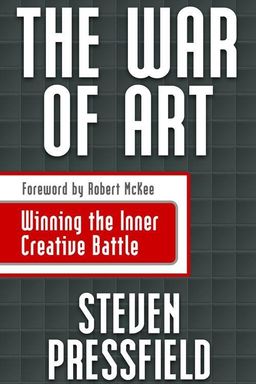
The War of Art cover

The War of Art

by Steven Pressfield

The War of Art by Steven Pressfield is a transformative guide to overcoming the inner battles of fear and self-doubt. It provides actionable strategies for identifying and defeating resistance, empowering readers to pursue their creative passions with professional discipline and resilience, ultimately helping them realize their dreams.

Winning the Inner War Against Resistance

Have you ever sat down to start a creative project—writing a book, launching a business, or even committing to a personal goal—only to find yourself paralyzed by hesitation, distraction, or self-doubt? Steven Pressfield’s The War of Art offers a startlingly direct explanation: you’re at war, not with the world or with your circumstances, but with an invisible enemy dwelling inside you. Pressfield calls this enemy Resistance.

At its heart, The War of Art argues that the biggest obstacle to creative achievement isn’t lack of talent, resources, or time—it’s Resistance, a universal force that sabotages our efforts to pursue what matters most. Drawing from his own struggles as a novelist and screenwriter, Pressfield defines Resistance as the insidious voice that urges you to procrastinate, indulge in distractions, or give up before you begin. It’s fear, rationalization, and self-sabotage condensed into one relentless adversary. To create anything meaningful, you must first learn to fight this internal war.

The Anatomy of Resistance

Resistance, according to Pressfield, isn’t random—it’s a force of nature, as constant and predictable as gravity. It’s fear-inducing, imperceptible, and fueled by self-deception. It doesn’t merely distract—it aims to destroy. Resistance surfaces whenever you attempt meaningful change: writing a novel, launching a startup, committing to spiritual growth, or transforming your body. It’s most powerful, Pressfield notes, when you’re closest to success. Like Odysseus falling asleep within sight of Ithaca, we’re often sabotaged just when victory is near.

He likens Resistance to forces portrayed in myth and psychology—from Freud’s death wish to the darker archetypes of human nature. Its enemy, therefore, isn’t discipline for discipline’s sake—it’s potential. Anything that awakens our higher nature—love, creativity, moral courage—invites Resistance to attack.

Turning Pro: The Creative Warrior’s Code

After defining the enemy, Pressfield proposes a radical shift in identity: to overcome Resistance, you must “turn pro.” Turning pro doesn’t mean earning money from your work—it means adopting a professional mindset toward your calling. Amateurs wait for inspiration, give into moods, and treat the creative life as an indulgence; professionals show up daily, prepared to face fear, boredom, and self-doubt. Like soldiers and monks, pros work whether or not they “feel like it.” They organize their lives around their craft, respect their tools, and accept pain as part of the path. The act of sitting down daily to work, Pressfield insists, is victory itself—because Resistance can only attack motionless targets.

In vivid anecdotes, Pressfield describes his own rituals: donning “lucky work boots,” saying a prayer to the Muse, and writing until exhaustion sets in. He admits that quality or productivity are secondary; only one measure matters: Did you show up today and fight the war? This respect for labor over outcome is what separates professionals from dabblers—and creators from dreamers.

The Higher Realm: Inspiration and the Divine

In the final section of the book, Pressfield turns mystical. Creativity, he argues, isn’t entirely human—it’s divine collaboration. When you consistently show up and do your work, “power concentrates around you.” You become “a magnetized rod that attracts iron filings”—ideas, intuition, and inspiration flow naturally. Pressfield personifies these forces as angels or Muses, echoing classical Greek beliefs that artistry is a sacred channel between heaven and earth. The professional’s daily discipline, therefore, isn’t just self-help—it’s liturgy.

This spiritual framing transforms creation into devotion. Your true work, he says, is to act as a vessel through which the divine brings new life into the world. To write, paint, code, or lead is not to “express yourself”—it’s to surrender yourself. When you resist, you betray your gift and the purpose for which you were born.

Why It Matters

In essence, The War of Art is part psychological manual, part spiritual manifesto, and part motivational kick in the pants. It speaks to anyone who hears the whisper to create but feels the invisible hand pushing them away. Comparing his approach to Sun Tzu’s The Art of War for the inner battlefield, Pressfield turns creativity into moral combat: you are responsible for overcoming Resistance not only for yourself but for humanity’s evolution. Each unrealized idea, each abandoned calling, is a loss to us all. As he closes, Pressfield’s plea is uncompromising—do not cheat the world of your contribution. The war of art never ends, but to fight it daily is to live the life you were meant to live.


Defining and Recognizing Resistance

Resistance is the invisible, universal force that keeps you from doing your work. It manifests as procrastination, self-sabotage, addiction, distraction, or rationalization—and it’s strongest when you’re pursuing something that could genuinely improve your life or elevate your spirit. Pressfield defines Resistance as the root of most human unhappiness because it keeps us trapped in what he calls the unlived life: the gap between who we are and who we could become.

The Many Faces of Resistance

Resistance isn’t just laziness—it’s protean, deceitful, and manipulative. It can appear as overthinking, guilt, endless preparation, or even virtue-signaling. Sometimes it disguises itself as seeking support or “waiting until we’re ready.” Pressfield lists numerous forms where Resistance thrives: launching a business, starting a diet, deepening spiritual practice, or making moral commitments. In every scenario, Resistance’s goal is the same—to prevent motion upward from a lower level of existence to a higher one.

Characteristics of Resistance

  • Invisible: You can’t see or touch it, but you can feel it as an internal repelling force.
  • Internal: It comes from within, not from bosses, families, or society.
  • Implacable: It never sleeps, never quits—it returns every morning.
  • Impersonal: It’s not targeting you personally; it’s the same enemy for everyone.
  • Infallible: It always points toward your true calling—the stronger the Resistance, the truer the path.

Perhaps most importantly, Resistance is universal. You’re not alone if you struggle to start. Every artist, entrepreneur, or seeker faces Resistance daily. Henry Fonda still threw up before performances at seventy-five; fear doesn’t vanish—it’s simply battled anew each day.

Why Resistance Matters

Pressfield’s metaphorical approach reframes creativity as a moral and existential battle. Yielding to Resistance isn’t mere procrastination—it’s spiritual betrayal. It stunts your growth and deforms the spirit. When you give into Resistance, you deny the world the gifts embedded within you. Whether you believe in God, the Muse, or natural talent, Pressfield insists that each of us carries a divine spark of genius—and that Resistance is its shadow. Every calling you ignore digs that shadow deeper.

To conquer Resistance is to align yourself with your higher nature. The stronger it feels, the more crucial your mission becomes. In this sense, fear itself becomes a compass—pointing directly to your soul’s evolution.


Turning Pro: Discipline as Liberation

The second act of The War of Art offers Pressfield’s antidote to Resistance: Turning Pro. To turn pro means to cross a lifelong threshold—from amateurish procrastination to wholehearted professional commitment. It’s not about making money; it’s about respect, repetition, and responsibility.

The Amateur vs. the Professional

Amateurs play for fun. They chase inspiration, crave validation, and work only when conditions feel ideal. Professionals play for keeps. They show up every day, rain or shine, sick or healthy, because the work is their vocation. The writer Somerset Maugham summarized it perfectly: “I write only when inspiration strikes. Fortunately, it strikes every morning at nine o’clock sharp.” Pressfield idolizes this mindset—discipline summons inspiration, not the other way around.

When Pressfield’s friends invited him to golf, he declined—not out of asceticism, but respect for his calling. “Golf is a virulent form of procrastination,” he quips. His professional duty was to show up at his desk. Each day he follows ritual: puts on his lucky hooded sweatshirt, points his miniature cannon toward his chair for “inspiration,” invokes Homer’s Muse, and writes until the fatigue sets in. He doesn’t care about quantity or quality—only about having overcome Resistance for that day.

Professional Qualities

  • Shows up consistently and stays the entire day.
  • Commits for the long haul; treats creativity like survival.
  • Separates identity from the job; doesn’t equate art with self-worth.
  • Masters technique, accepts adversity, and asks for help when needed.
  • Endures rejection with humility, learns from failure, and self-validates.

Turning pro transforms fear into fuel. When Pressfield’s film King Kong Lives bombed and critics mocked his name, he realized he’d grown into a professional—not by success, but by surviving honest failure. “You’re where you wanted to be,” his friend told him. “Stop complaining and be grateful.” The professional doesn’t fear adversity because he knows the war must be fought anew each day.

Discipline as Freedom

Ironically, turning pro liberates you. The disciplined artist becomes free from the chaos of moods, external validation, and irrational expectations. Like a Marine trained to “love being miserable,” the professional embraces hardship with honor. To be consistent, sober, and tough is not repression—it’s sovereignty over the self. By turning pro, you cease being a victim of Resistance and become its most formidable foe.


Fear, Self-Doubt, and the Compass of Growth

Fear and self-doubt may seem like obstacles to creativity, but Pressfield argues they’re actually vital signposts. They reveal precisely what you must do. The stronger your fear, the closer you are to the work that matters most to your soul’s evolution. He turns fear into a compass: move directly toward what terrifies you most.

Fear Is Proportional to Love

Resistance is directly proportional to love. The more you love a project, the more Resistance will attack. This paradox is the key diagnostic: massive fear indicates deep passion. As Pressfield puts it, “If you didn’t love it, you wouldn’t feel anything.” The opposite of love isn’t hate—it’s indifference. Thus, emotional intensity is a measure of importance, not avoidance.

Self-Doubt as an Ally

Uncertainty isn’t your enemy—it’s your proof of authenticity. Pressfield notes that real artists ask, “Am I truly a writer? Am I really an artist?” while phonies are wildly self-confident. Self-doubt demonstrates aspiration and sensitivity to your calling. The counterfeit innovator feels none, because he’s not truly risking anything.

Transforming Fear into Action

Fear never disappears; even veterans face it daily. Henry Fonda still vomited before stage performances, yet marched out to act anyway. That’s the essence of courage—the professional acts in the face of fear rather than waiting for its absence. Fear becomes fuel. It’s a sign that you stand at the threshold between your comfort zone and your destiny.

Pressfield’s insight echoes Joseph Campbell’s Hero’s Journey: the cave you fear to enter holds the treasure you seek. To grow creatively or spiritually, you must enter the cave—not despite fear, but because of it.


The Call of the Muse: Inspiration and the Divine

Pressfield’s notion of the Muse merges ancient myth and modern psychology into one luminous idea: inspiration doesn’t come from us; it comes through us. He revives the classical Greek belief that creativity stems from divine collaboration—with muses, angels, or what Jung might call the collective unconscious. This isn’t religious dogma—it’s humility. When you invoke the Muse, you acknowledge that creative power is cosmic, not personal.

Invoking the Muse

Each morning, Pressfield prays to the Muse, reciting Homer’s invocation from The Odyssey. This ritual reminds him to step aside and let the divine flow through. He shares how friend Paul Rink introduced him to this practice, a way of asking for “divine poesy” to sustain the work. Pressfield sees this invocation as sacred humility—a deliberate surrender of ego before creation.

Creative Collaboration

When you show up and grind daily, something mystical occurs. “When we sit down each day and do our work, power concentrates around us,” he writes. The muse takes notice. You become a magnetized rod attracting iron filings—ideas, insights, and meanings accumulate effortlessly. This process may feel supernatural, but it also aligns with neurological creativity; consistency trains the subconscious to deliver solutions automatically. (Note: similar to Mihaly Csikszentmihalyi’s “flow” state in Flow.)

Art as Service

To create is to serve. The artist is not the originator but the conduit. Pressfield concludes that the professional must efface ego entirely: “Give the work to God.” You’re not writing for applause, wealth, or critics—you’re delivering a gift entrusted to you by something greater. In this way, discipline becomes devotion, and creativity becomes worship.

Inspiration isn't mysterious; it’s reciprocal. The divine realm, Pressfield believes, is “in love with the creations of time.” When you do your work, you invite eternity into the moment. The Muse responds—not because she’s mythical, but because commitment itself opens the door to grace.


The Ego, the Self, and Spiritual Evolution

In one of the book’s most philosophical sections, Pressfield contrasts two internal forces—the Ego and the Self. Drawing on Jungian psychology, he suggests that the Ego believes only in material existence, while the Self recognizes deeper, spiritual truth. The artist’s battle, therefore, isn’t just with Resistance—it’s a war between these two realms.

The Ego’s Domain

The Ego lives by fear. It clings to reputation, safety, and hierarchy. It believes that death, time, and space are real, and thus acts defensively—guarding its territory and resisting transformation. It defines itself by social comparison and material gain, reacting to rejection as existential threat. In creative terms, the Ego is the voice saying, “Don’t risk it. Don’t stand out.”

The Self’s Domain

The Self transcends fear. It believes all beings are connected, that love is the supreme emotion, and that creation is sacred. Death, time, and rejection exist only in the Ego’s illusion. When you create authentically, you act from the Self—the divine part of you that seeks evolution. Artists, prophets, and visionaries operate from this dimension, bringing humanity forward. That’s why, Pressfield notes, history’s great innovators—Socrates, Jesus, Galileo, King—faced relentless Resistance. To uplift the Self is to threaten the Ego, both within and without.

Creativity as Evolution

Each act of creation is an act of spiritual progress. When you pursue your calling, you align with the Self and defy the Ego’s tyranny. Pressfield connects this idea to the concept of angels and destiny: your creative work isn’t just self-improvement; it’s cosmic participation. You’re helping eternity express itself in time. The more you live and create authentically, the more you evolve—and the more you heal both yourself and the world.


Finding Your Territory: Beyond Hierarchy and Comparison

In the final chapters, Pressfield offers a surprisingly practical framework for living a creative life. He distinguishes between two orientations: hierarchical and territorial. Most people, he notes, define themselves hierarchically—by social rank, opinions, or external validation. Artists, however, must define themselves territorially—by their devotion to a sacred space of personal work.

Hierarchy vs. Territory

In hierarchies, your value depends on others: your recognition, salary, or popularity. The artist who seeks acclaim becomes a hack—writing for applause rather than truth. Pressfield compares this to Hollywood politicians who consult polls before forming opinions. True creation requires independence from crowd approval.

Territorial orientation, on the other hand, is inner-focused. Your territory is your studio, keyboard, lab, or field—the space you cultivate alone. It sustains you without external input and rewards you exactly in proportion to what you give. The act of showing up on your territory daily restores balance and silences the noise of hierarchy. Arnold Schwarzenegger has the gym; Stevie Wonder has the piano. Their fulfillment comes not from fame, but from the act itself.

Working for the Work’s Sake

Once you commit territorially, you stop seeking approval and start serving the work. The territory becomes temple; labor becomes prayer. Pressfield summarizes this attitude with Krishna’s teaching from the Bhagavad-Gita: you have the right to your labor but not to its fruits. Do the work, give it to the divine, and let go. The practice of daily, ego-less creation, he insists, aligns you with the natural order of the universe. You may not be rewarded, but you will be whole.

In the end, your territory reveals your authentic self. The question isn’t what others expect—it’s whether, if you were the last person on earth, you’d still do it. If the answer is yes, you’ve found your calling.

Dig Deeper

Get personalized prompts to apply these lessons to your life and deepen your understanding.

Go Deeper

Get the Full Experience

Download Insight Books for AI-powered reflections, quizzes, and more.