
Idea 1
Turning Good Ideas into Scalable Impact
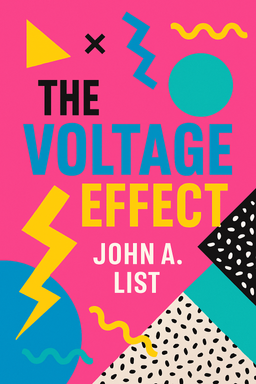
Why do some bright ideas change the world while others fizzle out the moment they expand? John A. List’s The Voltage Effect: How to Make Good Ideas Great and Great Ideas Scale offers an answer grounded in decades of behavioral economics, field experiments, and real-world research. Drawing from his work with businesses like Uber and Lyft, his academic field experiments in education, and his experiences crafting public policy, List argues that the difference between ideas that thrive and those that collapse lies in one essential quality: scalability.
Scalability, in List’s terms, is the ability for an idea to produce consistent, positive results when moved from a small sample or pilot project to a wider audience—without losing its “voltage,” or its power to generate impact. Just because something works once does not mean it will work everywhere. Most failed ideas are not bad ideas in themselves but suffer from poor understanding of what makes them endure and expand under real-world conditions.
List’s core message is both empowering and sobering: great ideas don’t scale by luck or charisma; they scale by design. To make that design process scientific and reliable, he introduces two frameworks. In Part One, he identifies the Five Vital Signs—the critical diagnostic tests that determine whether an idea is scalable. In Part Two, he reveals the Four Secrets to High-Voltage Scaling, practical tools to help leaders, policymakers, and innovators amplify the power of ideas once they’ve passed those initial tests.
From Field Experiments to Global Insight
List’s background makes him uniquely positioned to tackle the science of scaling. As a professor at the University of Chicago and the chief economist for tech giants Uber and Lyft, he’s spent his career bridging laboratory research and real-world impact. His “living labs” range from early-childhood education projects in disadvantaged Chicago neighborhoods to transportation economics in Silicon Valley. At the Chicago Heights Early Childhood Center, for example, he and collaborators like Steven Levitt (of Freakonomics) and Dana Suskind built a preschool that doubled as an experiment in improving parental engagement and child development. Yet even as the project succeeded locally, List realized that its true test would come when others tried to replicate it elsewhere—a challenge that forced him to confront the deeper science of what makes good ideas travel well.
Built to Fail or Built to Scale?
Drawing on this experience, List distinguishes between ideas that are built to fail—those that deliver spark but no sustained current—and those that are built to scale. He shows that many promising projects fall victim to what he calls “voltage drops,” the gradual dissipation of effectiveness as ideas grow. The cost, he warns, is enormous. Across industries, between 50% and 90% of initiatives lose their voltage when scaled. To prevent that fate, anyone hoping to change the world must act less like an entrepreneur chasing growth and more like a scientist testing reliability.
The Five Vital Signs
The first half of The Voltage Effect introduces five threats that can doom scalable ideas. Each “vital sign” warns of a potential failure mode:
- Dupers and False Positives: Some ideas never had real voltage in the first place—they succeeded on misleading data or flawed interpretation.
- Know Your Audience: What works for a test group may not work for the broader population if early adopters aren’t representative.
- Is It the Chef or the Ingredients? Some successes depend on rare conditions or people—charismatic leaders, unique teams, or ideal contexts—that can’t be replicated.
- Spillovers: Scaling changes ecosystems; new incentives cause side effects, both positive and negative.
- The Cost Trap: Many ideas collapse under the weight of unsustainable costs once growth begins.
List brings these concepts to life with evidence—from Nancy Reagan’s failed D.A.R.E. campaign (a profitless, nation-scale false positive) to Jamie Oliver’s restaurant empire (a cautionary tale of “chef versus ingredients”), and from Uber’s cultural implosion to early-childhood programs that quietly succeeded by balancing costs and fidelity. Each story drives home the point: scalability depends not on initial magic, but on a system’s ability to endure variation and replication.
From Science to Strategy: The Four Secrets
Once you’ve confirmed that your idea can scale, the second half of the book shifts from diagnosis to engineering. Here, List provides four “voltage amplifiers” that transform scalable ideas into truly world-changing ones: incentives that scale, revolution on the margins, quitting as a strategic advantage, and scaling culture. These aren’t one-time tactics but operating systems—ways of thinking that ensure you stay adaptive, data-driven, and human-centered as your idea grows. Together, they offer a manual for designing incentives that motivate people effectively, using marginal thinking to allocate resources wisely, knowing when to pivot or quit, and cultivating organizations whose culture grows stronger—not weaker—at scale.
Why Scaling Matters Today
List reminds readers that scalability isn’t just a business concern—it’s a societal one. In an age of big data, pandemics, and global interdependence, the ability to expand proven innovations rapidly may determine our survival. Whether tackling education inequality, climate change, or public health, the same principles apply: scalability is the ultimate force multiplier for progress. The world doesn’t just need more good ideas—it needs scalable ones. The Voltage Effect is a playbook for turning that ambition into reality.