
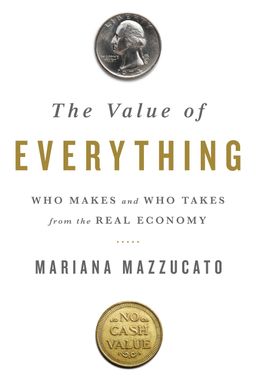
The Value of Everything cover

The Value of Everything

by Mariana Mazzucato

The Value of Everything by Mariana Mazzucato challenges conventional definitions of economic value, revealing who truly creates and extracts wealth in our global economy. By questioning GDP''s reliability and examining the impact of financialization, Mazzucato urges a rethinking of value that prioritizes real productivity and societal benefit.

Reclaiming the Meaning of Value

Every day you hear people talk about 'creating' or 'adding' value—whether when CEOs demand deregulation, workers ask for fair pay, or policymakers decide which sectors to subsidize. Yet behind this commonplace language lies a profound political question: who decides what counts as value? In Mariana Mazzucato’s work, this question becomes central. She argues that over time economics has moved from viewing value as something rooted in production to treating price as its synonym, a shift that has transformed capitalism’s institutions, policies, and inequalities.

The core claim is radical in its simplicity: value is not an objective given, but a social and political construct. The line that defines which activities lie 'inside' productive value creation and which are 'outside' (extraction or transfer) is drawn by theory, law, and narrative—what Mazzucato calls the production boundary. Once you realize that boundary is moveable, you begin to see how economic storytelling shapes who gets rewarded as a 'creator' and who gets dismissed as a cost or rent‑seeker.

How the Vision of Value Has Changed

From the mercantilists who equated wealth with trade surpluses and bullion to the physiocrats who glorified agriculture, early economists cast value as something tangible and national. The classical economists—Smith, Ricardo, and Marx—extended that lens to labor and production, grounding value in objective processes of work and resource use. In their view, profits and rents were not neutral outcomes but signs of underlying power and distributional conflict. Marx went further, separating productive from unproductive labor and defining capitalist profit as appropriated surplus value. These theories allowed debate over rents, wages, and exploitation.

Then came the marginal revolution of Jevons, Walras, and Menger, which shifted the focus from production to individual preferences. Value now meant utility to the consumer rather than labor or resources used. This apparently technical move had immense ideological consequences. If price reflected value, then whatever earned high income was, by definition, valuable. With rent and surplus redefined out of existence, the economy’s moral compass was reset: finance, speculation, and monopolistic profits could all claim legitimacy so long as they carried a market price.

Why Accounting Is Political

To convert these theories into numbers, policymakers had to formalize the production boundary through the System of National Accounts that defines GDP. Mazzucato reveals that GDP is neither neutral nor comprehensive: it includes or excludes activities according to past judgments of value. For example, unpaid care work is excluded; the financial sector’s interest margins (FISIM) and imputed rents on owner-occupied housing are included; and government output is counted only as its cost, implying zero profit. These technical choices reshape policy incentives: when finance’s boundaries expanded in the 1970s, its growth was celebrated as a sign of national productivity. In truth, it may have marked the institutionalization of extraction.

The logic extends further. If GDP rises when pollution is cleaned up but not when it is prevented, if paying someone to babysit boosts the economy but doing it yourself does not, then national accounting overvalues market prices and undervalues social goods. The measurement framework reinforces economic ideology—convincing you that the financial sector, speculative innovation, or privatized infrastructure are productive even when they recycle public resources into private profit.

The Political Stakes of Storytelling

“Our first business is to supervise the production of stories,” Plato said, and Mazzucato applies this literally. Economists, CEOs, and policymakers tell stories about value that determine legitimacy and power. In the neoliberal era, the story shifted to glorify the shareholder, the financier, and the tech founder—figures who now sit comfortably inside the production boundary. Meanwhile, workers, public institutions, and nature are often portrayed as passive costs. The result has been an economy that rewards speculation and short-term gain while underinvesting in the long-term productive base.

This book is an invitation to redraw that boundary. By understanding the historic evolution of value theories, the constructions of GDP, and the narratives of wealth, you can start to see that what counts as 'productive' is always subject to contest. It calls on you—as citizen and policymaker—to recover the language of value creation, distinguish it from extraction, and design institutions that reward the former. In short, Mazzucato’s mission is not to attack capitalism per se, but to rebuild its intellectual architecture so that finance, corporations, and the state work together to generate genuine public value rather than self‑referential growth in monetary returns.


How Value Theories Shape Economies

You can trace the evolution of capitalism through its shifting definitions of value. Each era’s dominant theory justifies its power structures and shapes institutions. Mazzucato’s historical journey through economic thought shows that understanding value is not about philosophy alone—it determines who gets rewarded, who is taxed, and what counts as progress.

From Mercantilism to Classical Economics

Mercantilists in 16th and 17th‑century Europe saw value as national wealth stored in gold and trade surpluses. Their focus on external trade justified state monopolies and colonial expansion. In contrast, the French physiocrats argued that only agriculture produced a ‘net product,’ drawing a narrow production boundary around land. Their Tableau Économique became an early model of flows of value among classes but privileged landlords over manufacturers.

With the industrial revolution, Adam Smith and David Ricardo redefined value through labor and production. Smith celebrated specialization as a source of productivity, while Ricardo analyzed income distribution across wages, profits, and rents. When land rents rose too much, he warned, industrial profit and growth would suffer—a political as well as theoretical insight leading to fights over tariffs and land reform.

Marx and Surplus Value

Karl Marx refined Ricardo’s labor theory by showing how capital appropriates surplus labor. Only labor produces new value; capital claims ownership of it through control of production. By defining productive labor functionally—work that generates surplus value—Marx distinguished real creation from financial or speculative profits. His categories of exploitation and rent kept moral and political critique alive inside economics.

The Marginal Revolution and the Rise of Price

In the late 19th century, Walras, Jevons, and Menger replaced objective theories with subjective utility. Value now came from individual desire and scarcity, measurable through prices. This new 'marginalist' vision promised mathematical rigor, but it severed value from production. In doing so, it normalized rent extraction: if financial assets fetch high prices, they must be valuable. Critics like Joan Robinson and Piero Sraffa later exposed the circular logic, yet the framework persisted and underpinned modern neoclassical economics.

The Politics of this Transition

The move from production-based to price-based value theories changed how you judge wealth and success. Classical theories allowed moral questions—distinguishing earned profit from unearned rent. Marginalism stripped those away, cloaking market outcomes in neutrality. When finance and asset ownership began yielding outsized returns, economics had lost the vocabulary to call those 'unearned.' This epistemological turn paved the way for the financialization of capitalism in the 20th century.

Understanding these intellectual shifts helps you see that economies evolve not only through technology or politics but through contested ideas of value. Once those ideas harden into accounting rules and policy habits, they shape the world you inhabit: what counts as productive, what counts as waste, and who society declares 'valuable.'


Counting Value: GDP and Its Politics

When you hear GDP growth celebrated as a sign of progress, pause. Mazzucato shows that GDP is not a neutral measure—it is a social artifact built upon subjective production boundaries and political choices. The accounting conventions that convert billions of diverse human activities into one number shape economic power and ideology.

How GDP Is Made

GDP aggregates output through three channels: production (value added), income (wages, profits, rents), and expenditure (consumption, investment, government). Yet each requires judgment calls. Are unpaid household tasks production? (No.) Should financial intermediation margins count as output? (Yes, since the 1970s.) These inclusions and omissions tilt economies toward privatized, monetized activity and away from social or environmental value.

Government services pose a similar paradox. Most countries measure their value as equal to their cost, implying public schools or hospitals generate no 'surplus,' while private ones do. Research and development was only reclassified as capital investment in 2008, instantly inflating recorded GDP. Even illegal activity and imputed rents are inconsistently treated, revealing how this supposedly objective statistic responds to political pressures.

A revealing paradox

Pay your neighbor to clean your house and GDP rises; clean it yourself and GDP stands still. Economic measurement cannot distinguish genuine wealth from monetized transfer, turning GDP into a political bat rather than a compass.

When Finance Enters the Accounts

The inclusion of FISIM—Financial Intermediation Services Indirectly Measured—counted interest margins as value added. This inflated financial sector contributions to GDP and legitimized deregulation. When the 2008 crisis exposed speculative fragility, governments still bailed out banks because national accounts treated finance as a key 'productive' engine. Mazzucato warns that measurement itself naturalized financialization.

Why It Matters

If you base policy and reward systems on GDP, you privilege short-term cash flows over long-term capacity. Environmental damage, unpaid care work, and knowledge-sharing—activities critical to human welfare—remain invisible. Instead of refining GDP with more technical variables, Mazzucato calls for re-engaging with the idea of value: deciding collectively which kinds of output truly enrich society. Until you do that, GDP will continue to count the cleanup of disasters but not the prevention of them.


The Financialization of Everything

From the 1970s onward, financial sectors surged and began to dominate corporate and national priorities. Mazzucato calls this the era when capital markets stopped serving production and started extracting from it. By analyzing deregulation, accounting choices, and changing ideologies, she shows how finance’s expansion reshaped both metrics and mindsets.

Deregulation and the Banking Problem

After World War II, systems like Bretton Woods and laws like Glass–Steagall constrained finance. But in the 1970s, currency volatility, Eurodollar markets, and deregulatory reforms dismantled controls. The 1986 'Big Bang' in London and parallel liberalization in New York encouraged speculative trading, while national accountants redefined bank intermediation as 'value creation.' Counting interest margins (FISIM) as production blurred the difference between facilitating productive investment and earning rents from debt.

Banks also create money through lending—"loans create deposits"—which means private credit decisions shape economic direction. Yet when speculative lending inflates housing and asset prices, the public ends up guaranteeing private risk. Quantitative easing after 2008, though stabilizing, reinforced moral hazard by rescuing finance without redesigning its purpose.

Money Manager Capitalism

By the 2000s, the system evolved into money‑manager capitalism, dominated by asset managers and hedge funds controlling trillions. Their incentives are short-term: seeking relative returns and charging layered fees. John Bogle famously showed that over decades, compounding fees destroy enormous value for savers. Hyman Minsky predicted that such speculative cycles, detached from real production, create systemic fragility.

Private equity provides vivid examples. Acquisitions funded by debt produce quick pay‑outs through fees and special dividends but often leave companies weakened. Alliance Boots and care-home chains in the UK exemplify how leveraged buyouts extract value without building lasting capacity. These cases expose the economic fiction that financial profits equal productive contribution.

Why It Matters for You

When corporate profits—and even GDP—rise due to asset inflation rather than industrial dynamism, the illusion of productivity hides widespread fragility. For workers and innovators, financialization redirects resources from innovation, R&D, and wages toward dividends and buybacks. For societies, it means dependence on volatile markets rather than sustainable value creation. Mazzucato urges you to see finance not as inherently bad but as needing reorientation: from extracting value from the economy to creating value within it.


Shareholder Value and Corporate Short‑Termism

If finance reshaped macroeconomies, shareholder value ideology reshaped corporations. Since the late 20th century, the mantra that a firm’s sole duty is to maximize shareholder returns has redefined corporate strategy, executive pay, and investment decisions—often at the expense of innovation and long-term capacity.

From Doctrine to Dominance

Milton Friedman’s 1970 declaration—'the social responsibility of business is to increase its profits'—and Jensen & Meckling’s (1976) theory of agency problems supplied the intellectual justification. Managers became agents of shareholders; everything else, from employees to communities, was secondary. Performance pay in stock options ensured alignment. But this alignment to stock price produced perverse behavior: managers now earn most when shares rise quickly, not when firms strengthen.

Buybacks and Financial Engineering

A prominent symptom is the explosion of share buybacks. Between 2003 and 2012, S&P 500 companies spent over $2.4 trillion (54% of earnings) on buybacks and 37% on dividends, leaving little for capital investment. Firms like Apple and GE exemplified this pattern. Buybacks mechanically raise earnings per share and thus executive pay, even if real innovation stalls. As BlackRock’s Larry Fink warned in 2014, debt‑funded buybacks jeopardize long‑term health—but markets continue to reward them.

Empirical evidence confirms the shift: business investment relative to GDP falls while profits remain high. Companies set hurdle rates for projects far above true costs of capital, preferring financial maneuvers to risky innovation. Economic energy flows toward balance sheets instead of factories, research, or workers.

Short‑Termism and Its Consequences

Average share‑holding periods dropped from four years in 1945 to mere months today. Fund managers 'rent' equity, creating constant pressure for quarterly results. Public firms, exposed to these expectations, downsize and distribute rather than retain and invest—a logic Lazonick dubiously labels 'Downsize and Distribute.' Private firms insulated from such pressure generally invest more. For economies, this shift explains slow productivity growth despite record profits.

In short, shareholder primacy feeds short‑termism, which in turn undercuts value creation. Mazzucato calls on policymakers to reward patient capital—public banks, sovereign funds, and mission‑driven investors—and to curb excessive buybacks, aligning corporate purpose with long‑term social and productive goals rather than stock market flashpoints.


Innovation, Patents, and the Public’s Role

Innovation appears as capitalism’s moral justification: the promise that entrepreneurial risk‑taking delivers collective progress. Mazzucato dismantles the myth that innovation is purely private by mapping how public institutions, collective learning, and patents interact to generate or block value creation.

Innovation as a Collective Process

Discoveries like the Internet, GPS, touchscreen technology, and biotechnology stem from decades of public funding through DARPA, the NIH, and other agencies. State institutions absorb early losses, fund high‑risk research, and sustain ecosystems of universities and firms. Venture capital usually enters later, after uncertainty has declined. Yet private investors capture the upside, while the public rarely shares in rewards—a dynamic Mazzucato summarizes as “heads I win, tails you lose.”

Patents and Unproductive Entrepreneurship

Patents were meant to balance reward and disclosure, but since the 1980s laws like the Bayh–Dole Act allowed universities and firms to privatize publicly funded discoveries. Strategic patenting and trolling turned intellectual property into barriers rather than enablers of innovation. As economist William J. Baumol warned, this creates unproductive entrepreneurship—activity aimed at rent extraction, not discovery.

In pharmaceuticals, Gilead’s hepatitis‑C drugs Sovaldi and Harvoni show the consequences: prices above $80,000 per treatment despite public contribution to underlying research. These monopoly premiums label themselves as 'value‑based pricing'—charging according to health benefits—but the correlation between price and real therapeutic advance is weak. The public effectively pays twice: once for the research, again for the product.

Sharing Risk and Reward

Because innovation is collective, its governance should mirror that structure. Public agencies can attach conditions to funding—equity stakes, price caps, open licensing—or reclaim returns through royalties. Patent pools, prizes, and mission‑based R&D programs encourage diffusion. The goal is not to stifle profit but to maintain a fair link between public risk and reward.

Recognizing innovation’s shared foundations reopens the political debate about value. It helps you see that the problem is not the entrepreneur, but a system that privatizes publicly funded breakthroughs while moralizing about private genius. True innovation policy, Mazzucato argues, treats the state as an entrepreneurial actor—both the first investor and rightful beneficiary of collective progress.


Redefining Public Value and Mission‑Driven Growth

The final stage of Mazzucato’s argument reverses decades of neoliberal storytelling. Governments, she insists, are not passive fixers of market failures—they are co‑creators of markets themselves. Far from being purely redistributive, the state often takes the riskiest bets and builds the foundations of modern economies.

Why the Public Sector Is Undervalued

National accounts portray public output as cost, not value. When governments invest in education or infrastructure, the returns rarely show up as GDP profits. Meanwhile, debt and deficit rules—like Europe’s arbitrary 3% and 60% thresholds—create an illusion of prudence while blocking productive investment. Austerity since 2010 has degraded capacity, leaving nations less able to innovate or cushion crises.

Outsourcing and privatization, hailed as efficiency boosters, often increase long‑term costs, as seen in the UK’s Private Finance Initiatives (PFI). The NHS and public services carry hidden liabilities to private contractors that exceed what direct public investment would have cost. In effect, policy has transferred rents from taxpayers to corporations under the guise of efficiency.

From Public Cost to Public Value

Mazzucato proposes a new frame: public value. Instead of asking whether government is big or small, you ask what purpose it serves and what societal missions it drives. Public value includes rights, sustainability, and innovation capacity—not just fiscal balance sheets. For example, German public bank KfW, mission‑driven funds, and green transition programs illustrate how public institutions can lead coordinated innovation.

Mission‑Oriented Policy

Borrowing inspiration from Apollo’s moonshot, Mazzucato advocates defining grand public missions—decarbonization, digital inclusion, health equity—and aligning private and public actors around them. Government should retain a share of upside via equity, royalties, or conditionalities (for instance, no buybacks on publicly subsidized R&D). Procurement and industrial policy become tools for shaping markets toward collective goals, not merely correcting market failures.

Guiding ethos

Set ambitious missions, invest early and patiently, share risks and rewards symmetrically, and measure success by inclusive, sustainable outcomes rather than short-term GDP alone.

This redefinition completes the book’s arc: from deconstructing old myths of value to reconstructing a dynamic framework where creation and distribution reinforce each other. For you as a policymaker, investor, or citizen, the lesson is clear—markets are designed spaces, not natural forces, and designing them around public purpose is the first step toward truly shared prosperity.

Dig Deeper

Get personalized prompts to apply these lessons to your life and deepen your understanding.

Go Deeper

Get the Full Experience

Download Insight Books for AI-powered reflections, quizzes, and more.