
Idea 1
Dying Ten Times to Live Again: Heather Armstrong’s Radical Pursuit of Life
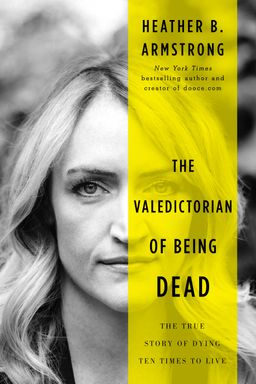
How far would you go to save your own life when living feels unbearable? In The Valedictorian of Being Dead, Heather B. Armstrong transforms this haunting question into an astonishing act of courage and science. Armstrong—known for her pioneering role as a famous blogger on motherhood and raw honesty—dives into one of the most controversial experiments in mental health treatment: undergoing ten medically induced near-death experiences to cure her treatment-resistant depression. Her journey, equal parts fearless memoir and social critique, examines the boundaries of morality, science, family, and survival.
At its heart, the book argues that when the mind becomes your enemy, radical compassion and scientific innovation can become salvation. Armstrong contends that severe depression is not a character flaw but a disease that requires as much courage and ingenuity to treat as cancer. Her propofol-induced comas—where her brain literally flatlined—symbolize both destruction and rebirth. What makes the book so gripping is not just her descent into darkness but her reemergence into light: rediscovering laughter, motherhood, and music after eighteen agonizing months of wanting to die.
The Science of Resurrection
Armstrong’s narrative centers on the experimental study led by Dr. Brian Mickey and Dr. Lowry Bushnell at the University of Utah Neuropsychiatric Institute. Instead of electroconvulsive therapy (ECT), which involves controlled seizures, this study used propofol anesthesia to induce a burst suppression state—temporary brain silence. The hypothesis: by bringing the brain to near-death, it could reboot the neural circuitry responsible for depression—not unlike turning off and on a malfunctioning computer. Armstrong’s description of these sessions, her mother watching her lifeless body, and her own near-absurd calm convey both the terror and hope embedded in modern psychiatry.
Depression Without Romance
Unlike many memoirs that aestheticize suffering, Armstrong strips depression of glamour. She portrays it as mechanical paralysis—crying in closets while whispering, “I only have two hands.” It’s a visceral display of daily collapse rather than abstract psychology. She spares the reader nothing: anxiety as acid burns through her veins each morning she wakes alive again; the alienation of single motherhood under exhausting demands; the corrosion of body image and relationships. These confessions—funny, inappropriate, haunting—make her survival deeply human and deeply relatable for anyone who’s ever felt crushed beneath their own thoughts.
Faith, Family, and the Science of Hope
Armstrong’s Mormon upbringing collides with her secular salvation. Her mother prays to Jesus while Heather prays to science. Their contrasting faiths form one of the book’s most moving dynamics: her mother symbolizing spiritual redemption while Heather seeks pharmacological resurrection. This interplay between religion and medical science shows how both attempt to answer the same question—how to save a soul. Yet Armstrong’s narrative honors both equally: the mother’s belief in divine intervention and the daughter’s belief in neurons, anesthesia, and data.
Why It Matters Today
In an age where depression affects hundreds of millions yet remains stigmatized, Armstrong’s experiment feels revolutionary. She goes where few would dare—to the frontier of death—to ask whether science can truly rewire despair. Her candor about suicide ideation, parenting through misery, and rebuilding after recovery offers readers radical empathy. She reminds us that wanting to die is not a moral failure but a medical emergency—and that healing may demand both innovation and surrender.
Armstrong’s Core Message
“Depression convinced me that my children would be better off without me. Science taught me that the brain can lie.” Her story is not just survival—it’s a manifesto against the silence surrounding mental illness.
Through humor, grief, and dazzling resilience, Heather Armstrong proves that death was not her escape—it was her doorway back to life. She doesn’t glorify the abyss but transforms it into proof that hope, whether divine or medical, can resurrect even the most broken mind.