
Idea 1
Why We Sometimes Need Delusion to Survive
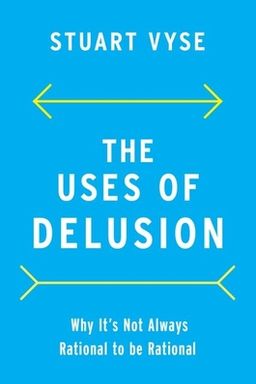
Have you ever clung to a comforting thought you knew wasn’t entirely true — just to stay afloat? In The Uses of Delusion: Why It’s Not Always Rational to Be Rational, behavioral scientist Stuart Vyse suggests that some of our irrational beliefs aren’t merely flaws in our reasoning. They’re survival tools. He argues that, while logic and evidence guide many of humanity’s greatest achievements, there are crucial moments when reason fails us — when self-deception, optimism, or faith can be more useful than fact.
Vyse has spent his career promoting rational thinking, writing for skeptical audiences and debunking superstition. Yet this book marks a bold shift. Drawing from psychology, philosophy, and lived experience, he contends that “useful delusions” — beliefs that defy evidence yet help us function — can make life bearable, relationships meaningful, and societies cohesive. Humans, he notes, are the only creatures deeply aware of mortality and capable of contemplating their own behavior. That intelligence creates paradoxes: we reason ourselves into anxiety, guilt, and despair. Delusion, then, can act as an emotional buffer.
Reason vs. Resilience
The heart of Vyse’s thesis lies in the tension between two mental operating systems popularized by psychologist Daniel Kahneman: System One, quick and intuitive, and System Two, deliberate and analytical. System Two may calculate probabilities or remind you that the lines in the Müller-Lyer illusion are equal in length — but System One will still insist one line looks longer. This stubbornness isn’t always a problem. Some biases are hardwired — perceptual or emotional illusions so powerful they persist even when we know the truth. Others, like optimism or overconfidence, we can learn to modulate.
Vyse suggests that our dual-system mind explains why rational models alone can't capture human behavior. Economists, he notes, long assumed people were rational actors optimizing self-interest. Behavioral economics dismantled that myth by proving that intuition often overrides logic — sometimes disastrously, but not always. Our irrational tendencies can harm us (as in ratio bias or superstition) yet also protect us from crushing emotional truth, as Joan Didion described in The Year of Magical Thinking when she kept her deceased husband’s shoes, believing he might still return.
The Pragmatic Case for Unreason
Vyse aligns his thinking with William James’s “pragmatism,” which valued beliefs not for their correspondence with reality but for their practical consequences. If an illusion helps us live a better life — by motivating us, sustaining hope, or preserving connection — it may be rational in a broader sense. James once claimed that, if believing an idea led to a better existence, it was really better for us to believe it. Vyse extends this argument: delusions about love, health, religion, and even free will can, paradoxically, make us more functional humans.
His position echoes psychologist Jonathan Baron’s view that rational thinking is defined by what helps us achieve our goals. If following logic made us perpetually miserable, how rational would that be? The “uses of delusion” are not calls to abandon reason but an invitation to see irrationality as part of our biological and cultural design — one that often supports resilience when cold logic would leave us paralyzed.
The Spectrum of Delusion
Throughout the book, Vyse distinguishes between harmful distortions — like flat-Earth conspiracies or gambling biases — and beneficial ones that encourage persistence or emotional balance. He surveys a range of contexts in which delusion helps: self-flattering beliefs that sustain confidence, optimism that fuels motivation and health, religious or superstitious rituals that provide comfort and control, and romantic idealization that binds couples together. He also pushes further, into philosophical territory, asking whether our most cherished sense — of being conscious, consistent selves with free will — might itself be a helpful illusion.
This central question reframes irrationality as a human advantage. Other animals act instinctively, without contradiction; we live with internal paradox. To survive, we sometimes need stories that make sense of chaos. As Vyse writes, our delusions are not always bugs in our mental software. Occasionally, they’re features — traits evolution kept because they worked.
Why This Matters
In an era obsessed with truth and misinformation, Vyse’s message is deliberately provocative. He warns that while political and conspiratorial delusions can be destructive, other illusions — such as faith in love, hope for recovery, or a belief in personal freedom — are vital for mental health and moral functioning. The challenge is not to eliminate irrationality but to recognize its double edge: it can both save and ruin us.
By exploring grief, optimism, superstition, love, identity, and free will, Vyse offers a sweeping psychological portrait of humanity as a species that needs both truth and tender falsehoods. The Uses of Delusion ultimately invites you to accept your mind’s contradictions — to appreciate how sometimes not knowing, not accepting, or not seeing clearly helps you live more fully. Rationality may illuminate the world, but delusion, it turns out, keeps us human.