
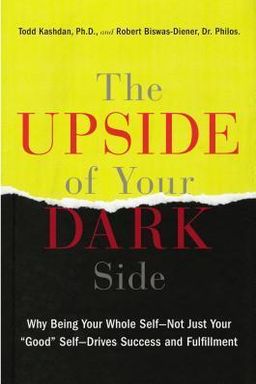
The Upside of Your Dark Side cover

The Upside of Your Dark Side

by Todd Kashdan and Robert Biswas-Diener

Explore how embracing your darker emotions like anger and anxiety can lead to success and fulfillment. Backed by scientific studies, this book challenges the pursuit of constant happiness, advocating for emotional wholeness instead.

Wholeness: Embracing the Full Range of Human Emotions

What if the key to living a meaningful, successful, and happier life wasn’t positivity at all—but embracing your discomfort, anger, and even fear? In The Upside of Your Dark Side, psychologists Todd Kashdan and Robert Biswas-Diener argue that society’s obsession with happiness is misguided. They contend that true fulfillment comes not from staying positive but from becoming whole: developing the ability to use your entire range of emotions—dark and light alike—to thrive in life’s unpredictable situations.

Instead of promoting endless optimism, Kashdan and Biswas-Diener propose a bold alternative: psychological flexibility, the skill of adapting emotionally, mentally, and socially to whatever life throws at you. They show how anger can fuel courage, anxiety can sharpen awareness, guilt can deepen compassion, and even mindlessness can spark creativity. Their central argument is powerful: if you suppress negative experiences, you also limit your capacity for growth, innovation, and genuine happiness.

The Happiness Trap

We live in what the authors call the age of “smiling fascism”—a cultural era where happiness is treated as the ultimate goal. Positive psychology, social media, and corporate wellness programs reinforce the notion that one must be upbeat to be successful. Yet, Kashdan and Biswas-Diener show that this relentless pursuit has backfired: anxiety rates are rising, emotional tolerance is fading, and society is becoming addicted to comfort. People chase immediate pleasure while avoiding discomfort, but the cost of this comfort addiction is psychological weakness—the inability to face, tolerate, and learn from pain.

The Promise of Wholeness

Wholeness, as defined by the authors, is not simply balance—it’s completeness. It’s the ability to draw strength from both sides of your emotional spectrum. A whole person doesn’t reject sadness or frustration; they understand how those emotions can serve their goals. Think of anger used by civil rights leaders like Martin Luther King Jr., or the fear that keeps us vigilant in dangerous situations. Wholeness allows you to become mentally agile—choosing the right emotional tool for the right moment instead of defaulting to positivity.

The 80:20 Rule of Emotional Agility

Kashdan and Biswas-Diener introduce what they call the “20 percent edge.” Research across psychology suggests that while most people function best in positive states about 80 percent of the time, the remaining 20 percent—those darker, uncomfortable emotions—provide the finishing touch that enables excellence. This balance between happiness and hardship leads to emotional agility, the capacity to shift perspectives and emotions fluidly. Wholeness is not about avoiding pain; it’s about recognizing when fear, guilt, or anger can improve performance and deepen meaning.

From Comfort Addiction to Psychological Resilience

As society grows wealthier and technology eliminates inconvenience, people have become psychologically fragile. The authors trace what they call the “rise of the comfortable class”: Americans increasingly view comfort as a moral good and discomfort as a problem to solve. Yet children raised in this culture are less resilient, parents hover protectively, and adults panic over small frustrations. By contrast, older generations and many non-Western cultures embrace hardship as essential to strength (In The Happiness Hypothesis, Jonathan Haidt similarly argues that meaning often arises from struggle and suffering). Kashdan and Biswas-Diener challenge you to reframe discomfort as an opportunity for growth.

Why You Need the Dark Side

The authors present remarkable evidence showing how negative emotions drive success. Anger boosts courage and negotiation power. Anxiety fine-tunes attention and decision-making. Guilt fosters stronger social bonds and prevents reckless actions. Even sadness can heighten analytical thinking and memory. By labeling these states “bad,” we throw away half our psychological toolkit. True mastery comes from learning to wield both light and dark emotions instinctively and effectively.

What You’ll Learn from This Book

Across the seven chapters, the authors explore core principles of psychological wholeness:

  • Why pursuing happiness can actually make you unhappy—and how emotional time-travel mistakes warp your reality.
  • How comfort addiction erodes resilience, and why learning from discomfort builds mental toughness.
  • How negative emotions like anger, guilt, and anxiety serve important evolutionary and social functions.
  • Why “mindlessness,” far from being a flaw, enhances creativity and decision making when used strategically.
  • How dark personality traits—Machiavellianism, narcissism, and psychopathy—can amplify leadership and courage in healthy ways.
  • And finally, how integrating the light and dark aspects of your emotions leads to wholeness—a deeper form of happiness grounded in authenticity, growth, and meaning.

Ultimately, The Upside of Your Dark Side challenges the biggest psychological myth of modern times: that happiness means the absence of pain. Kashdan and Biswas-Diener want you to stop chasing happiness and start cultivating wholeness—a richer, tougher, and more resilient state of mind that accepts life in its full complexity.


The Myth of Comfort

Why do so many people chase comfort—even when it quietly destroys their ability to handle life’s challenges? Kashdan and Biswas-Diener call this modern phenomenon the rise of the comfortable class. In their view, Western culture has become addicted to convenience. We equate comfort with success: thermostats, smartphones, air conditioning, and ergonomic chairs keep us insulated from discomfort, but also disconnected from growth.

The Cost of Comfort Addiction

Research reveals that material abundance leads people to use external tools to soothe internal states. We turn to entertainment to fight boredom, medications to manage sadness, and technology to dodge frustration. The authors cite studies showing that since the 1970s, Americans have increasingly labeled luxuries as “necessities.” Comfort became a moral value. Yet the result is an epidemic of anxiety and fragility—what psychologist Jean Twenge calls “generation me.”

Comfort weakens what Kashdan and Biswas-Diener term your psychological immune system. Just as overusing antibacterial soap lowers your physical immunity, excessive avoidance of discomfort lowers your mental resilience. When everything feels easy, even minor setbacks—a traffic jam, a harsh email—trigger outsized distress. Comfortable living breeds impatient minds.

The Rise of Experiential Avoidance

Comfort addiction feeds into what psychologists now call experiential avoidance: the tendency to bury or escape unwanted thoughts and emotions. Instead of facing anxiety, people binge-watch TV or scroll endlessly. Kashdan and Biswas-Diener note that this avoidance becomes self-reinforcing: the less you confront discomfort, the weaker your ability to handle it next time. This phenomenon, studied by Steven Hayes’s Acceptance and Commitment Therapy (ACT), underlies many modern disorders—from depression to substance abuse.

“Avoiding discomfort may seem like sanity in the moment, but over time it erodes your capacity to live meaningfully.” —Todd Kashdan & Robert Biswas-Diener

Learning to Embrace Discomfort

The antidote is what the authors call distress tolerance—your ability to sit with uncomfortable emotions without fleeing. They cite Acceptance and Commitment Therapy’s approach: rather than changing your feelings, focus on acting according to your values instead. You are not your thoughts or emotions; you can observe them without being controlled by them. This mental stance builds resilience and allows you to function well even when anxious or afraid.

Children and the Comfort Paradox

Kashdan and Biswas-Diener apply this insight to parenting. Modern parents, driven by fear, micromanage children’s experiences—from playground safety to emotional “safeguarding.” But shielding kids from frustration robs them of self-reliance. Studies show that children deprived of risk play and independence grow up anxious, indecisive, and less creative. Ironically, overprotection is its own form of harm. (Comparatively, Angela Duckworth’s concept of “grit” emphasizes that resilience develops through trial, not ease.)

Lessons from Other Cultures

In contrast, collectivist cultures—especially in East Asia—value suffering as a teacher. Studies cited in the book show that Koreans and Japanese associate happiness not with pleasure but with peace and endurance. These societies encourage emotional restraint and acceptance. Americans, in contrast, equate happiness with excitement and comfort. The authors challenge readers to learn from this Eastern wisdom: discomfort can co-exist with harmony, and it often leads to psychological depth.

When you stop fighting discomfort and start embracing it, you break free of comfort addiction. You reclaim the inner toughness that allows you to grow through hardship—a strength that defines wholeness, not just happiness.


The Hidden Power of Negative Emotions

We’ve been taught to fear emotions like anger, anxiety, guilt, and sadness—but these so-called negative feelings are powerful tools for growth. Kashdan and Biswas-Diener show that “bad” emotions can help you make sharper decisions, perform better, and deepen relationships. Their message: when you reject discomfort, you reject your most potent sources of wisdom.

Anger: Energy for Courage and Justice

Instead of being destructive, anger serves as a catalyst for meaningful action. The book describes how Pat Riley’s deliberate fury motivated his unfocused Lakers players to victory, and how civil rights leaders harnessed righteous anger to fuel change. Anger signals that your boundaries are being violated and mobilizes you to defend them. In controlled doses, it increases optimism, risk-taking, and creativity. Experiments revealed that angry people took bolder risks and made more persuasive arguments than neutral participants. The key, however, is channeling anger strategically—not explosively.

Guilt: The Moral Compass

Unlike shame, which attacks your entire identity, guilt targets specific behaviors. Feel guilty about lying? You can correct it; feel shame about being “a liar”? You spiral. Guilt motivates repair, empathy, and better judgment. The authors share psychologist June Tangney’s research showing that guilt-prone inmates were less likely to reoffend after release because they took responsibility for their actions. Guilt keeps you connected to your values—it hurts, but it heals.

Anxiety: The Sentinel of Survival

Anxiety sharpens awareness, improves performance, and prevents disaster. Kashdan and Biswas-Diener define highly anxious individuals as “sentinels” who detect problems early, gather crucial information, and sound alarms before others notice danger. In many workplaces, these anxious employees are undervalued—but they’re vital for safety and innovation. Moderate anxiety keeps you focused and socially attuned. Rather than suppressing it, learn to use its energy for preparation and vigilance.

Sadness and the Gift of Reflection

Sadness often improves accuracy and thoughtfulness. Experiments show that mildly unhappy people generate stronger arguments, detect lies more accurately, and recall details better than their upbeat peers. Happiness encourages quick, broad-brush decisions; sadness encourages depth and precision. Sometimes being “a little down” helps you think more clearly—a cognitive advantage for tasks requiring attention, empathy, or moral reasoning.

From Guilt to Growth

The authors teach simple tools for using negative emotions constructively. One is the “discomfort caveat”—open a difficult conversation by admitting discomfort (“I’m upset, so it’s hard to express this, but it’s important I do”). This honesty disarms defensiveness, preserves relationships, and turns anger into dialogue. Another is the “speedometer technique”, where you measure your anger like a car’s speed. Slowing down emotional acceleration lets logic guide your next move.

Emotional Agility: Integrating All Feelings

At the heart of these examples lies emotional agility: the ability to use emotions—not control them—to navigate life. Kashdan and Biswas-Diener echo the work of psychologist Susan David, emphasizing that emotional diversity is a sign of health, not instability. Every feeling offers information. By welcoming anger, guilt, and anxiety instead of exiling them, you expand your range of adaptive strategies—and move closer to genuine wholeness.

If you dare to harness discomfort rather than flee from it, your darkest emotions become your deepest sources of strength.


Beyond Mindfulness: The Value of Mindlessness

Mindfulness has become a modern obsession—but Kashdan and Biswas-Diener argue that sometimes the opposite—mindlessness—is exactly what you need. While mindfulness promotes calm awareness, mindlessness taps into the unconscious wisdom that allows creativity, intuition, and quick problem solving. The authors reveal how alternating between these states builds superior psychological flexibility.

Harnessing Autopilot

Much of life runs on automatic pilot: walking, driving, interacting. This unconscious processing—even snap judgments—can be surprisingly accurate. Studies show people form reliable impressions in one-tenth of a second. Kashdan and Biswas-Diener explain that automatic thinking saves mental energy and enhances social safety. For instance, subtle body-temperature cues and mimicry instincts help us detect trustworthy interactions long before conscious analysis kicks in.

Mindless Emotion Regulation

Emotion control can also operate beneath awareness. In experiments, participants exposed to words like “restrain” or “cool” remained calmer when provoked—proving that unconscious cues help regulate emotional reactions. Instead of endlessly monitoring your feelings, the authors suggest priming yourself with reminders of patience and composure. Training your subconscious to respond intelligently minimizes stress more efficiently than constant self-analysis.

Mindlessness Sparks Creativity

Innovation often arises when your mind drifts. Psychologist Scott Barry Kaufman—cited by the authors—calls mind wandering “constructive.” Doodling, shower thoughts, and short naps activate brain circuits that combine ideas in novel ways. NASA even found that pilots who take brief naps improve decision-making accuracy by 34 percent afterward. Allowing your brain to “go offline” lets unconscious incubation generate creative leaps that deliberate focus cannot.

Mindless Decision-Making

Complex decisions often benefit from unconscious processing. Dutch psychologist Ap Dijksterhuis discovered that people distracted before choosing between apartments made better choices than those who deliberated. The ideal pattern? First reflect consciously, then disengage and let the unconscious integrate information. Kashdan and Biswas-Diener summarize the formula: think briefly, distract yourself, then decide. Combining mindfulness and mindlessness optimizes results.

Priming Success Without Awareness

Mindless interventions can even improve performance automatically. In one call-center study, workers who looked at a photograph of smiling telemarketers increased pledges by 85 percent—without realizing why. Unconscious priming shapes behavior without effort. By designing environments that cue success (images, words, symbols), you can harness mindlessness as a silent ally.

Mindlessness isn’t stupidity—it’s your brain’s efficient autopilot. When you balance it with mindful awareness, you access hidden intelligence that keeps you productive, creative, and emotionally stable in a complex world.


Dark Traits and the Teddy Roosevelt Effect

What if being fearless, manipulative, or self-confident could actually make you a better leader? Drawing on Theodore Roosevelt’s bold personality, Kashdan and Biswas-Diener explore what they call the Teddy Effect: the ability to strategically use dark traits—Machiavellianism, narcissism, and psychopathy—for socially constructive outcomes.

Fearlessness and Grandiosity

Psychologist Scott Lilienfeld’s research on U.S. presidents found that those scoring higher in “fearless dominance”—a mild psychopathic trait—performed better in crises, negotiated effectively, and inspired confidence. Roosevelt ranked first in fearlessness and second in narcissistic confidence. His willingness to bend rules and embrace aggression led to extraordinary achievements—winning the Nobel Peace Prize, exploring the Amazon, and founding the National Park System. The authors argue that healthy use of dominance and grandiosity enables decisive leadership.

The Dark Triad—Used Wisely

Machiavellianism builds strategy and emotional detachment; narcissism fuels ambition and charisma; and psychopathy cultivates composure under pressure. These traits, often maligned, can give you a competitive edge if tempered with empathy and integrity. A dentist quoted in the book describes turning off emotions during painful procedures—not cruelty, but professional focus.

Manipulation Reimagined

The authors redefine manipulation as influence. Everyone manipulates—parents persuading children, managers motivating teams, negotiators framing arguments. They illustrate this through police officer Adam Morengo, who de-escalated gang conflict in Portland by calmly negotiating rather than threatening force, using respect and psychological tact as tools of control. Hard influence (assertive action) and soft influence (charm or guilt) both have their place; effective leaders switch between them as context demands.

Creativity Through Controlled Narcissism

Research from Cornell University shows that teams with two narcissists—not one—produce the most creative ideas. Their defiance of norms and hunger for recognition inspire risk-taking others shy away from. (Michael Maccoby’s The Productive Narcissist similarly describes this leadership style.) The key lesson: self-confidence and desire for admiration can motivate innovation when balanced with collaboration.

Kashdan and Biswas-Diener warn against unbridled egotism but urge you to stop demonizing ambition and toughness. When integrated with compassion, your inner Teddy Roosevelt—bold, daring, and unapologetically authentic—becomes a powerful driver of growth and influence.

Dark personality traits are not moral defects; they’re psychological tools. Wholeness means knowing when to be kind and when to be fierce—and using both with purpose.


Balancing Pleasure, Meaning, Novelty, and Stability

After exploring the dark side, Kashdan and Biswas-Diener present a roadmap for lasting fulfillment. Happiness, they insist, isn’t one-dimensional—it’s a dance between pleasure and meaning, novelty and stability. The secret lies in mastering these opposing forces through psychological flexibility.

Pleasure and Meaning: Short-Term Joy vs. Long-Term Purpose

Pleasure gives joy now; meaning gives direction later. Psychologist Roy Baumeister’s research supports this duality: pleasure is present-oriented, meaning is future-oriented. Kashdan and Biswas-Diener found that people naturally prefer short-term pleasure but long-term meaning—their “psychological seesaw.” The trick is to live intentionally with both: enjoy your daily coffee (pleasure) while pursuing goals that enrich others (meaning). They showcase this formula as Pleasure + Growth + Sacrifice = Wholeness.

Novelty and Stability: The Yin and Yang of Experience

You crave adventure and change, yet also familiarity and security. Research cited from Shigehiro Oishi shows that retirees who once dreamed of novelty end up valuing routine. Kashdan and Biswas-Diener identify boredom as an emotional signal—a push toward novelty. Similarly, anxiety warns of too much change. Balancing both creates vitality and self-awareness. Embrace boredom as fuel for curiosity, much like naturalist E. O. Wilson described his slow contemplation as key to discovery.

Cultivating Flexibility Through Time Perspective

The authors encourage alternating between fast and slow mental modes. Novelty brings “fast time”—immersion and excitement; stability offers “slow time”—reflection and depth. Measuring your life through awareness rather than smoothness transforms boredom and anxiety into productive emotions. This mirrors Viktor Frankl’s insight in Man’s Search for Meaning: meaning arises in tension, not comfort.

Embracing Imperfection

The authors end by invoking Gandhi—not as a saint above human flaws, but as an example of integrated imperfection. Wholeness means acknowledging contradictions: love and frustration, success and failure. It’s not balance—it’s acceptance of complexity. In their closing metaphor, they describe “Aquaman” as the symbol of wholeness: a hero powerful in his domain yet smart enough to rely on allies on land. Success, they say, comes from agility between worlds, emotions, and selves.

To live a whole life, don’t seek comfort, certainty, or constant joy. Seek depth. Use pleasure to recharge, meaning to guide, novelty to grow, and stability to anchor. Together, these create the psychological ecosystem of wholeness.

Dig Deeper

Get personalized prompts to apply these lessons to your life and deepen your understanding.

Go Deeper

Get the Full Experience

Download Insight Books for AI-powered reflections, quizzes, and more.