
Idea 1
Upcycling a Life
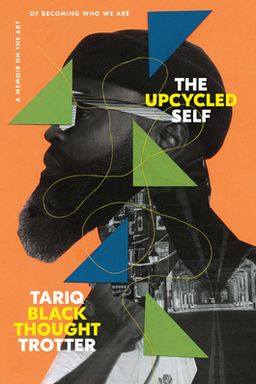
What would it look like if you could turn your hardest losses into fuel? In The Upcycled Self, Tariq Trotter—better known as Black Thought of The Roots—argues that healing and greatness come from “upcycling” your past: salvaging the broken pieces of childhood, family, place, and pain, then recombining them into a stronger, truer self. He contends that identity is a call-and-response between the child you were and the adult you choose to become—and that answering that call means facing your shadows, honoring your people in their full complexity, and translating trauma into art, work, and responsibility.
This story unfolds as both memoir and method. It opens with literal fire—the six-year-old boy who accidentally burns down his family’s Mount Airy home—and follows the cascade: a mother altered, a brother arrested, and a child who learns to get small, work hard, and watch closely. The book then maps two Philadelphias—leafy, communal Mount Airy and concrete, combustible South Philly—each stamping its code into the author’s nervous system. From there, it tracks how art (drawing, encyclopedias, dictionary word games, graffiti, rap) became his survival engine, how a city’s underbelly (police under Rizzo, neighborhood mafias, crack’s devastation) made him hyper-alert, and how mentors (Jane Golden, Arthur Price) and collaborators (Ahmir “Questlove” Thompson, manager Rich Nichols) became scaffolding for a public self rooted in private discipline.
A Communal Self, Not a Self-Made Man
Trotter’s core claim is countercultural: your “self” is communally built. Parents, grandparents, uncles and aunts, corner sages, teachers, and even betrayers all shape you. He resists easy sainthood or villainy for the adults who raised him—his mother Cassie’s ferocious love and addiction, his father Tommy’s gangster brilliance and early murder, the tenderness and violence of men like James Black and Brother Faheem—and asks you to hold people whole. This stance echoes James Baldwin’s insistence that love begins with rigorous honesty, and resonates with Kiese Laymon’s Heavy in how it refuses to sanitize family truth.
Art as Alchemy, City as Curriculum
If there is a method here, it’s creative alchemy. Visual art, the Mann Center’s summer classes, and Fleisher Art Memorial gave him tools to organize attention and emotion. Graffiti schooling (Cornbread’s legacy, rooftops and tunnels, the Anti-Graffiti Network, Jane Golden) taught risk, resourcefulness, and consequence. Rap became his language of precision: dictionary duels with cousin Shawn Gee, breath control learned while literally outrunning danger, a painstaking ear trained by Rakim and local emcees. The city—its alleys, railroad tracks, borders, and brawls—functioned as a living conservatory. (See also Angela Duckworth’s Grit on sustained practice, and Steven Pressfield’s The War of Art on creative discipline.)
Partnership, Patience, and the Long Game
Trotter’s bond with Ahmir Thompson (Questlove) is the book’s hinge. They meet at CAPA (the arts high school), exchange musical contraband (N.W.A. one way, rare jazz breaks the other), and start building a band. Their differences—Ahmir’s padlocked, practice-obsessed home versus Tariq’s street-exposed life—create a powerful complement. Together with the late Rich Nichols, they take a “long game” approach: busk anywhere, do every show, build evidence. When a stolen boombox (and their first demo) or a credit omission triggers conflict, they learn to unlearn South Philly’s fight code and practice strategic patience. You see how a city’s survival skill can become a career liability—and how choosing differently opens doors (compare Questlove’s Mo’ Meta Blues for a parallel vantage).
Crack, Catastrophe, and Radical Acceptance
The book’s darkest passages confront the crack epidemic’s ruthless math. Adolescents become dealers with BMWs; elders, clergy, and neighbors slip into addiction; boundaries collapse. Trotter’s mother disappears into that vortex; his attempts to save her culminate in him shooting out a crack-house window in grief and rage. Later, her murder—and the retraumatizing ordeal of two trials—forces a choice: be stopped by death, or be driven by it. He chooses to transmute grief into craft and responsibility, aligning with Viktor Frankl’s Man’s Search for Meaning in using suffering as purpose fuel.
The Upcycle: A Working Definition
Take inventory of your “scraps” (losses, shames, near-misses). Clean and sort them without denial. Reuse what’s foundational (craft, community, conscience). Release what no longer serves (self-sabotaging codes, inherited scripts). Reassemble into a design stronger than the original. Repeat for each season of life. (Note: Trotter explicitly cites Clarissa Pinkola Estés’s Life/Death/Life cycle from Women Who Run with the Wolves.)
Why does this matter? Because you, too, carry broken pieces. The Upcycled Self gives you a lived blueprint—how to honor the people who made you without mythologizing them, how to stay loyal to place without letting its worst lessons run your life, and how to alchemize pain into creative power and communal responsibility. In the pages ahead, you’ll move through the fire that formed him, the family that complicated and protected him, the two Phillys that coded him, the art that saved him, the partnership that elevated him, the epidemic that nearly broke him, and the purpose that steadied him.