
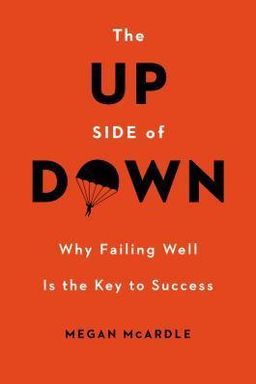
The Up Side of Down cover

The Up Side of Down

by Megan McArdle

The Up Side of Down by Megan McArdle reveals how failure is not the end, but a powerful tool for success. With actionable insights, the book guides readers on how to embrace and learn from their failures, transforming setbacks into stepping stones for personal and societal growth.

The Power of Failing Well

Failure is not the end of the story—it’s the mechanism by which you learn, adapt, and eventually succeed. In The Up Side of Down, Megan McArdle argues that the ability to fail well is one of the most important yet underdeveloped human skills. She blends neuroscience, social science, economics, and personal narrative to show why individuals, institutions, and societies should design for recoverable failure rather than trying to avoid it altogether.

Through vivid examples—from Peter Skillman’s “Spaghetti Problem” to the HOPE probation experiment, bankruptcy law, and the brain’s own wiring—McArdle’s core claim is simple but radical: every durable success rests on the capacity to encounter error, learn quickly, and adjust before catastrophe strikes.

Why failure builds skill and adaptability

Neuroscientist Jeff Stibel calls the brain a “failure machine.” Dopamine strengthens neural patterns that match expectations and weakens those that don’t, making trial and error the biological essence of learning. In Skillman’s design experiment, kindergarteners built taller marshmallow towers than engineers because they treated failure as feedback. Repeated attempts—small mistakes, fast corrections—beat perfect plans.

This principle scales. Entrepreneurs like Jim Manzi turned near-collapse at Applied Predictive Technologies into survival by pivoting fast under pressure. Manzi’s rule—take small, reversible bets and iterate relentlessly—emerges throughout McArdle’s analysis. Failure is data. The faster you collect it, the faster you can improve.

The mindset that sustains learning

Carol Dweck’s “growth mindset” research shows that how you interpret ability determines how you respond to setbacks. If you believe talent is fixed, failure threatens identity; if you believe ability grows with effort, failure becomes practice. McArdle weaves Dweck’s findings through stories of procrastinating writers, students who self-handicap, and professionals paralyzed by impostor syndrome. The cure is permission to be bad early—to praise process, not innate brilliance, and to normalize mistakes as steps toward mastery.

The cultural complement to Dweck’s psychology appears in Stibel’s corporate experiments: offices full of quotations about failure, reviews that ask “Have you failed enough?” It’s deliberate re-engineering of norms to make trial and correction safe.

The danger of the “Whiffle Life”

Society’s attempt to eliminate small risks often produces fragile adults. McArdle’s “Whiffle Life” describes an over-protective world of helicopter parenting, grade inflation, and credential obsession. Kids raised without failure enter adulthood untested, easily demoralized, and poorly equipped to handle feedback. Systems that suppress minor mistakes—schools, bureaucracies, even playground designs—make individuals brittle. Resilience arises only from repeated exposure to discomfort and recovery.

For poor families, the problem reverses: they experience too many failures without safety nets. The solution isn’t insulation but structured recoverability—institutions that allow mistakes to be fixed, paths to be retried, and effort to be rewarded. Video-game models (short levels, frequent saves) illustrate how controlled risk trains persistence without lasting damage.

From personal to systemic failure

McArdle scales up from human error to market and institutional collapse. Vernon Smith and Bart Wilson’s lab markets show that success requires not only rules but shared moral culture; without trust and communication, markets disintegrate. Similarly, crises—from GM’s decline to Solyndra’s political fiasco—reveal how normalcy bias and sunk-cost thinking prevent necessary course corrections. Organizations value stability and reputation, even as data signal decline. “Groupidity”—herd-like escalation—is the result.

Whether it’s Dan Rather’s journalistic blind spot or policymakers’ unwillingness to admit early failure, the pattern repeats: denial multiplies damage. The Swiss Cheese Model of medicine illustrates this perfectly—catastrophe occurs only when multiple small, recoverable mistakes align. Systems that detect and correct early are the ones that survive.

Designing for recovery and forgiveness

What separates thriving cultures from stagnant ones isn’t the absence of failure but the ability to recover gracefully. The HOPE probation program, which uses swift, small sanctions, teaches that consistent consequences change behavior better than draconian punishments. Similarly, America’s forgiving bankruptcy laws encourage entrepreneurship by making risk survivable. The paradox: when forgiveness coexists with cultural restraint, it boosts accountability and innovation simultaneously.

Housing First programs apply the same logic socially—providing unconditional shelter reduces long-term costs by preventing spirals of compounded failure. Systems that allow resets, whether personal or institutional, transform error from fatal to formative.

Practical resilience: hedging your life

The book culminates in a pragmatic philosophy: hedge against failure. Reduce fixed commitments so you can take meaningful risks. McArdle recommends paying down debt, keeping liquidity, and choosing homes and careers you can afford to fail in. Emotional hedging counts too—build identity across multiple domains so no single setback defines you. When you design a life that can absorb failure, you unlock the freedom to pursue ambitious goals without fear of collapse.

The essential argument of The Up Side of Down: mistakes are not only inevitable but necessary. A successful life, organization, or nation depends less on avoiding error than on building systems that learn and reset well.

McArdle’s synthesis—from brain chemistry to bankruptcy court—forms one coherent message: fail early, fail smart, fail small, and keep moving. Failure is painful, but it’s also how progress happens.


Learning Engines: Brains, Teams, and Markets

McArdle places learning by failure at the center of both human and organizational growth. Your brain, she explains, is a self-repairing learning engine—wired by evolution to improve through mistakes. Each time you make an error, neurological feedback weakens wrong pathways and strengthens right ones. Dopamine is less a pleasure molecule than a teaching signal, guiding you toward optimal patterns through the rhythm of error and correction.

The Spaghetti Problem: fail early, succeed soon

Peter Skillman’s “Spaghetti Problem” dramatizes this truth. When groups compete to build a spaghetti tower supporting a marshmallow, kindergartners outperform engineers because they prototype early, fail quickly, and adjust rapidly. Adults treat failure as shame; children treat it as data. The takeaway is practical: iteration beats deliberation. In design, entrepreneurship, and life, rapid, low-cost learning loops yield better outcomes than perfect upfront plans.

Failure-friendly environments

Jeff Stibel’s company practiced “heroic failure”: employees were required to document their mistakes, not hide them. This cultural engineering transformed error from stigma into fuel. McArdle connects this to Jim Manzi’s pivot story—when his startup nearly crashed, failure forced creative adaptation that eventually made it successful. The lesson extends to economic and policy design: create small, reversible failures that produce fast feedback before catastrophe.

If your system punishes small mistakes harshly, it guarantees large ones later. Every resilient system—biological, corporate, or social—learns through minor breakdowns.

Markets as adaptive learning systems

Economist Vernon Smith’s lab markets show similar patterns. When participants communicate and share norms, markets quickly converge toward equilibrium. When they fail to build trust, markets collapse. Learning requires not just data, but social context—rules, moral culture, and shared expectations. Bart Wilson’s experiments on deregulated electricity markets mimic real-world failures like Enron: absent moral scaffolding, incentives drive manipulative behavior.

You can’t separate markets from morality. Systems that teach through error depend on norms that make it safe to err and repair. Markets, like brains and teams, thrive when feedback channels remain open—and collapse when pride, fear, or bureaucracy block correction.


Why Denial Destroys Before Failure Does

McArdle explores the psychology that keeps people and organizations trapped in failure long after warning lights flash. We don’t lack information—we lack willingness to interpret it honestly. The culprits are normalcy bias, sunk-cost thinking, and groupidity, her term for collective irrational escalation.

Normalcy bias and the freeze response

In crises—fires, financial crashes, or personal disasters—people prefer to act as if everything is normal. The World Trade Center survivors, airlines passengers, and failing CEOs share this reflex. Talking instead of fleeing, questioning instead of deciding, they waste crucial minutes or years. McArdle shows that organizations display identical paralysis: GM managers ignored decline because admitting failure endangered reputation and jobs.

Sunk costs and escalation

Once you’ve invested years of effort or billions of dollars, quitting feels impossible. Solyndra’s executives kept building even as market signals turned hostile. Individuals do this too—staying in bad relationships or doomed projects—preferring familiar pain to the shame of reversal. These are emotional failures of decision-making, worsened by pride and social approval.

Groupidity and institutional self-deception

Groups magnify delusion. In CBS’s Killian Memo debacle, journalists dismissed contradictory data because the story fit their priors. Laurence Gonzales’s phrase “bending the map” captures this tendency to force reality to match expectations. McArdle parallels this with Richard Feynman’s critique of NASA’s Challenger disaster: optimism and bureaucracy redefined safety thresholds to excuse known faults. Denial, not error, killed astronauts.

Admitting error early is not humiliation; it’s the gateway to repair. Slow confession compounds failure until recovery costs become unbearable.

McArdle’s cure is institutional humility: create trigger points that force review, build external audits, and valorize quick retraction. Whether you’re a CEO or a journalist, fast admission turns disasters into learning events instead of final chapters.


Failure in Systems and the Swiss Cheese Effect

Every catastrophe looks sudden until you trace its ancestry in small, ignored mistakes. McArdle uses her mother’s near-fatal appendix rupture to show how minor lapses—delayed scanning, weekend understaffing, record-system transitions—can align into systemic crisis. This is the Swiss Cheese Model from psychologist James Reason: layers of defense each have holes; disaster occurs when those holes line up.

Understanding types of error

Charles Bosk’s taxonomy distinguishes accidents (unpredictable), mistakes (recoverable), and failures (when safety nets collapse). He adds normative errors—ethical lapses like hiding mistakes—that silently corrode system resilience. A technician forgetting to wash hands or record a drain flush may sound trivial but represents moral drift. Systems collapse not from singular crimes but from cumulative complacency.

When fixes hide feedback

Antibiotics are lifesaving, but McArdle warns they act as “spell-check” for medicine: they mask underlying process failures by bailing out bad procedures. Every miracle cure weakens attention to preventive error detection. The lesson extends far beyond hospitals: safety technologies, bailouts, and subsidies can all erase feedback loops that would otherwise teach systems to improve.

Feedback is painful but vital. When systems anesthetize their learning process, they drift toward silent disaster.

Whether in hospitals or organizations, resilience depends on designing overlapping defenses and detecting weak signals early. You can’t eliminate error—you can only ensure it doesn’t line up long enough to kill the patient, business, or institution.


Forgiveness as a System Design

Forgiveness, in McArdle’s world, is not sentimental—it’s structural. Economic and social systems that give second chances outperform ones that trap people in punishment. She compares bankruptcy law and Housing First programs to show how compassionate resets enhance productivity and save money.

Economic forgiveness and entrepreneurship

America’s bankruptcy laws function like social insurance for risk-takers: they let failed entrepreneurs start over instead of becoming permanent debt-serfs. McArdle contrasts this with Denmark, where debt forgiveness is rare and lifelong. One Danish photographer’s $80,000 obligation ruined decades of initiative. In contrast, U.S. bankruptcy’s periodic mercy sustains the country’s entrepreneurial churn. Shame, not legal permanence, acts as restraint—making forgiveness both moral and practical.

Social forgiveness and efficiency

Sam Tsemberis’s Housing First model applies similar logic to homelessness: give housing unconditionally, and cascading failures ( ER visits, arrests) decline dramatically. The lesson echoes the HOPE probation program—swift, predictable, limited consequences combined with support produce reform; harshness multiplied by unpredictability yields collapse.

Forgiveness does not erase accountability—it optimizes it. Systems that let people recover create more responsible citizens than those that permanently condemn.

Forgiveness turns failure from shame to signal: a message to adapt and proceed. Cultures of perpetual punishment destroy initiative; cultures of redemption institutionalize learning.


Resilience and the Personal Economy of Risk

In the book’s closing movement, McArdle returns to the personal level—how you hedge your life against inevitable downturns. Her message: don’t aim for immunity; aim for flexibility. Financial, emotional, and geographic mobility are the true hedges against unpredictable shocks.

Hedging finances and commitments

The author and her husband lived the principle, paying off debt, keeping cash reserves, and buying a modest home they could afford even on half income. These choices reduce fragility. When your obligations are low, you can take risks without fear of annihilation. Dave Ramsey’s debt-free philosophy, economic diversification, and basic savings combine into a toolkit for survival.

Emotional diversification

You also hedge emotionally. If your identity rests solely on your job or success metrics, unemployment crushes you. Research from the London Centre for Economic Performance shows that job loss inflicts lasting misery precisely because it erases structure and identity. McArdle’s advice—keep multiple projects, relationships, hobbies—is psychological diversification: you prevent emotional ruin when one domain falters.

Movement and recovery after loss

After losing jobs or facing rejection, your best strategy is motion. “The Way of the Shark,” McArdle says—keep swimming. Networking, blogging, volunteering, or freelancing maintain both momentum and visibility. Alan Krueger’s studies on search fatigue confirm that staying active reduces emotional pain and improves re-employment odds. Sitting still, by contrast, guarantees stagnation.

Resilience is not avoiding risk—it’s preparing to absorb it. Financial buffers and emotional flexibility make failure survivable and growth possible.

You cannot predict every crash, layoff, or crisis. But if you design your life to fail gracefully—to learn and restart quickly—you convert adversity into upward mobility. That is McArdle’s ultimate lesson: the freedom to fail well is the foundation of every lasting success.

Dig Deeper

Get personalized prompts to apply these lessons to your life and deepen your understanding.

Go Deeper

Get the Full Experience

Download Insight Books for AI-powered reflections, quizzes, and more.