
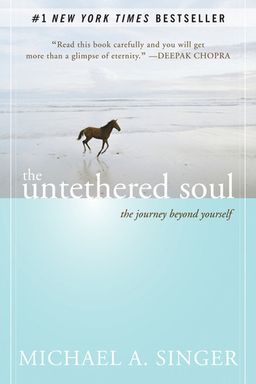
The Untethered Soul cover

The Untethered Soul

by Michael A Singer

The Untethered Soul guides you on a transformative journey to master your mind and emotions. By exploring spiritual practices, it shows how to connect with your consciousness, overcome negativity, and achieve enlightenment. Discover the power within you to live a fulfilling and enlightened life.

The Journey Beyond Yourself

Have you ever wondered who you truly are beyond the voice in your head, the moods you feel, and the stories you tell yourself? In The Untethered Soul, Michael A. Singer invites you on a profound journey inward—a journey to discover the part of you that is aware of life itself. Singer contends that your real self is not the chaotic chatter of your mind, nor the accumulation of your experiences; it is the quiet, witnessing consciousness that notices all of it. His central premise is deceptively simple yet spiritually revolutionary: you are not your thoughts, emotions, or circumstances—you are the observer behind them.

This book, described by Deepak Chopra as “a mirror to see your unconditional, holy Self,” blends insights from yoga philosophy, mindfulness, and psychology into an accessible guide to inner freedom. Singer takes you step by step through the process of awakening consciousness, transcending emotional blockages, releasing the mind’s control, and embracing life as it unfolds. He calls this process the spiritual journey of untethering the soul—the act of freeing your inner being from the limitations that keep you bound to fear and suffering.

Awakening Awareness

Singer begins with the unsettling realization that most of us live trapped inside an internal dialogue that never stops. This mental voice—your “inner roommate”—narrates every moment, judges every experience, and never lets you rest. When you identify with that voice, you are pulled into a cycle of anxiety, confusion, and emotional reactivity. But the moment you step back and realize “I am the one who hears that voice,” you begin awakening consciousness. From that vantage point, life’s drama becomes something you’re watching rather than suffering through.

Experiencing Energy and Opening the Heart

Once you discover that you’re not your mind, Singer guides you deeper—to the experience of energy and emotion. He explains that every human has vast stores of inner energy that can be either flowing freely or blocked by past experiences. When you close your heart out of fear, pain, or resentment, you isolate yourself from that infinite source of vitality. Through acceptance and conscious openness, you can learn to let life’s energies pass through you rather than resist or suppress them. The heart, he writes, is an instrument for spiritual resonance: when it opens, love and enthusiasm arise naturally.

Letting Go and Going Beyond

Central to Singer’s teaching is the art of letting go. Every moment gives you a choice: to cling to the past or release it in favor of the present. Resisting pain only reinforces it; relaxing and surrendering allows suppression to dissolve. “Let go now or fall,” he warns—a reminder that every act of resistance pulls you into inner struggle. Letting go doesn’t mean apathy; it means trusting the natural flow of life’s unfolding without closing your heart.

Living Untethered: The Spiritual Path in Daily Life

In later chapters, Singer turns theory into practice. He describes unconditional happiness as the highest form of spiritual realization. By refusing to close your heart—no matter what happens—you align with a boundless joy that transcends circumstance. He also explores nonresistance, embracing death as a teacher, and living in balance (a reflection of Lao-tzu’s Tao). The final vision of God is not of a judging deity but of divine love overflowing through creation, seeing beauty in every soul. When you identify with your true consciousness rather than your fears, you live in what Singer calls the loving eyes of God—a state of unity, freedom, and compassion.

Ultimately, The Untethered Soul offers not a religious system but a way of being. It teaches you to sit back in the seat of your awareness and observe the play of human experience with clarity and serenity. Singer’s message echoes ancient wisdom—from the Buddha’s mindfulness to Ramana Maharshi’s inquiry “Who am I?”—but it arrives wrapped in simple, practical steps for modern readers. If you’ve ever felt trapped by your own thoughts or emotions, this book promises a way out: wake up, watch, and let go.


Listening to the Voice Inside Your Head

Singer opens the journey by exposing the incessant mental chatter that accompanies us each moment. Picture yourself driving down the street or trying to fall asleep—the mind never stops talking. It comments, judges, worries, and narrates your life. Singer likens this inner commentary to living with a roommate who won’t stop talking. You may have thought that this voice was “you,” but he insists it is merely a habit of mind that echoes your fears and desires.

Observing, Not Engaging

The key insight is that you can observe the voice without becoming it. Singer encourages you to step back into the witness position—to notice that there is someone in there who hears the thoughts. This is the first act of awakening consciousness. Try the experiment he suggests: make your inner voice say “hello.” Who heard it? That listener is you—the consciousness, not the chatter. Once you understand this, you see that all thoughts, whether kind or cruel, meaningful or meaningless, are just mental noise passing through awareness.

Why the Voice Never Stops

Singer explains that the mind talks because you want to control life and make yourself feel safe. The narration gives a false sense of comfort and protection, as if by commenting on reality you could manage it. But in truth, no amount of inner dialogue changes the world—it only disturbs your peace. He compares the voice to a teakettle that whistles because energy has built up inside; the talking releases nervous or fearful energy. When you simply notice it, the buildup dissolves naturally.

The Path to Inner Silence

Freedom begins by no longer differentiating what the voice says. Stop deciding which thoughts are “you” and which are not. Everything you hear inside is just sound in space; none of it defines you. This realization separates the observer from the observed—the same principle found in Buddhist mindfulness practice. As Singer writes, the one who watches is silent, steady, and eternal. When you rest in that awareness, the mind may still speak, but its noise loses power.

Key takeaway

Your mind’s voice is not your identity—it’s merely the echo of past conditioning. Learning to watch it without judgment is the first step toward inner freedom.


Taming Your Inner Roommate

After identifying the mind’s constant chatter, Singer introduces its personality: your inner roommate. This roommate lives inside your head, analyzes every moment, and often acts like a neurotic companion. He argues endlessly, gives bad advice, and creates emotional messes. Imagine if that voice had a body and you had to live with it in your home—you would call it disturbed and ask it to leave. Yet inside, you listen to it day and night.

Seeing the Separation

Singer invites you to personify this roommate to understand your predicament. Treat the inner chatter as if it were another person sitting next to you. When you do, you realize how irrational, fearful, and inconsistent it is. One moment it loves someone, the next it hates them. It worries about small things, invents dramas, and constantly corrects your behavior. Recognizing this separation is crucial—you are the witness, not the roommate.

Breaking Identification

Most suffering, Singer says, arises from identifying with this roommate. You confuse the voice with your true self and allow it to dictate your emotions and decisions. But when you realize that the roommate is just psychological conditioning—the echo of past fears and desires—you can begin reclaiming inner authority. He calls this process “taking back your life from the psyche.” You decide not to listen, not to follow its melodrama, and instead remain seated as the calm observer.

Freedom Through Awareness

Singer explains that spiritual practices like yoga and meditation exist precisely to help you separate from the inner roommate. Once you see it clearly, your will becomes stronger than the habit of listening. You learn to stand firm in awareness and release its grip. The mind still speaks, but you don’t take orders from it. Eventually, you experience profound peace—the silence that was always there behind the noise.

Key takeaway

Your constant inner dialogue is not a friend to consult but a chatter to observe. True growth begins when you stop identifying with your mind’s roommate and listen instead to the quiet witness within.


Opening the Spiritual Heart

Singer teaches that your heart is the center of spiritual energy—the place through which love, inspiration, and joy flow. Like a valve, it can open to allow life’s energy in or close to block it out. Every time you cling to pleasure or resist pain, you close your heart’s flow. Over time, these closures accumulate as emotional wounds, what yogic tradition calls Samskaras, or stored impressions. They create the walls that keep you from love and vitality.

Understanding Emotional Blockages

To grasp how blockages form, Singer invites you to recall ordinary moments. For example, you’re driving and see a car that looks like your ex’s, with two people inside. Instantly your chest tightens, your mood shifts, and your energy drops. A memory—an unfinished emotional pattern—was triggered. These stored impressions act as embedded energy that remains until released. They distort perception and keep you reacting to the past.

Releasing Samskaras

Whenever an old feeling surfaces, Singer encourages you to welcome it. Smile when the heart hurts; it means an opportunity to cleanse has arrived. Relax your body, breathe, and let the energy of the pain pass through. It may feel intense, but resisting only keeps it trapped. In yoga his teaching echoes the principle of purification through awareness: whatever rises to consciousness can dissolve in consciousness.

Living With an Open Heart

When you stop closing, energy flows unimpeded. You feel spontaneous love and enthusiasm in ordinary life. At a high level of openness, energy even radiates outward—your presence lifts others. Singer describes this as becoming “a source of light for all those around you.” This mirrors many spiritual traditions: in Chinese practice it is Chi; in yoga, Shakti; in the West, Spirit. The message is universal: an open heart is the gateway to boundless energy and joy.

Key takeaway

Don’t fight emotional pain—feel it fully and let it pass. Each release purifies the heart and expands your capacity to live in love.


Let Go Now or Fall

Singer insists that letting go in the moment is the most powerful spiritual act. Life will inevitably hit the pain stored inside you, and when it does, two options arise: release it immediately or hold onto it and fall into inner turmoil. Most people choose to resist, which pulls consciousness downward into confusion and drama. By releasing as soon as disturbance appears, you rise upward into freedom.

The Anatomy of Falling

He explains the process step by step. First, an event strikes a blockage, and you feel uncomfortable. If you don’t let go, that discomfort attracts your attention like a magnet. You become lost in the emotion, lose your centered awareness, and sink into reaction. The mind then rationalizes, defends, and externalizes the problem, deepening the spiral. Every fall begins at the moment you abandon witness consciousness to chase the energy of disturbance.

The Secret of the Ascent

The opposite is equally powerful. When you relax and keep your awareness steady, the same triggered energy purifies and ascends. Singer likens it to fuel for spiritual growth—the pain that once weighed you down now lifts you up. “Use life’s disturbances as the fuel for the journey,” he writes. This echoes the Buddhist path of mindfulness and surrender: by observing discomfort without resistance, it transforms itself.

Living in Constant Release

Over time, releasing in every situation becomes a habit. You no longer analyze the disturbance or blame others; you instantly relax behind it. Like clouds passing through the sky, emotions arise and dissolve. The practice is simple but radical—never hold anything. Singer’s mantra captures it: “Let go now or fall.”

Key takeaway

The sooner you let go of inner resistance, the faster you rise in consciousness. Freedom begins the moment you stop fighting the energies within you.


Unconditional Happiness

Singer’s radical proposal is that happiness is not dependent on external conditions. You can decide, right now, to be happy for the rest of your life—no matter what happens. It sounds impossible, but he insists it’s the highest form of spirituality. If you make happiness conditional on circumstances—on people behaving right, events going your way, or desires being met—you’ll live in endless vulnerability. True happiness arises from refusing to close your heart.

Making the Choice

Singer challenges you to answer one question: “Do you want to be happy or not?” Without qualifications, without exceptions. Most people say yes but immediately add “as long as…” Those caveats are the problem. He uses simple analogies: you don’t need perfect circumstances to eat when hungry; you just need food. Likewise, you don’t need life to be perfect to be happy; you just need to choose happiness unconditionally.

Staying Open When Life Closes

The technique of unconditional happiness is staying open in the face of disturbance. When your boss criticizes you or your friend betrays you, notice the urge to close and contract inside. Instead of succumbing, relax and release. By doing this repeatedly, your energy remains free-flowing, and joy becomes your natural state. This is the path of saints and mystics—remaining open regardless of external events.

Why It Matters

Singer reminds us that constant happiness doesn’t mean constant euphoria; it means presence, peace, and appreciation. You stop fighting life and become one with it. In practical terms, it transforms relationships and work, making every moment a chance to practice openness. Over time, he says, this choice purifies the heart and awakens spiritual energy. “Unconditional happiness,” he concludes, “is the highest technique there is.”

Key takeaway

Happiness isn’t something life gives—it’s a decision to stay open, no matter what. Each challenge is a test of your commitment to joy.


Facing Death and Living Fully

One of Singer’s most moving chapters contemplates death as the ultimate teacher. Death instantly erases all attachments, possessions, and identities, revealing what truly matters. He asks: why wait until that last moment to learn its lesson? If you realized you might take your last breath at any time, would you waste energy on trivial worries, resentments, or fears? Death calls you to live fully now, not someday.

Embracing Impermanence

When you remember your mortality, priorities shift. The small annoyances that consume you fade against the vast backdrop of life’s fragility. Singer encourages reflecting on how you would spend your final week. You’d forgive people, express love, and savor every breath. Why not live that way all the time? Awareness of death clears distractions and returns you to the present—the only place life actually happens.

Seeing Death as a Friend

Rather than fearing death, Singer calls it a liberator. It gives life meaning through its scarcity. Without death, we’d take every moment for granted. Knowing time is finite makes each experience sacred—the taste of rain, the touch of a loved one, even ordinary conversation. In this sense, death “gives life back” by urging awareness. The yogic and Buddhist traditions echo this: all things are temporary, therefore precious.

Living in Light of Death

As Singer writes, “Death is your liberator.” It wipes away fear by exposing the truth that you own nothing—not even your body. Once you internalize that truth, you stop clinging. You become free to love deeply and live vividly. Death is always near; instead of avoiding that fact, let it guide you into gratitude and courage. To live with awareness of death is to live without wasting life.

Key takeaway

When you remember that death can come at any moment, you stop postponing joy. Every breath becomes both a farewell and a celebration of being alive.


Seeing Through the Loving Eyes of God

The book’s final vision is luminous. Singer asks what it’s like to see the world through the loving eyes of God. In this state, judgment disappears. You no longer categorize people as good or bad; you see every being as part of divine creation. Like sunlight shining equally on saints and sinners, love flows impartially. This, he says, is the ultimate transformation that occurs when you identify with consciousness itself—the source of love.

Drifting Toward Spirit

As you release lower emotions and thoughts, consciousness naturally expands. You begin feeling love not just for a few people but for all creatures, all colors, all forms. Judging fades; appreciation takes its place. Singer compares this to looking at a garden—every leaf and flower is unique and beautiful, neither right nor wrong. When you reach that perception toward humanity, you glimpse divine awareness.

The Nature of Divine Love

God, Singer writes, does not judge; He loves absolutely. Nature offers proof—the sun shines on everyone; the rain nourishes all alike. This love is unconditional because it is the essence of creation. To experience divinity is not to reach an external deity but to merge with love itself. The Bible’s descriptions of Christ’s compassion exemplify this state, echoed in all spiritual traditions from Hinduism’s Atman to Sufi mysticism.

Becoming a Vessel for Love

When you live from this awareness, love flows through you effortlessly. You give without hesitation, forgive without effort, and see beauty everywhere. Judgment was the mind’s way of protecting the false self; love is the soul’s way of celebrating truth. In this state, Singer says, God’s joy becomes your joy. You have merged with the universal consciousness—the loving eyes that behold all life as sacred.

Key takeaway

The ultimate awakening is love without judgment. When you see the world through God’s eyes, you experience life as one continuous expression of divine joy.

Dig Deeper

Get personalized prompts to apply these lessons to your life and deepen your understanding.

Go Deeper

Get the Full Experience

Download Insight Books for AI-powered reflections, quizzes, and more.