
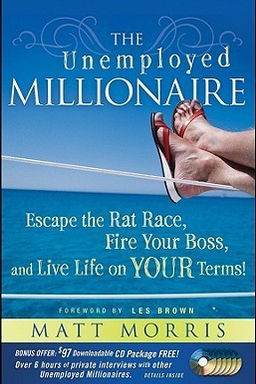
The Unemployed Millionaire cover

The Unemployed Millionaire

by Matt Morris

The Unemployed Millionaire is a transformative guide to financial independence. Matt Morris shares his journey from adversity to success, offering strategies for aspiring entrepreneurs. Learn how to build self-sustaining businesses, leverage real estate, and embrace a mindset of resilience and innovation.

Becoming an Unemployed Millionaire: Freedom Through Self-Made Success

What if the life you dream of—one filled with freedom, fulfillment, and financial independence—were actually closer than you think? In The Unemployed Millionaire, entrepreneur and speaker Matt Morris argues that anyone can escape the rat race and become both wealthy and free, provided they are willing to reshape their beliefs about work, money, and success. Morris contends that the secret to real wealth isn’t just owning a business or earning a high income—it’s creating multiple streams of residual income that generate money even when you’re not working. His central philosophy: stop trading hours for dollars, and start building systems that let you live life on your own terms.

The book chronicles Morris’s own rags-to-riches story—from being homeless and bathing in gas station sinks to building multimillion-dollar companies before the age of 30. Along the way, he distills the “inner game” of success (beliefs, dreams, goals, and mindset) and the “outer game” (business models, leadership, and financial systems) into a practical formula anyone can follow. His journey shows that wealth is not reserved for the privileged but for those with purpose and persistence.

Escaping the Time-for-Money Trap

Morris begins by challenging one of society’s deepest assumptions: that working harder in a job leads to financial security. In fact, he argues, traditional jobs are “well-paid prisons,” trading freedom for predictable paychecks. True success, he says, lies in working on your business rather than in it—creating systems and teams that function independently of your daily labor. For Morris, being an “unemployed millionaire” is not about laziness or luck—it’s about designing a life where your time, not your boss, governs your destiny.

The Inner Game: Beliefs, Dreams, and Purpose

Before teaching how to make money, Morris focuses on the beliefs that make success possible. Drawing on his own transformation, he demonstrates how limiting stories—such as “success is hard” or “I’m not good with money”—create a mental ceiling for what’s possible. Inspired by mentors like Tony Robbins, he reframed his identity from being a broke struggler to being a future millionaire. That mindset shift became the foundation for all his later successes.

Dreams, he says, are the emotional fuel for success—but only *wild* dreams have enough power to ignite real change. Through journaling, visualization, and radical goal-writing (he keeps a “lifetime dream list” of at least 100 goals), he helps readers imagine a life so exciting that failure isn’t an option. The bigger your dreams, the bigger your drive.

The Outer Game: Systems that Create Freedom

After building a powerful mindset, Morris turns to wealth-building strategies that combine entrepreneurial discipline with lifestyle design. He introduces business models that maximize leverage—network marketing, Internet sales, real estate investing, and outsourcing. Each of these models shares one trait: they create *residual income*, the Holy Grail of financial independence. Once systems are running, you can step away while money continues to flow, freeing you to invest your time wherever it matters most.

Leadership, Leverage, and Lifestyle

The book also explores leadership as the ultimate multiplier of success. Drawing insight from mentors like Wayne Nugent and Les Brown, Morris argues that confidence—not talent—is the defining trait of great leaders. When people believe in your vision because you believe in it first, results multiply. This concept runs through all his ventures: from network marketing to Internet companies employing virtual assistants across the globe.

Ultimately, The Unemployed Millionaire blends motivational storytelling with practical, step-by-step wealth systems. It’s equal parts personal growth manual and entrepreneurial blueprint. The book doesn’t promise overnight riches—it demands discipline, heart, and authenticity. Morris’s message is simple yet radical: your past does not decide your future, and success begins the moment you take 100% responsibility for your life. For readers stuck in unfulfilling jobs or frustrated by traditional career paths, his story offers both proof and a path to freedom.


From Homeless to Self-Made Millionaire

Matt Morris’s story is one of the most dramatic transformations you’ll find in modern self-help literature. Before he became a bestselling author and globetrotting entrepreneur, Morris hit rock bottom—homeless, jobless, and broke at 21, living out of a beat-up Honda Civic. But instead of giving in, that pain became the catalyst for reinvention. His turnaround began not in a classroom or boardroom, but in a church parking lot, bathing naked under the rain. That night, listening to a Tony Robbins audio program, he made a lifelong decision: to model success and dedicate his life to personal development.

The Power of Modeling

Inspired by Robbins, Morris adopted the principle of modeling—studying and replicating the habits, mindsets, and systems of the world’s most successful people. He devoured hundreds of books on business, psychology, and wealth, replacing music with inspirational audio programs during his long commutes. This relentless pursuit of knowledge reshaped his identity. As he puts it, “If the human body can regenerate every cell in a few years, surely I can reinvent my future.”

Embracing Pain as Fuel

Rather than running from struggle, Morris learned to view pain as the ultimate motivator. He recognized what many never do: most people settle for comfort, which breeds mediocrity. Only those who confront extreme discomfort grow beyond it. “Pain,” he writes, “is weakness leaving the body.” That belief carried him from debt to determination—first earning a modest income in sales, then building his first six-figure business by age 24.

Hard Lessons from the Road

Success wasn’t a straight line. Morris worked grueling jobs—repairing coffee machines at Starbucks by day and serving tables at night—so he could fund his entrepreneurial dreams. When new ventures failed, he learned to separate his worth from his results. These setbacks became his classroom. Over eight years, he climbed from “flat broke to seven figures,” proving that consistent daily improvement trumps luck or timing. His formula: humble beginnings + disciplined learning + relentless modeling = predictable success.

“You can drop me anywhere in the world, take away my money and contacts, and within 24 months, I’ll be a millionaire again.” —Matt Morris

Morris’s confidence isn’t arrogance—it’s a reflection of skill mastery. By building his foundation through study and persistence, he reached a point where success became a repeatable process, not a fluke. His story offers hope to anyone buried under debt or doubt: rock bottom is not an ending—it’s a beginning, if you decide to climb.


Beliefs: The Foundation of Success

Morris dedicates a full chapter to belief, calling it “the most important factor in success.” Beliefs shape identity, and identity determines results. We are not limited by reality, he says, but by the lies we repeatedly tell ourselves. These self-limiting beliefs—'I’m not smart enough,' 'I always fail,' or 'money is hard'—act like invisible chains that keep us stuck. To break free, you must reprogram your mind at the subconscious level, where habits and self-concept live.

The Easy Principle

Morris introduces a powerful mindset shift: stop telling yourself life is hard. The moment you decide something is easy, your brain works differently—it relaxes, gets creative, and finds solutions faster. When successful people like Donald Trump or Oprah Winfrey pursue a project, they don’t think “Can I?” but “How fast can I?” For Morris, that “Easy Principle” became his daily mental training. Every time he faced a challenge, he would say, “This is easy,” until his mind believed it.

Rewiring Through Stories

Much of what we believe comes from early experiences and other people’s opinions. Morris shares how a childhood comment from his mother (“We’re not runners”) convinced him he was bad at athletics—until he realized that belief was based on nothing factual. Once he saw it as a *lie*, he could replace it with truth. He encourages readers to view beliefs not as facts but as stories you can rewrite at any moment. Change your internal narrative, and success becomes inevitable.

Programming the Subconscious

To rewire the subconscious, Morris recommends three inputs: experiences, external voices, and self-talk. Surround yourself with success stories, change your environment, and speak affirmatively. He cites daily practices like affirmations (“I’m a millionaire”) and mental rehearsals. Because the subconscious cannot distinguish between a truth or a lie, consistent repetition engrains a new identity. In effect, you can transform your mind from poverty programming to prosperity programming (a concept echoing Napoleon Hill’s Think and Grow Rich).


Dreams: The Engine of Desire

If beliefs are the foundation, dreams are the fuel. Morris insists that without big, outrageous dreams, mediocrity becomes inevitable. He tells readers bluntly: “Impotent dreams produce impotent results.” To achieve greatness, you must desire it so intensely that average goals feel insulting. He invites readers to resurrect their childlike imagination—before adults told them to be realistic—and create a “dream list” of 100 life goals that stir emotion and fear in equal measure.

The Obituary Exercise

Morris uses a thought experiment inspired by Alfred Nobel, who changed his legacy after reading his own premature obituary calling him “The Merchant of Death.” By imagining what your own obituary might say, you clarify what really matters. This vision becomes your compass for bold, purpose-driven action. Nobel’s story reminds readers that wealth without impact is hollow—and that success means aligning ambition with contribution.

Creating Momentum

Dreams generate motivation, which feeds consistency. Success breeds more success, forming a self-perpetuating cycle. Morris shares how he and his wife spend evenings discussing their five-year fantasies—from flying private jets to sponsoring charities. Those conversations, he says, keep his emotional drive alive. He compares dreams to jet fuel: volatile, explosive, but essential for takeoff. Without them, life drifts; with them, every obstacle becomes a stepping-stone.

No More “Try-Babies”

One of his most memorable lessons: don’t be a “try-baby.” Morris criticizes adults for replacing bold dreams with timid attempts (“I’ll try to start a business”). Children never say, “I’ll try to be an astronaut”—they just declare it. The word “try,” he says, is emotional camouflage for fear of commitment. By replacing “I’ll try” with “I will,” you commit at a cellular level. As he puts it, “When you burn your bridges, retreat is not an option.”


Goal Setting That Works with the Subconscious Mind

Traditional goal setting doesn’t work, Morris argues, because it subconsciously reinforces lack. When you say “I will be rich,” your mind hears “I am not rich now.” To fix this, he advises stating goals in the present tense, as if they’re already true (“I am earning $100,000 per year through my business”). The subconscious mind, unable to discern fact from fiction, begins aligning your behavior with this new identity.

The Three-Part Goal Formula

Morris’s practical formula for goals includes three sections: the specific outcome, the emotional reason (“why”), and a detailed action plan. Without a powerful why, even the best goals collapse. For instance, earning $100,000 isn’t compelling on its own—but earning it to transform your child’s future gives it fire. He emphasizes daily review: goals must attack your consciousness until they become automatic. “Your goals,” he writes, “should smack you in the face every morning.”

Balance and Holistic Success

Morris outlines five categories for balanced living: business/finances, health/fitness, family/relationships, personal growth, and fun. True wealth, he reminds readers, isn’t just about money—it’s time, health, and connection. By integrating these dimensions, goals evolve from to-do lists into blueprints for a fully realized life. This approach parallels frameworks from Brian Tracy’s Goals! and Stephen Covey’s 7 Habits of Highly Effective People.


Action Management and Time Freedom

Effective action—not endless planning—creates results. Morris replaces time management with what he calls “action management,” arguing that you can’t control time but you can control your actions. The key is distinction: managing energy and priorities rather than hours on a clock. By focusing on high-leverage activities—and rewriting your beliefs about scarcity of time—you can accomplish in three hours what most do in eight.

The Daily System

Each night, Morris creates a list of tasks he wants to complete (not “needs” to—because “want” excites the brain). He ranks them A, B, or C by importance, then schedules the A tasks as non-negotiables for the next day. Tasks get time blocks and deadlines, transforming vague intentions into commitments. He also sets aside time for e-mail and planning to avoid digital addiction—a common productivity killer. This mirrors productivity philosophies from David Allen’s Getting Things Done and Brian Tracy’s “Eat That Frog.”

Ego and Energy Management

In one of his most introspective lessons, Morris admits that his past obsession with work came from ego—deriving significance through stress. He calls this “unconscious ego management.” The cure is to replace significance with joy as your core value. He advises readers to revise their top values—adding happiness, health, and love above achievement. By doing so, productivity becomes sustainable, not self-destructive.

Through this structure, Morris teaches that freedom doesn’t come from doing less; it comes from doing what matters most, guided by clarity rather than chaos.


The Secret Trait of Powerful Leaders

Morris devotes an entire chapter to what he calls “the secret character trait of the world’s most powerful people.” That trait is confidence. Confidence attracts followers; insecurity repels them. People don’t follow the best expert—they follow whoever radiates certainty. In his early years, he learned this lesson from his mentor Wayne Nugent, who told him, “I’m good because I have confidence—not the other way around.”

Projecting Confidence

Confidence is 80% perception, 20% competence. Morris teaches simple cues that signal leadership: direct eye contact, firm handshake, upright posture, and a smile under stress. He even suggests raising your speaking volume slightly—studies show the loudest voice in a group is subconsciously seen as the leader. These micro-behaviors establish authority instantly.

The Seven Laws of Leadership

He introduces seven “Leadership Laws,” from maintaining the biggest dream and attitude to embodying integrity and persistence. One lesson—“be a strong decision-maker”—uses Edison’s 10,000 failed lightbulb experiments as a metaphor for persistence over perfection. Every failure is progress toward mastery. Another law, “set the bar high,” recalls Roger Bannister’s four-minute mile story as proof of how one bold example expands everyone’s belief of what’s possible.

Taking 100% Responsibility

Closing the lesson, Morris defines the ultimate leadership trait: extreme ownership. Excuses, he warns, are declarations of powerlessness. When you blame circumstances, you give away control. The world’s most powerful people take full responsibility—because that’s the only path to influence anything. “Power,” he writes, “is assumed, not granted.”


The Entrepreneur’s Toolkit: Business Models for Freedom

In Part II, Morris translates mindset into money, laying out practical models for achieving financial freedom. He examines network marketing, Internet entrepreneurship, and real estate investing—not as quick fixes, but as vehicles for leverage and residual income. Rather than glorifying any one path, he helps readers see patterns that all successful ventures share: low overhead, scalability, automation, and alignment with passion.

Network Marketing as a Launchpad

Morris credits network marketing for changing his life—it allowed him to cultivate leadership, sales, and resilience while earning residual income. He defends it as a legitimate business model when built on integrity, citing its explosion during recessions as evidence of its resilience. Critics see it as risky; he reframes it as training for entrepreneurship, calling it “a university for self-reliance.” (Robert Kiyosaki likewise sees network marketing as the best school for entrepreneurship in Rich Dad, Poor Dad.)

Internet Marketing and Automation

His own Internet businesses became a laboratory for automation. He details how to build web-based systems that sell products automatically, from digital downloads to affiliate networks. He emphasizes list-building—the “real money is in the list”—and the art of relationship-based marketing. The Internet, he argues, is the perfect playground for unemployed millionaires because it scales infinitely without physical constraints.

Real Estate as Tangible Leverage

Real estate, for Morris, represents leverage in the physical world. Unlike volatile stocks, properties generate income and appreciation over time. With no-money-down strategies, lease options, and foreclosures, he demonstrates how investors can create immediate equity and long-term gains. His rule: never gamble on future appreciation—profit from the buy. In today's world of Airbnbs and remote investing, this lesson feels more timely than ever.

Together, these models illustrate a deeper truth: freedom isn’t one business, it’s a principle—using systems, people, and technology to multiply impact while reclaiming time.

Dig Deeper

Get personalized prompts to apply these lessons to your life and deepen your understanding.

Go Deeper

Get the Full Experience

Download Insight Books for AI-powered reflections, quizzes, and more.