
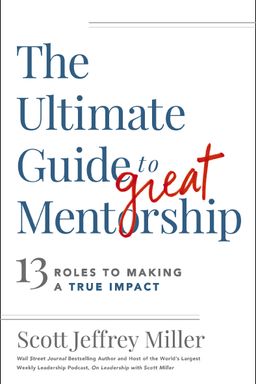
The Ultimate Guide to Great Mentorship cover

The Ultimate Guide to Great Mentorship

by Scott Jeffrey Miller

The Ultimate Guide to Great Mentorship by Scott Jeffrey Miller demystifies effective mentorship. Discover 13 powerful roles that guide and inspire mentees toward success. This book offers practical strategies to refine your mentoring skills and make a lasting impact.

Mentorship as Multiplying Human Potential

Have you ever thought about the immense impact a single conversation can have on someone’s life? In The Ultimate Guide to Great Mentorship, Scott Jeffrey Miller argues that mentorship isn’t a vague act of guidance—it’s a deliberate set of roles you can master to make a true, lasting impact on another person. Drawing on his decades at FranklinCovey and hundreds of interviews with celebrated thinkers, Miller contends that excellent mentorship depends less on being wise and more on being aware of which role a mentee needs at any moment. Great mentors, he insists, shift consciously between thirteen distinct roles—from Revealer and Challenger to Connector and Closer—each one unlocking a different dimension of transformation.

Miller’s premise is simple yet profound: every mentor must act with intention. Mentorship isn’t about doling out advice like a guru at the mountaintop—it’s about recognizing when to guide, when to listen, when to challenge, and when to celebrate. This book urges you to trade generic encouragement for precision, empathy, and structure. Through stories from his own career, humorous self-reflections, and practical frameworks, Miller breaks mentorship down into actionable identities you can adopt depending on what your mentee needs most. Importantly, he grounds each role in language that feels human and relatable, reminding us that mentoring isn’t management; it’s influence through service.

Why Mentorship Still Matters

Miller begins by confronting a modern cynicism: Is mentorship still relevant in an age of virtual work, self-paced learning, and infinite online resources? His answer is an emphatic yes. In fact, he argues, the need for mentorship is greater now, not lesser, because people crave authentic human connection and real accountability amid all the noise. We’re bombarded by advice that’s untethered from relationship. A mentor offers substance—a mirror for self-awareness and a map for growth.

Mentors, Miller says, shape identity, not just productivity. They challenge self-perception, interrupt limiting narratives, and give permission to evolve. Whether in one’s career or personal life, mentorship acts as the ground where insight grows into confidence. This, he insists, isn’t soft guidance—it’s psychological architecture built through trust, boundaries, and curiosity.

The 13 Roles That Shape Mentorship

At the heart of Miller’s framework are thirteen roles every effective mentor should know. They range from early-stage guiding functions like The Revealer (who uncovers hidden passions and fears) and The Boundary Setter (who builds safe, structured expectations) to advanced modes such as The Visionary (who helps mentees expand their future possibilities) and The Closer (who ensures the relationship ends with celebration and continuity).

There’s also The Absorber, a master listener who hears between the words; The Questioner, who provokes introspection; The Challenger, who dismantles flawed assumptions; and The Validator, who restores confidence without necessarily agreeing. Middle-stage mentors often act as Navigators and Visionaries, steering the journey and reframing ambition. Later comes The Distiller, who helps prioritize ideas; The Activator, who ignites motivation; and The Connector, who opens doors. Finally, we meet The Closer, a gracious finisher. As comic relief, Miller ends with The Jerk, the anti-mentor who embodies what not to do—over-talking, dominating, and mentoring for their own ego.

Mentorship as Dynamic Role-Shifting

According to Miller, mentors often stumble because they cling to one comfortable identity (teacher, fixer, counselor) rather than adjusting roles as situations evolve. His thirteen-role model functions as a “toolbelt”—you reach for the right instrument when the context demands it. The key is awareness. It’s not the quantity of advice you give but the quality of presence you maintain. Mentoring success, he says, is having “the discernment to know which role fits the moment.” A mentor might listen as The Absorber one week, challenge assumptions as The Challenger the next, and finish with The Validator to re-infuse confidence.

This adaptability turns mentorship into an art. Like an orchestra conductor, the mentor modulates tone, rhythm, and tempo to bring out growth. Miller’s own stories—such as the Alabama workshop where someone told him, “You’re too close; back up!”—illustrate how self-awareness transforms even awkward feedback into teaching tools. Those moments remind you that influence begins with humility, not dominance.

Why These Ideas Matter

The broader relevance of Miller’s guide transcends formal mentoring programs. His roles apply to any situation where human development is at stake—leadership, parenting, coaching, or even friendship. Each role cultivates specific emotional intelligence skills: empathy, curiosity, discipline, and vulnerability. In a world that prizes speed over depth, these skills remain uncommon and precious. Great mentorship, as Miller shows, isn’t about teaching others to be you—it’s helping them become more of themselves.

Ultimately, Miller’s thesis is both practical and philosophical: mentoring builds legacy. You may never know the full measure of your impact, but the ripple effect of one intentional role—a Revealer’s question, a Validator’s affirmation, a Challenger’s push—can alter a mentee’s life trajectory. As he writes, “Trust that your investment is likely changing a life. Maybe even your own.”


The Revealer: Discovering Hidden Potential

The first and foundational role Miller describes is The Revealer—a mentor who operates like a paleontologist, revealing what’s buried beneath the surface of another person’s ambitions. The Revealer’s goal isn’t to advise quickly, but to unearth slowly. They help mentees uncover motivations, fears, and blind spots by brushing away metaphorical dust rather than charging in with a jackhammer. Miller uses this metaphor extensively to emphasize patience and awareness: you don’t announce “Eureka, I’ve found a T. rex!” after uncovering one fragment of bone.

Know the Dig Site

Every mentee’s environment—what Miller calls their “dig site”—differs. Some excavate career decisions within rigid organizations; others face creative uncertainty or entrepreneurial risk. As a Revealer, your job is to understand the terrain: what your mentee is trying to accomplish and where they’re working from. Miller warns that mentors must resist imposing their own maps. Your life shortcuts and snap judgments may distort their excavation. Instead, enter their world gently, asking questions rather than prescribing solutions.

Be Patient and Self-Aware

Patience is vital here. Miller openly admits he learned this the hard way—his natural energy once overwhelmed people. He recounts a story in Alabama where a participant bluntly told him: “It’s way too early for this. Back yourself up.” Realizing that high energy can intimidate, he learned that influence starts with emotional calibration. The Revealer mirrors Stephen Covey’s Habit 5, “Seek first to understand, then to be understood.” You create safety so the mentee can be “comfortable being uncomfortable.”

Maintain Awareness of Your Footprints

Miller shows how mentoring can turn intrusive when mentors’ personalities dominate. Leaders often project confidence and data-driven certainty, which can unintentionally silence mentees. He invites mentors to check how their presence affects the atmosphere—tone, volume, vocabulary, humor, and speed can create hierarchy or intimidation. The Revealer must hold back the impulse to lead and instead stay curious. Advice such as “If I were you…” is forbidden; instead, share experiences without equating them: “When I faced something similar, here’s what I learned. You are not me.”

Why It Matters

By mastering this role, you move from simply teaching toward discovery facilitation. The mentee learns not just to find answers but to define the right questions. Miller’s story about mentoring a thoughtful medical professional with a totally different communication style—quiet, measured, and deliberate—illustrates how even mismatched personalities can illuminate growth for both sides. He learned to slow down, match her pace, and let silence guide progress. The result: both became revealers, discovering patience and self-awareness in each other.

(Comparable perspectives appear in Carl Rogers’s humanistic psychology, where a facilitator leads through empathy rather than instruction. Rogers might call The Revealer’s work “creating conditions for authenticity.”)


The Boundary Setter: Building Safe Structures

If The Revealer builds trust through curiosity, The Boundary Setter sustains it through structure. Miller argues that boundaries aren’t limitations—they’re the guardrails that make deep relationships work. Quoting leadership expert Blaine Lee, he reminds readers that “Nearly all conflict in life comes from mismatched or unfulfilled expectations.” In mentorship, clarity precedes chemistry. Without it, sessions drift into awkwardness or overreach.

Design the Framework Early

Boundary Setting begins with logistics: duration, frequency, and agendas. Miller advises forty-five minutes of focused discussion—a long enough span to reach depth, short enough to preserve energy. Importantly, mentees should lead the agenda, not the mentor. Teaching them this skill fosters ownership and discipline. The mentor models but doesn’t rescue; you empower the mentee to learn pacing and prioritization.

Set Emotional and Professional Guardrails

More than scheduling, boundaries guard against role confusion. Miller lists what mentors aren’t: marriage counselor, lawyer, therapist, banker, or benefactor. Mentorship isn’t a hotline for personal finance or therapy. By separating those spheres early, both parties avoid uncomfortable entanglements. However, he leaves room for flexibility—earned maturity can blur lines responsibly when trust solidifies. As he jokes, “Good fences make good neighbors.”

Learn When to Call Time-Out

Mentors sometimes must pause conversations to restore focus or address ethical missteps. Miller humorously distinguishes between guidance and policing—you’re not the FBI, but sometimes a strategic interruption preserves sanity and professionalism. Calling a time-out signals respect for truth, not control. He notes that doing this early prevents reactive conflict later, echoing principles from organizational behavior studies on “psychological contracts” (Rousseau).

Commitments and Consequences

A major part of boundary setting is accountability. Mentors must model reliability; mentees must learn it. Keeping commitments—however small—builds reputational capital. Miller connects this to brand: “Everyone has a brand—a collection of all decisions they make and commitments they keep or break.” This insight reframes mentorship as character training. Following the rules first, he says, earns the right to break them later, much like his speech coach Judy Henrichs teaches about mastering and then bending presentation rules.

By protecting time, energy, and purpose, The Boundary Setter elevates mentoring beyond casual advice and into disciplined partnership. The relationship becomes respectful, sustainable, and empowering—a foundation for all other roles.


The Absorber and Questioner: Listening and Asking

These two roles—The Absorber and The Questioner—form the mentor’s toolkit for transformative dialogue. The Absorber listens deeply; the Questioner probes thoughtfully. Miller frames them as partners: one creates space for expression, the other distills meaning from what’s said. Together, they model curiosity without judgment and conversation without control.

The Art of Listening as Absorption

Miller cites Voltaire and Stephen Covey to remind us that knowing and doing are not the same: “Common knowledge isn’t common practice.” Listening requires withholding your impulse to reply. Using Dr. Deborah Tannen’s research, he explains how people interrupt when their internal “alarm clock” says the other has talked too long. His fix: when tempted to speak, close your lips and silently count to ten. That simple pause transforms relationships. The Absorber’s skill isn’t silence alone—it’s empathic focus, resisting distractions to truly hear what’s underneath.

Avoid the “If I Were You” Trap

Few phrases destroy mentorship faster than “If I were you.” Miller calls it the linguistic form of arrogance. You’re not them, and you can never be. Instead, he suggests statements grounded in self-awareness: “Here’s what I learned when I faced something similar.” This shift transfers wisdom without colonizing their decisions. Listening becomes about discovery, not duplication.

The Questioner’s Precision

As sessions mature, mentors transition into The Questioner role—less interrogator, more defense attorney. You ask open-ended questions that surface motives and challenge assumptions. Miller contrasts “bad news” (acceptable) with “wrong news” (dangerous deception). Once psychological safety exists, it’s the mentor’s duty to invite truth early and often. Effective questioning catches problems at the root before they rot the relationship. Structured questions—from “Tell me about your journey so far” to “What fears do you have that you’ve told no one?”—anchor discussion in humanity rather than performance.

From Dialogue to Discovery

The Absorber and Questioner embody the heart of mentorship: making dialogue a tool of revelation rather than persuasion. The mentee learns not to defend but to reflect. You, as the mentor, practice patience and humility. Combined, these roles represent Socratic methodology in modern form—questions that illuminate rather than manipulate. As Miller warns, your sharpest questions come after trust, not before.

(The approach resonates with Chris Voss’s negotiation framework in Never Split the Difference, where tactical empathy and calibrated questions generate breakthroughs through emotional trust.)


The Challenger and Validator: Balancing Push and Support

Miller places The Challenger and The Validator back-to-back for a reason: growth demands both tension and tenderness. The Challenger confronts; The Validator comforts. Together, they teach mentees to think critically and rebuild confidence.

Challenge for Clarity

The Challenger role asks tough, respectful questions to separate feelings from facts. Miller urges mentors to confront delusions—whether inflated self-assessments or destructive assumptions—but with empathy. He introduces the Challenger Continuum, ranging from mild questioning to firm truth-telling. The goal? Win the war, not the battle. The mentor’s job isn’t to score points but to preserve momentum toward the mentee’s goals.

Miller’s own misstep—a premature “You’re unconsciously incompetent” remark that ended a mentoring relationship—illustrates how timing and tone determine whether challenge builds or breaks trust. You can bruise hard and heal fast, he says, but never bruise early.

Validation Without Agreement

After challenge comes validation. Quoting psychologist Marsha Linehan, Miller outlines six levels of validation—from presence and reflection to radical genuineness. You acknowledge feelings without needing to agree. Validation isn’t indulgence; it’s emotional literacy. Using Gary Chapman’s “5 Love Languages” as analogy, Miller encourages mentors to learn a mentee’s “validation language”—how they experience acknowledgment, be it words, time, or acts of service. He revises the Golden Rule into the Platinum Rule: “Treat others how they want to be treated.”

Emotional Alchemy

The synthesis of these roles transforms mentorship into emotional alchemy: challenge reveals truth; validation restores courage. Together they build an upward spiral of learning—safe discomfort followed by affirmed growth. Miller’s own life proof surfaces when he shares how sparse validation from his father shaped his understanding of praise. Decades later, the rare words “I’m proud of you” still echo in his memory, proving how memorable authentic validation can be.

A great mentor alternates between pushing and praising in rhythm. Too much challenge without validation crushes potential; too much validation without challenge coddles mediocrity. Mastering both builds sturdy, resilient mentees.


The Navigator and Visionary: Guiding the Path Forward

The Navigator and The Visionary represent mentorship’s strategic heart. After uncovering truths and establishing confidence, the mentor must guide direction and inspire aspiration. Miller organizes both roles around wisdom and possibility—the former offers maps; the latter builds mountains.

Stay a Day Ahead

Miller’s conversation with teacher Gabe Dannenbring becomes his metaphor for navigation: “I only need to be one day ahead of my students.” Likewise, a mentor need not be omniscient, just informed enough to spotlight what’s coming. Navigators connect mentees’ decisions to governing principles that rarely change—honesty, commitment, credibility. Borrowing from Stephen Covey, he defines these as universal laws, timeless across industries.

Mapping Experience to Action

The Navigator creates a “how-to map.” It might involve clarifying next steps: networking, financial basics, or deciding between ventures. Miller lists practical knowledge—from calculating profit margins to reading organizational hierarchies—as tools that prevent “unconscious incompetence.” His advice mirrors entrepreneur Jill Koziol’s principle that success isn’t about maximizing risk but minimizing it. Mentorship here becomes preventive wisdom—helping others avoid mistakes you once made.

The Visionary’s Spark

Then comes The Visionary, an energizing role that paints possibility. Using Patrick Bet-David’s term “Future Truth,” Miller teaches mentees to speak as if success already exists—what you say shapes belief. Yet he warns vision can intoxicate if unrealistic; mentors must balance inspiration with feasibility. Instead of inviting mentees to climb new mountains, find new summits on existing ones. Expansion, not reinvention, sustains momentum.

Keep It Their Vision

Perhaps the most vital caution: the vision must belong to them, not you. Miller confesses his tendency to think big—sometimes too big. His exuberance once left mentees overwhelmed or disillusioned. The cure? Calibrate. Discuss, brainstorm, refine, but never impose. You’re painting alongside your mentee, not over their canvas. Vision without ownership breeds dependency.

Together, Navigation and Vision form mentorship’s compass: your past lights their direction while their passion fuels their next horizon.


From Distiller to Closer: Turning Insight into Legacy

The final arc of Miller’s model moves from The Distiller to The Closer, transforming accumulated insights into closure and continuity. The Distiller refines abundance into clarity; The Closer memorializes progress through celebration.

Distilling the Essence

After many sessions, mentees face information overload—ideas, options, advice. The Distiller acts like an artisan, combining previous roles (Absorber, Navigator, Activator) into a curated essence. You and the mentee sift what’s resonant, discard noise, and bottle the learnings into an actionable plan. Miller compares this to crafting fine whiskey: refining complexity into purity.

The Archivist’s Memory

Within The Distiller hides a sub-role—The Archivist—charged with capturing invaluable insights for future retrieval. The Archivist takes notes on breakthroughs, commitments, and lessons that may later guide reflection. It’s the mentorship version of building a personal portfolio. These archives become ingredients for closure, proof of progress, and evidence of growth.

Celebration and Closure

The Closer formalizes the journey’s end with purpose. Miller insists that endings matter as much as beginnings. He laments that our culture undervalues celebration—we rush on to the next goal. His six-step process for closure—revisiting beginnings, affirming growth with humor, naming commitments, revisiting parked ideas, celebrating wins, and articulating confidence—ensures mentors end relationships with dignity and memorable affirmation. Simple gestures, he says, matter most: handwritten notes, homemade certificates, or verbal affirmation of faith.

Legacy Through Mentorship

The journey closes not with finality but with continuation. Whether or not the relationship endures, the mentee carries the mentor’s essence forward. Miller’s humor—his description of “The Jerk” as what not to become—only amplifies the contrast: genuine mentors measure success not by being followed, but by being remembered for making others better. Mentorship, distilled to its essence, is moral stewardship of human growth.

(Comparable frameworks appear in John Maxwell’s Mentoring 101 and Marshall Goldsmith’s What Got You Here Won’t Get You There, both underscoring closure as the true completion of influence.)

Dig Deeper

Get personalized prompts to apply these lessons to your life and deepen your understanding.

Go Deeper

Get the Full Experience

Download Insight Books for AI-powered reflections, quizzes, and more.