
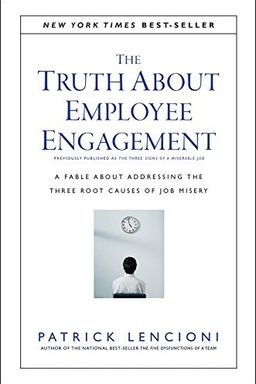
The Truth about Employee Engagement cover

The Truth about Employee Engagement

by Patrick Lencioni

Discover how to transform any job from miserable to meaningful with Patrick Lencioni''s insights. Uncover the root causes of job dissatisfaction and learn strategies that empower employees and employers to create a thriving, engaging workplace.

Transforming Job Misery into Genuine Engagement

Have you ever dreaded Monday mornings, feeling that your work somehow drains rather than fulfills you? Patrick Lencioni’s The Truth About Employee Engagement digs into this universal experience, arguing that misery at work isn’t inevitable—and that the cure, surprisingly, doesn’t require expensive perks, flashy offices, or huge pay raises. Instead, it comes down to three profoundly human needs that most managers neglect. Lencioni contends that if managers address anonymity, irrelevance, and immeasurement—the three root causes of employee disengagement—they can make almost any job motivating and meaningful.

The book blends a management fable—centered on the retired CEO Brian Bailey’s experiment managing a small, struggling pizzeria—with straightforward guidance distilled from real-world leadership experience. Through Brian’s journey, Lencioni frames employee engagement as more than just a business outcome—it’s a moral and relational responsibility. Engaged employees don’t just improve performance; they restore dignity to work and ripple positivity through families, communities, and organizations.

Job Misery Versus a Bad Job

Lencioni begins by separating misery from what we usually consider a “bad” job. A miserable job is not necessarily one that pays poorly or feels repetitive—it’s the job that robs you of energy and makes you cynical about life outside work. You can be a well-paid executive with a corner office and still hate going to work. Conversely, someone scrubbing hotel rooms or busing tables might feel deeply fulfilled if their work connects to something meaningful. In other words, misery is silent, invisible, and—tragically—common across all income levels and occupations.

Lencioni argues that job misery is an epidemic with enormous social and economic costs. Disengaged workers sap productivity, drive high turnover, and spread frustration to their families and colleagues. He compares this to an emotional contagion: unhappy workers produce unhappy homes and communities. What makes this even more tragic, he insists, is how simple the fix truly is.

Three Root Causes of Misery

Drawing from Brian’s experiment at Gene and Joe’s restaurant, the book identifies three invisible factors that make people miserable at work:

  • Anonymity – People feel unknown and unseen. They think their manager doesn’t genuinely care who they are as a person.
  • Irrelevance – Workers can’t see who benefits from their labor or how their work makes a difference to others.
  • Immeasurement – Employees have no clear way to evaluate success daily; their performance feels arbitrary and dependent on managers’ opinions.

When these three issues pile up, a dangerous pattern forms: people shut down emotionally, lose pride, and become spectators in their own lives. Brian’s unconventional experiment managing line cooks, waitresses, and delivery drivers, reveals that solving these “simple human omissions” can ignite passion in even the most disenchanted workers.

Why Simplicity Matters

Lencioni anticipates skepticism: how can something so elementary fix such a massive workplace problem? His answer echoes eighteenth-century wisdom from Samuel Johnson—people need reminding, not instruction. Most managers already know that caring about employees and giving honest feedback matter. Yet, real empathy and consistent measurement vanish under spreadsheets and deadlines. Lencioni’s remedy demands rediscovering management as a human practice, not a procedural one.

He compares this approach to Peter Drucker’s insistence that management is a liberal art—rooted in understanding people, their motivations, and their values. For Lencioni, engagement isn’t about perks; it’s about being seen, being needed, and seeing progress. When those three needs are met, work becomes meaningful, regardless of the job title.

Why It Matters Today

In a world obsessed with “quiet quitting,” burnout, and turnover, this book’s simplicity feels revolutionary. Lencioni doesn’t talk about hybrid work models or compensation structures. He talks about human connection. The manager who asks about an employee’s daughter’s dance recital or who helps the accountant see how their spreadsheets make a colleague’s life easier—those actions aren’t sentimental; they’re transformative.

By presenting timeless truths through an engaging fable, Lencioni challenges you to rethink what management really means. It’s not commanding, calculating, or controlling—it’s caring, connecting, and cultivating purpose. The story’s conclusion—Brian’s transformation of not one but two organizations through these ideas—shows that engagement, once seeded, spreads like wildfire. And it begins with one conversation, one manager, making one person feel seen.


The Three Root Causes of Job Misery

Lencioni’s three causes—Anonymity, Irrelevance, and Immeasurement—are deceptively simple but universally powerful. Together, they explain why people from factory workers to Hollywood editors lose enthusiasm for their work and why others, in modest roles, radiate energy and satisfaction.

Anonymity: The Pain of Being Invisible

When employees feel that nobody at work knows or cares who they are, their emotional connection with the job fades. Brian notices this first at Gene and Joe’s, where kitchen staff and servers move like ghosts—no one asks about their days or families. Lencioni warns that pretending workers are just a means to output erodes loyalty and motivation. The fix is genuine curiosity—not forced small talk, but heartfelt interest. Asking about a dance recital or a parent’s recovery signals more than politeness; it communicates dignity.

Think about management here as parenting—or as mentorship. People bloom where they’re seen. A top-down leader can transform morale simply by listening with empathy. (Note: Daniel Coyle’s The Culture Code also emphasizes belonging cues; Lencioni’s anonymity insight aligns closely with that research.)

Irrelevance: The Need to Matter

Humans crave impact. They need to know who benefits from their labor. When that link disappears, apathy replaces passion. Lencioni compares miserable celebrities and athletes—people adored and wealthy but often depressed—to fulfilled nurses or grocery clerks who know they’re easing others’ burdens. At Gene and Joe’s, Brian helps his cooks and servers discover their relevance: the cook isn’t “just making food” but helping weary travelers feel at home.

Managers can clarify relevance by asking two questions: Who am I helping? and How am I helping? Some employees, such as accountants or IT staff, might serve internal colleagues instead of external customers. Even acknowledging how an assistant’s efficiency makes the manager’s life easier fulfills this need. Lencioni humorously shows that false modesty—managers pretending not to benefit from employees’ work—actually denies workers that satisfaction of being needed.

Immeasurement: The Desire to See Progress

People want to know if they’re winning. Without clear metrics, work becomes political and subjective. Employees depend on arbitrary opinions from bosses instead of self-evaluation. Lencioni invents the term immeasurement to describe this fog—a lack of tangible markers for success. When Brian teaches the pizza team to track smiles, tips, and error-free orders, work becomes a game. Everyone, even the grumpy drive-thru clerk Carl, regains control and pride.

Lencioni stresses that measurement doesn’t always mean numbers. It can be behavioral or qualitative—such as assessing customer reactions or teamwork improvements. (In contrast, Daniel Pink’s Drive spotlights autonomy and mastery as core motivations; Lencioni’s measurement principle offers the clarity that sustains mastery.) When people can chart their own progress, they move from helplessness to ownership. And ownership is the heart of engagement.


Brian Bailey's Management Experiment

The fable’s central figure, retired CEO Brian Bailey, acts as Lencioni’s stand-in—a leader obsessed with understanding why work often makes people miserable. His journey from corporate luxury at JMJ Fitness Machines to the gritty kitchen of Gene and Joe’s restaurant reveals the universality of disengagement and the power of purpose-driven management.

From CEO to Pizza Manager

Brian’s story begins with post-retirement restlessness. Despite financial security and family peace, he feels purposeless—a common fate among leaders whose identities are tied to achievement. When he encounters apathetic employees at Gene and Joe’s, a lightbulb goes off: this tiny restaurant could be his laboratory for dissecting job misery. He invests his own savings, becomes weekend manager, and starts applying his management principles in real time.

At first, he faces skepticism and laughter. The crew—Joleen, Patty, Migo, Carl, Joaquin, and others—are used to mediocrity. Orders get lost, the décor crumbles, and customer service is indifferent. Yet Brian’s caring curiosity begins to transform them. Through conversations, he introduces measurement charts, personal check-ins, and shared goals.

Discovering the Pattern

Slowly, Brian realizes that every case of disengagement—whether greasy spoons or corporate towers—stems from the same pattern: people feeling unseen, unnecessary, and uncertain about success. His model emerges not from theory but from lived experience. When Carl begins tracking customer smiles, when Patty learns her kindness has real impact, and when Migo feels recognized as future leader, the entire climate shifts.

Scaling Human Connection

Later, Brian applies these lessons at Desert Mountain Sports, a regional retailer plagued by turnover and poor morale. He initiates interventions in each store—teaching managers to measure small wins, clarify impact, and show genuine interest in employees. Within months, the company’s performance and energy surge. Yet when corporate greed sells the firm prematurely, Brian sees that his legacy isn’t money—it’s the spread of meaningful work practices. Engagement, once learned, travels with people wherever they go.

The experiment’s moral is clear: authentic management can thrive anywhere—a pizza parlor, a sporting goods chain, even a global hotel group. You don’t need a consultant or big budget; you need conversation, sensitivity, and courage to connect. Lencioni transforms Brian’s journey into a mirror for every leader tempted to hide behind strategy instead of showing humanity.


The Manager's True Role: Ministry of Management

In the book’s closing reflection, Lencioni reframes management as a moral vocation—a form of ministry. This idea turns leadership from a power position into an act of service. When managers embrace their role as human developers, not task enforcers, they create ripple effects that reach employees’ families and communities.

Management as Service

Lencioni admits envying missionaries and social workers for their explicit role in serving others. Then he realizes managers hold an equal calling. By helping employees find fulfillment, a manager improves their emotional health, home life, and overall well-being. This viewpoint elevates even mundane managerial acts—checking on progress, offering feedback, communicating gratitude—into ethical gestures of care.

Ripple Effects of Engagement

Workplace engagement doesn’t stay confined to office walls. When people feel valued and purposeful, they return home energized rather than drained. Families thrive, communities strengthen, and workplaces evolve from transactional to transformational. Lencioni calls this chain reaction “the ministry of management” because it mirrors pastoral care: tending souls through meaningful labor. (In many ways, it echoes Robert Greenleaf’s concept of “servant leadership,” which also turns authority into responsibility.)

Why Managers Need Courage

Of course, this model demands vulnerability. Many managers fear emotional openness, worrying it will seem soft or unprofessional. Lencioni argues the opposite: those who avoid personal connection build fragile cultures where cynicism festers. True leadership requires bravery to ask about people’s lives and to admit that progress is measured in human growth, not just numbers.

If you manage anyone—even a small team—you hold enormous power to impact their happiness. By shifting focus from control to compassion, you can turn ordinary supervision into meaningful mentorship. For Lencioni, every manager has the potential to become a kind of unseen pastor, silently restoring purpose to workplaces one conversation at a time.


Implementing the Three Fixes in Practice

Lencioni closes with pragmatic advice for applying his model across roles and industries. Whether you’re a CEO, supervisor, or entry-level employee, his approach centers on human dialogue. The key is to intentionally dismantle anonymity, irrelevance, and immeasurement through small, repeatable actions.

For Managers

Start with three honest assessments:

  • Do I truly know my people—their aspirations, joys, and struggles?
  • Do they understand whom their work serves and how it helps?
  • Can they measure success without relying on my approval?

Once gaps are found, take action. Schedule informal one-on-one chats, redesign feedback systems, and celebrate measurable small wins. Lencioni insists this costs nothing except time and sincerity. Transparency is vital—telling employees upfront that you’re working to improve engagement demonstrates authenticity.

For Employees

Even if your boss isn’t enlightened, you can request these conditions. Talk openly about wanting clearer metrics, understanding your impact, and feeling known. Lencioni suggests using a non-confrontational tone—“I think I could perform better if…”—to spark change. And if your boss shows no interest, consider finding an organization that values more than your output.

For Organizations and Consultants

Companies often waste resources on superficial engagement programs—training sessions, perks, and surveys—without touching emotional reality. Lencioni proposes simple workshops teaching managers the three causes and crafting personal plans. His case studies show how employees—from hotel attendants to marketing VPs—can transform once they connect their daily work to human benefit.

Applying his model doesn’t mean erasing structure; it means energizing it. Every good system needs heart and clarity. Lencioni’s three fixes make organizations healthier and more humane. They remind you that managing people isn’t a technical function but a human privilege—one conversation, metric, and moment of empathy at a time.

Dig Deeper

Get personalized prompts to apply these lessons to your life and deepen your understanding.

Go Deeper

Get the Full Experience

Download Insight Books for AI-powered reflections, quizzes, and more.