
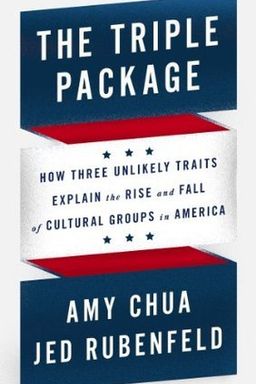
The Triple Package cover

The Triple Package

by Amy Chua and Jed Rubenfeld

The Triple Package explores the paradoxical traits that drive some cultural groups to success in America: a sense of superiority, deep insecurity, and impulse control. Unpacking these forces, the authors reveal the cultural and psychological dynamics that fuel achievement and the unintended consequences that come with it.

The Triple Package and the Secret of Success

Why do certain immigrant and cultural groups in America consistently outperform others in education, income, and mobility? Amy Chua and Jed Rubenfeld’s The Triple Package argues that the answer lies not in genetic difference or privilege but in a distinctive cultural formula—a trio of psychological traits that interact to produce disproportionate success. This trio, called the Triple Package, is made up of a superiority complex, a productive form of insecurity, and disciplined impulse control. Each on its own is incomplete, but together they trigger ambition, resilience, and achievement across generations.

The engine of cultural success

The Triple Package describes a paradox: groups that see themselves as exceptional yet also feel underestimated generate enormous drive. Superiority instills confidence; insecurity provides the hunger to prove worth; impulse control channels both into sustained discipline. This triad appears across cultures, from Mormon missionary rigor to Jewish scholarship, Chinese academic drilling, and the occupational networks of Cuban exiles or Nigerian immigrants. The authors argue that these cultural legacies explain outsize professional and academic results better than raw IQ or selective immigration alone.

For example, Jewish families transmit moral and intellectual pride through centuries of legal study and ritual self-restraint; East Asian families emphasize discipline and filial honor through practices like extra tutoring and restricted socializing; Mormons institutionalize willpower through years of missionary training and community obligations. Cuban and Iranian émigrés illustrate insecurity turned into energy after status collapse: professional elites who lost everything channeled humiliation into rebuilding their prestige from scratch. What unites these cases is not geography or race, but a cultural formula that converts psychological tension into achievement.

Beyond genetics and selection

The book takes aim at two popular myths. First, the idea that immigrants succeed mainly because of selection: while elites from India or East Asia may arrive with high education, similar success among low-skilled Chinese or West Indian immigrants suggests culture matters more than credentials. Second, the notion that group-level IQ differences explain everything. Studies by scholars such as James Flynn show that measured IQ fails to fully predict outcome disparities. Many groups outperform what IQ would predict because their cultures activate effort, constraint, and long-term goal orientation—what social psychologists call self-regulation or grit.

The authors also integrate sociology: stereotype threat and stereotype boost research show that cultural narratives shape measurable performance. Positive identity messages—like Asians being "good at math" or Jews valuing study—can act as self-fulfilling motivators, while negative stereotypes depress outcomes. Culture therefore amplifies potential that raw ability alone cannot realize.

Costs, contradictions, and the national story

The Triple Package is a double-edged sword. Its components that drive success also create vulnerability. Insecurity can mutate into chronic anxiety; superiority into arrogance or intolerance; impulse control into rigidity and burnout. The same families producing prodigies often also produce emotional distress. Jewish and Asian American memoirs reveal children who internalize impossible perfectionism; Mormons experience pressures to conform; immigrant parents sometimes impose achievement as repayment for sacrifice. The book insists you must weigh the psychic cost of relentless striving.

On a societal level, productive superiority can degenerate into chauvinism. Cuban exiles defining themselves as distinct from other Hispanics, or nationalist movements grounded in moral exceptionalism, show how pride can harden into prejudice. The authors caution that collective success requires tempering confidence with inclusivity.

America's changing relationship to the Triple Package

Chua and Rubenfeld close with a provocative extension: America itself was once a Triple Package nation. The Puritan ethic embodied impulse control; revolutionary insecurity fueled ambition; and a sense of exceptional destiny supplied national confidence. Over time, postwar prosperity and the self-esteem revolution eroded two of these elements—insecurity and restraint—while amplifying a brittle form of superiority. The decline in delayed gratification shows up in consumerism, debt, and policy short-termism. Reclaiming productive insecurity and renewed impulse control, they argue, is key to restoring mobility and long-term dynamism.

Core insight

Cultural success depends on a paradoxical mix of pride and doubt, drive and restraint. When a community believes it is destined for more but must struggle to get there, it creates the motivational engine behind mobility. When those cultural levers weaken—through comfort, excessive pride, or lack of trust in institutions—ambition collapses. The Triple Package encourages you to harness constructive tension rather than flee from it.

In this way, The Triple Package offers both a sociological explanation and a moral argument. Success is not just about opportunity, but about how cultures teach the will to seize it. The book invites you to learn from successful groups—not to worship their doctrines but to adapt their virtues: pride balanced with humility, insecurity redirected into drive, and willpower anchored to purpose.


Superiority and the Power of Identity

The first pillar of the Triple Package is superiority—a deep-seated belief that your group or mission is special. This idea is not about arrogance; it’s about identity. You succeed partly because you believe you can. The book demonstrates how groups sustain that belief across generations through story, ritual, and moral narrative.

Sources of superiority

Superiority draws from varied sources: religious chosenness (Jewish covenant identity), providential destiny (Mormons seeing America as theology in action), ancient civilization pride (Iranians tracing lineage to Persia, Chinese to 5,000 years of civilization), or caste and lineage honor (Indians identifying with high-education or professional lineages). Each generates collective confidence—a psychological buffer that enables persistence under hardship.

For example, Jewish communities fused chosenness with ethical duty: obligation to wisdom and justice transforms superiority into moral mission. Mormon theology reframes exceptionalism as service; their missionary structure teaches leadership through constraint. Chinese and Persian identity narratives bind national humiliation with pride, motivating recovery and excellence. Even among exiles or minorities, superiority often survives precisely because it resists mainstream assimilation, preserving the idea “we are special even if the world doubts it.”

Constructive vs. destructive superiority

Superiority can elevate or distort. The book distinguishes inclusive pride—anchored in moral universalism—from exclusionary chauvinism. America’s founding ideal of exceptionalism was meant to be aspirational, not tribal. By contrast, national or religious movements that define uniqueness through contempt (imperial Japan, Nazi Germany) show its dark extreme. Chua and Rubenfeld invite you to examine how pride functions in your own context: does it inspire contribution or breed superiority complexes?

Insight

Healthy superiority is a psychological defense: it builds confidence against prejudice and fuels aspiration when objective conditions do not favor you. Used wisely, it becomes strength under stress; used bitterly, it plants division.

In America’s plural society, the challenge is to cultivate inclusive superiority—a belief in excellence that welcomes others to share it. That form turns identity from a wall into a wellspring of collective energy.


Insecurity as Drive

The counterintuitive core of the Triple Package is insecurity: the feeling that you are never good enough. Rather than paralyzing, this emotion becomes fuel. You act because comfort feels unsafe. The book frames this hunger as the invisible partner of superiority—it keeps pride from devolving into complacency.

Immigrant anxiety and status collapse

Immigrants embody this dynamic vividly. Cuban exiles arrived as displaced elites, humiliated yet proud. The shock of “NO DOGS, NO CUBANS” signs turned wounded pride into ferocious ambition, rebuilding Miami’s economy and politics. Iranian immigrants after 1979 experienced similar drives—Persian cultural pride fused with exile’s insecurity to produce high educational and entrepreneurial attainment. Sociologist Min Zhou calls this "reactive ethnicity": insecurity sharpened into motivation.

Family culture of redemption

Within families, superiority and insecurity fuse through relentless expectations. East Asian “99 vs. 100” logic—why not perfect?—and Jewish insistence that grades redeem parental sacrifice embody moralized ambition. Parents convey two messages at once: “You are blessed” and “You must prove worthy.” That inner conflict forms the psychological kernel of drive. Even outside cultural contexts, individuals like Steve Jobs reflect this mix personally—combining conviction of unique insight with insecurities rooted in childhood displacement.

Ethnic armor and stereotype boost

Insecurity also interacts with social perception. Groups exposed to prejudice often cultivate "ethnic armor"—defensive pride that shields self-worth. Nigerian Americans reference Igbo and Yoruba achievements as insulation against stereotypes, while positive cultural narratives (e.g., “Asians excel in school”) statistically correlate with actual performance gains due to expectation effects. The delicate paradox is that feeling underestimated—and believing you can prove others wrong—is among the most reliable motivators of human achievement.

Productive insecurity distinguishes ambition from arrogance. It reminds you that believing in greatness doesn’t excuse you from earning it.


Impulse Control and the Discipline Advantage

Impulse control—the ability to delay gratification and persist through discomfort—is the bridging element that makes superiority and insecurity effective rather than chaotic. It transforms high expectations into consistent effort. Modern psychology calls this grit, self-regulation, or delayed gratification.

Science of self-control

Studies like Walter Mischel’s famous marshmallow test demonstrate that children who wait for two rewards outperform peers decades later in academics, health, and happiness. Angela Duckworth’s work on grit and Roy Baumeister’s research on willpower reinforce that self-control predicts success as strongly as IQ. The book weaves these findings into cultural analysis: groups that institutionalize patience—through rituals, missions, study, or strict parenting—tend to sustain high mobility.

Cultural incubators of willpower

East Asian traditions teach chi ku (“eating bitterness”): mastering discomfort through repetition. Mormons formalize willpower in two-year missions that demand sacrifice and service, while Orthodox Jewish routines reinforce habit and restraint through law and ritual. These daily structures amount to psychological training for perseverance. Even when modernization lessens strict observance, the inherited discipline persists.

The transfer effect

Impulse control compounds across domains: practicing piano strengthens study habits; academic discipline fosters professional reliability. Parents who enforce routines cultivate children who persist. The mechanism is cumulative self-regulation—a habit of persistence that transfers universally. The authors present examples from Juilliard alumni to Intel award winners as evidence that endurance trumps innate talent.

Endurance as virtue

When a culture moralizes restraint—honoring the one who studies, the missionary who serves, or the child who practices daily—it converts effort into virtue and patience into prestige. That builds social capital not just for individuals, but entire communities.

Yet the book also cautions against overcontrol. Excessive pressure can breed anxiety and rebellion. The deepest lesson is balance: teaching self-mastery without suffocating individuality.


When Culture Overrides IQ and Selection

One of the authors’ most controversial claims is that cultural factors—not IQ or immigrant selection alone—explain group success in modern America. They marshal sociological and psychological evidence to show how the Triple Package reshapes outcomes across differing abilities and backgrounds.

Culture amplifies potential

Immigrant selectivity matters, but it’s incomplete. Highly educated Indians from elite institutes do arrive with privilege, but the children of Chinese restaurant workers still reach top New York high schools. Nigerian Americans, despite modest starting resources, dominate elite campuses relative to population share. Culture—not just credentials—determines how families translate opportunity into progress.

IQ as partial predictor

The authors draw on James Flynn’s analysis: measured IQ differences cannot fully predict life outcomes across groups. Asian Americans outperform their IQ baselines, suggesting that discipline and expectation create leverage on equal cognitive foundations. Motivation converts capacity into results. IQ may set a ceiling, but culture determines height reached.

The interplay of stereotype and self-view

Claude Steele’s concept of stereotype threat—and its converse, stereotype boost—shows how identity perception interacts with performance. Positive stereotypes reinforce effort: when Asian students are reminded of cultural math prowess, scores rise. Immigrant children internalize positive narratives as obligations, driving hard work that “matches the story.”

Core message

Selection provides ability; culture provides utilization. IQ gives you potential; the Triple Package supplies motivation and method.

Instead of asking whether genes or opportunity bins explain success, ask how culture multiplies opportunity. The authors propose policies that expand stable institutions—schools, savings frameworks, community rituals—so impulse control becomes rational for all, not just for the privileged.


The Dark Side of Drive

Every strength shadows a weakness. The same cultural formulas that propel achievement can also breed anxiety, exclusion, and ethical lapses. The Triple Package dedicates an unflinching section to these consequences, arguing that success culture, if left unchecked, can destroy the wellbeing it seeks.

Psychological and family costs

Relentless expectations generate chronic stress. East Asian and Jewish students often exhibit the lowest self-esteem despite the highest academic outcomes. Accounts from Amy Tan and Philip Roth capture that lifelong sense of never being enough. Among Mormons, intense communal discipline builds unity but limits individual roles, especially for women. Children of Holocaust survivors or war refugees describe perfectionism as inherited trauma—a demand to redeem parental suffering.

Social and moral consequences

Superiority narratives risk exclusion. Some groups define identity through contrast—Cuban exiles distinguishing themselves from other Hispanics; religious groups enforcing inward hierarchies. Pride curdles into disdain when recognition becomes proof of worth. On the moral plane, unbridled drive can produce greed and self-rationalization: figures like Rajat Gupta exemplify ambition unmoored from ethical restraint.

Lesson

Drive without reflection can erode empathy and integrity. Cultural tools must serve human values, not replace them.

There is also a life-cycle risk: as groups assimilate and become comfortable, insecurity fades, and success erodes. History shows waves of rise and decline—WASPs relinquishing dominance, second-generation prosperity dulling vigilance. The cure, say the authors, is to use the Triple Package as scaffolding: climb with it, but step off once you can sustain confidence without obsession.

Seen this way, the book’s moral is stoic: ambition should serve meaning, not identity wars or endless competition. Achievement alone is not fulfillment.


America’s Cultural Drift

The final section broadens the lens from ethnic groups to the nation as a whole. America itself once embodied all three elements of the Triple Package. Today, argue the authors, it possesses confidence without hunger, ambition without discipline. The result is cultural drift—economic short-termism and eroding social trust.

From Puritan thrift to present bias

Early America balanced individualism with restraint: Puritan work ethic, constitutional checks, and frontier insecurity created enduring prosperity. Postwar affluence and the self-esteem revolution of the 1970s reversed these virtues—teaching that self-approval matters more than earned mastery. National saving fell, public debt rose, and politicians prioritized immediate gratification over infrastructure and education. The same psychological shift that afflicted families echoed in national policy.

The 2008 collapse as cautionary tale

The financial crisis dramatized what happens when insecurity and impulse control vanish. Banks chased instant profits, consumers borrowed recklessly, and regulators believed the boom immortal. The cultural traits that made earlier generations patient and skeptical gave way to entitlement and shortsightedness. Recovering a healthy Triple Package is, for the authors, not nostalgia but practical necessity.

Policy implication

Deferred gratification requires trust: children delay rewards only when promises are credible. Similarly, citizens invest for the future only when institutions keep faith. Strengthening reliability—schools, courts, safety nets—is as vital to impulse control as family values.

By ending here, The Triple Package turns from ethnography to national ethics. Cultural confidence must couple with productive insecurity and the discipline to plan across generations. Without that balance, both individuals and nations risk mistaking comfort for success.

Dig Deeper

Get personalized prompts to apply these lessons to your life and deepen your understanding.

Go Deeper

Get the Full Experience

Download Insight Books for AI-powered reflections, quizzes, and more.