
Idea 1
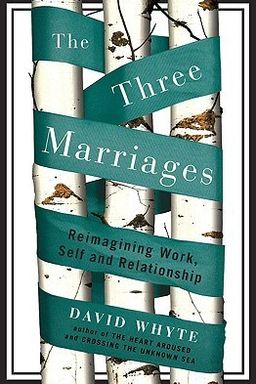
The Three Marriages: Integrating Work, Self, and Relationship
Have you ever felt torn between the demands of work, the pull of your relationships, and your own nagging need for inner peace? In The Three Marriages, David Whyte argues that our culture’s obsession with “work-life balance” is not only misguided—it’s impossible. According to Whyte, life isn’t something to be divided into competing zones of productivity and rest. It’s an ongoing conversation between three lifelong commitments: the marriage to a partner or others, the marriage to one’s work, and the marriage to oneself.
Whyte contends that to live fully, you must stop trying to manage these realms as if they were separate and instead view them as interconnected marriages—each requiring devotion, intimacy, endurance, and renewal. Trying to achieve balance between them only exhausts you, forcing one marriage to suffer for the survival of another. True fulfillment comes from recognizing how they converse and support one another, forming what Whyte calls a “marriage of marriages.”
The Myth of Work-Life Balance
At the heart of Whyte’s argument is a challenge to one of modern life’s most cherished illusions: work-life balance. He sees the phrase as a cultural error—a punishment disguised as wisdom. “Work-life balance” implies that work and life are separable, measurable, and opposable, when in reality, life itself is the conversation between our commitments. Whyte argues that by compartmentalizing our existence, we rob ourselves of integration—the sense that our daily actions reflect our deepest selves. Instead of balance, what we need is synthesis.
Each marriage—work, self, and other—is nonnegotiable. Neglect one, and the others falter. Yet each speaks its own language, pushing and challenging the others. The marriage to work asks for perseverance and passion; the marriage to others asks for vulnerability and love; and the marriage to the self requires silence and self-compassion. A well-lived life, Whyte insists, depends not on balancing these forces but on letting them converse, even when those conversations are difficult.
The Three Lifelong Conversations
Whyte structures his book around these three marriages: each introduced through poetry, biography, and spiritual reflection. The first marriage—between yourself and another person—is familiar to most people. It’s marked by attraction, commitment, disappointment, and renewal. Drawing on Jane Austen’s wit and Robert Louis Stevenson’s courage in pursuing Fanny Osbourne, Whyte reveals how the hunger for union teaches us about our capacity for vulnerability and courage. The marriage to another demands that we risk everything and “dare everything,” as Stevenson put it.
The second marriage—to work—parallels romantic devotion. Whyte recalls how Wordsworth, Dickens, and Joan of Arc found vocations that made them “dedicated spirits.” Work, he writes, is not a series of tasks but a form of love—a passionate pursuit that shapes your identity. Like a relationship, your vocation asks for courtship, perseverance, boredom, and recommitment. It invites you to fall in love and then to endure.
The third marriage—to the self—is the most elusive. It demands solitude, forgiveness, and attention. Whyte draws on Buddhist teacher Pema Chödrön (formerly Deirdre Blomfield-Brown), who discovered peace through depression, loss, and meditation. He also explores his own Himalayan encounters where exhaustion and beauty forced him to confront a “pathless path”—an invisible way toward self-recognition. The marriage with the self is not narcissistic but sacred. It’s where all conversation begins.
An Invitation to Belonging
Whyte’s work is deeply poetic, but his message is practical. You belong to these three marriages whether you acknowledge them or not. You cannot divorce your self from your work without losing vitality; you cannot sustain a love without finding solitude; and you cannot honor your inner life without expressing it in your relationships or work. Whyte invites you to stop measuring success by balance sheets or productivity charts and instead to listen for the “invisible conversation” that connects all three parts of your life. Each marriage gives language to the others. Each reveals what it means to be human.
In his final analysis, Whyte offers an alternative to balance: grace. To live gracefully is to accept the imperfection of each marriage—the irritations, the fatigue, the moments of mystery. It means refusing to compartmentalize and daring to see wholeness where others see conflict. “We should not feel embarrassed by our difficulties,” Whyte reminds us, “only by our failure to grow anything beautiful from them.” The quest is not for equilibrium but for connection. The reward is not balance—it is belonging.