
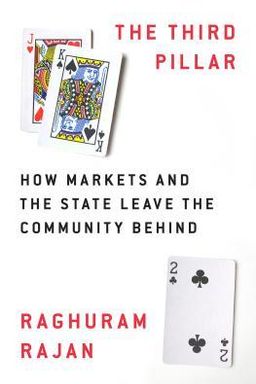
Idea 1
The Three Pillars of Society
How can societies remain prosperous, fair, and stable amid rapid technological and political change? Economist Raghuram Rajan argues that every successful society stands on three interconnected pillars: the state, the market, and the community. The state provides security, the rule of law, and essential public goods; markets generate opportunity and innovation; and the community grounds people in relationships, trust, and identity. When these pillars are balanced, societies thrive. When one dominates, the structure wobbles.
Rajan’s thesis is at once historical and prescriptive. He shows how communities once mediated between individuals and institutions, but waves of industrialization, globalization, and government centralization eroded their capacity. The result is a fraying of social bonds, populist anger, and loss of belonging. His remedy—what he calls inclusive localism—invites you to restore power to local communities without abandoning open markets or capable states.
How the three pillars evolved
Medieval Europe was organized around tight community networks—villages, guilds, and the Church. Markets were limited, and the state was weak. As trade revived, the introduction of enforceable debt contracts allowed lending across social boundaries and gave rise to impersonal markets. Over time, property rights, contract law, and restrained monarchies created the limited state—the framework markets needed to grow. England’s Glorious Revolution and institutions such as the Bank of England illustrate how states gained power by limiting arbitrariness and earning public trust.
Industrialization and rising global trade then expanded market power further. But when competition led to monopolies—from Rockefeller’s Standard Oil to modern platform champions—democratic movements and regulatory reforms stepped in. Throughout history, markets and states alternately checked and reinforced each other. Community, however, gradually lost influence, as welfare systems and bureaucracies displaced local initiative, and global corporations disrupted geographic ties.
When imbalance sets in
The twentieth century tilted power toward the state after the Great Depression and two world wars. Centralized welfare programs and national safety nets stabilized democracies but crowded out community engagement. Then, after the 1970s oil shocks and fiscal strain, neoliberal deregulation and shareholder-value ideologies swung the pendulum toward markets. In both cases, communities were weakened—first by dependence, then by neglect.
As technology and trade accelerated in the late twentieth and early twenty-first centuries, local economies and middle-skill jobs hollowed out. Many workers lost not only income but also role and esteem. The result, Rajan writes, is the social despair visible in rising deaths of despair and populist backlash. When market and state functions scale globally while the community remains local, the third pillar crumbles under the strain.
What revival looks like
To restore balance, Rajan prescribes inclusive localism: devolving decision-making to communities that can act effectively, while maintaining open national markets and civic cohesion. You see this in places like Chicago’s Pilsen neighborhood, where the Resurrection Project used faith-based organizing and partnerships with local businesses and schools to turn decline into renewal. The guiding logic is that local institutions—community banks, school boards, neighborhood councils—translate soft information into action better than distant agencies or impersonal markets.
Yet inclusive localism is not parochialism. Communities must stay open—to ideas, talent, and trade—so they remain dynamic rather than insular. The state’s task is to build connective infrastructure (roads, broadband, digital access) and guarantee equality of opportunity across localities. Markets should reward initiative but be embedded in fair competition and moral legitimacy. Together, these actions rebuild the interdependence of all three pillars.
Core message
Whenever one pillar of society—state, market, or community—grows too strong or too weak, the whole system destabilizes. Rebalancing means re-empowering the community without rejecting global markets or the modern state.
Reading The Third Pillar is like tracing the architecture of civilization: how we moved from moral economies rooted in villages to global networks bound by code. Rajan urges you to look beyond policy silos and see that sustainability—economic, political, and moral—depends not only on rules and contracts, but on the proximity, trust, and dignity that only living communities can provide.