
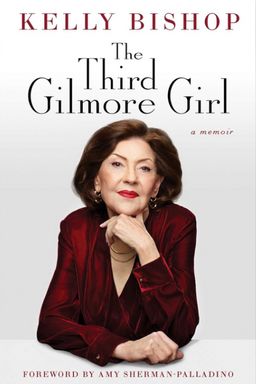
The Third Gilmore Girl cover

The Third Gilmore Girl

by Kelly Bishop With Lindsay Harrison

The dancer and actress, who appeared in “A Chorus Line,” “Dirty Dancing” and “Gilmore Girls,” imparts insights on career longevity.

Reinvention, Craft, and Courage

When life doesn’t give you the role you wanted, how quickly can you rewrite your part? In The Third Gilmore Girl, Kelly Bishop argues that the arc of a creative life is sustained not by luck or even talent alone, but by an ethic of reinvention, exacting craft, and principled courage. Bishop contends that staying power in the arts—and in any demanding field—depends on your willingness to learn the next thing, say no when it counts, and claim authorship over your story even when the industry, the culture, or fate tries to write it for you.

Across seven decades—from ballet-barre beginnings in Denver, to a Tony-winning turn in A Chorus Line, to screen work that made her Emily Gilmore iconic—Bishop demonstrates how you survive by refusing false choices: between ensemble and excellence, between ambition and integrity, between love and autonomy. Her memoir isn’t a "how I got famous" reel. It’s a deeply practical playbook for building a durable creative life—one marked by discipline (daily class, immaculate preparation), difficult calls (refusing a lucrative tour, ending a marriage, choosing an abortion), and a fierce allegiance to one’s own center of gravity.

From barre to Broadway to Stars Hollow

Bishop’s story begins with an eight-year-old in Denver learning pliés in a basement from her mother, Jane—a gifted pianist who bartered accompaniment to pay for her daughter’s ballet lessons after Bishop’s father refused ("He wasn’t warm. Well, not to her, well, not to us."). Under the demanding Romanoffs of American Ballet Theatre’s Denver school, Bishop learns rigor, silence, and the power of two words of praise—"okay" and "good." A humbling rejection from ABT’s New York auditions (where Lucia Chase won’t meet her eye) becomes the first great test: she pivots to the corps de ballet at Radio City Music Hall, then to show dancing, Vegas pep pills, and the hard decision to come home and reset. The lesson is not that dreams die, but that they molt.

The catalytic turn arrives with A Chorus Line. She says yes to an after-hours confessional circle of dancers, refuses to be manipulated by Michael Bennett, and then—after a bruising detour into a winter tour of Irene—gets bought out of her contract so she can create Sheila Bryant. The book’s most luminous hinge is hearing "At the Ballet" for the first time and realizing the lyrics are pulled from her own taped words about a fragile childhood and a mother who said she’d be "different" but not pretty. Acting, not just dancing, becomes home—"a play set to music." The Tony follows. So does a signature line from her acceptance speech—"Welcome to my theater."

A principled career built on saying no—and yes

Repeatedly, Bishop shows how boundaries create mobility. She stands up to Bennett over a flesh-colored leotard (then admits when the choice is right). She asks for a raise—and when refused, walks away at the peak, rather than tour to LA with the original cast. She rejects a steady chorus career to pursue acting because Elaine Stritch proves that character can trump vocal velvet (see also Patti LuPone’s memoir for a companion thesis). She leverages an "accidental" SAG name-change debacle into a permanent reinvention from Carole to Kelly, so her stage and screen selves align.

Onscreen, she learns the machinery of film (matching, energy on take ten), does soaps without snobbery to pay the bills, then lands a tiny role in Dirty Dancing—and is recast on arrival as Marjorie Houseman, the mother, working through to the end of the shoot. Serendipity, in Bishop’s world, favors the prepared and the brave. (Compare Twyla Tharp’s The Creative Habit: readiness is a discipline, not a mood.)

The love that steadies the work—and the grief that reshapes it

The memoir is also a love story. Bishop’s marriage to broadcaster Lee Leonard becomes a masterclass in partnership: honest, funny, allergic to drama, and mutually ambitious. Through ESPN and CNN, firings and new starts, cross-country moves and golf, they choose each other’s thriving. Later, Bishop walks us through hospice, the daily courage of presence, and the uncanny moments that suggest the bonds between lives don’t end at a last breath. That tenderness infuses her portrayal of Emily Gilmore in Gilmore Girls—a woman armoured in social codes yet cracked open by love and loss.

Why this matters for you

If you’re wrestling with a career pivot, setting boundaries, or wondering if the disciplined life is worth it, Bishop’s answer is yes—if you harness stamina to principle. You’ll see how to convert rejection into redirection; how to turn a "Gee, I wish…" into a phone call you’re ready to answer; how to insist that decency and craft can coexist with ambition. You’ll also get a candid, non-polemical account of reproductive choice (a Planned Parenthood counseling protocol that respected agency), activism (marching in DC with Amy Sherman-Palladino), and aging with intention (choosing when not to chase youth).

Working credo

“If I don’t earn it, I don’t want it.”

In the pages that follow, you’ll trace Bishop’s formative years (and the mother who saved her), the improbable birth of A Chorus Line, the craft-and-boundary toolkit she forged through personal crucibles, the soulmate marriage that anchored the art, the creation of Emily Gilmore with Amy Sherman-Palladino, and the long view on grief, health, and working well into later life. Read it as a backstage pass, a survival manual, and a reminder that the best work still begins—always—at the barre.


From Basement Barre to Radio City

Bishop’s first act is a study in grit, resourcefulness, and the right kind of mentorship. You watch a child who hates school but loves exacting effort discover that ballet gives her life borders, purpose, and a daily reason to get better. That discovery doesn’t happen because the world makes room; it happens because her mother, Jane, barters her piano talent when Bishop’s father refuses to pay for lessons. That choice—one woman’s agency against scarcity—becomes the book’s genetic code.

The Romanoffs and the religion of rigor

Under Dimitri and Francesca Romanoff at the American Ballet Theatre school in Denver, Bishop internalizes a severe, high-standard culture. Students are seen, not heard. Praise is rationed. But rigor binds to love; she thrives on her mother’s quiet pride. When Romanoff arranges ABT classes in San Francisco and photo packets to Lucia Chase, Bishop can taste her dream. Then Chase never shows—and later, in New York, twice ignores Bishop during corps auditions, passing her over for weaker dancers. The truth lands hard: merit doesn’t always decide. (If you’ve read Patti LuPone’s memoir, you’ll recognize this theme of gatekeepers and grit.)

Her response isn’t to quit—it’s to pivot. Radio City’s corps de ballet audition is tougher than ABT (slippery floor; 16 fouettés on command), but the job comes. The pay is meager ($90/week; $83 take-home) and the hierarchy sharp—the Rockettes are the draw, the ballet corps the “art.” Yet this is a laboratory: a strict schedule, blistered feet, performance stamina, and, crucially, the discovery that she doesn’t want stardom; she wants to work well in a company. That ethos will anchor her later in Gilmore Girls, where ensemble—not ego—wins.

First love, first reset: Roy and Las Vegas

Bishop’s first serious relationship—with fellow dancer and gifted photographer Roy Volkmann—unlocks tenderness and creative play. He photographs her after shows; she becomes his test subject for lenses, light, and technique. Their move to Harrah’s (Lake Tahoe) and then Las Vegas adds character dancing and jazz (Wonder World with choreographer Michael Kidd; a young Morgan Freeman among the dancers) to her toolkit. It also introduces the period’s occupational hazard—"pep pills" to get through triple-show days—and the hard clarity to quit them on the drive back to New York. The break with Roy is amicable; he will become a renowned dance photographer. She returns east with a stronger self—technically broader, emotionally steadier, financially sober.

Lesson set for you

  • Rigor is portable. If a gate shuts (ABT), take your discipline where your work can live (Radio City, show dance).
  • The right mentors matter. The Romanoffs form Bishop’s spine; they also model generosity (free tuition for Saturday help) you can mirror later.
  • Hierarchy can teach you. Being "the art" not the draw taught Bishop to prize company over spotlight—an antidote to burnout.

By the time Bishop moves from the Music Hall to Broadway auditions, she’s learned a durable truth: you can keep your center in the churn if you travel with your craft and your standards.


The Night Sheila Bryant Was Born

A Chorus Line doesn’t materialize as a role; it emerges from a roomful of vulnerable dancers who decide their lives are material. Bishop walks into the Nickolaus Exercise Center on January 26, 1974, sits opposite Michael Bennett (whom she’s sparred with since Promises, Promises), and watches honesty alchemize into art on Bennett’s reel-to-reel tapes. Those circles become workshops; workshops become a show with Joseph Papp’s backing, Marvin Hamlisch’s score, and Ed Kleban’s lyrics. Bishop misses the second magic tape-night, endures a dead second session, then waits while nothing happens—an apprenticeship in uncertainty you’ll recognize if you’ve ever built something from scratch.

Irene vs. the future—and one lifeline call

Flat broke after a gambling husband drains her finances, Bishop takes a winter tour of Irene with Jane Powell. It’s Christmas Eve in a Denver hotel, her dog Venus beside her, the loneliest night of her life. Then rumors: Bennett has money; Chorus Line is moving. A hotel slip—“Call Michael Bennett”—becomes a hinge. He buys her out of her six-month Irene contract ("What I do mind is that now I owe Howard Feuer a favor."). Bishop refuses his offer of a loan (“I don’t borrow money. I have to earn it.”). Back in New York, she lands Sheila, the wary, witty, older dancer with heat and armor—"very much me, with added sass."

Writing the role, writing the self

In the Public Theater rehearsal room, Bishop reframes Chorus Line as "a play that happens to be set to music" and resists the trap of being "not-half-bad" as a new actor. She crafts a fierce bio for the Playbill—“Carole Bishop (Sheila) has survived in show business for twelve years.”—a declaration that she’s no longer the chorus. When Bennett slashes her monologue and adds "At the Ballet" (a trio), panic gives way to awe as she hears Kleban’s lyrics quoting her childhood confessions verbatim. The song is an x-ray of a little girl in a hard house who found a temple in tendus.

A costume, a concept

Bennett and costume designer Theoni Aldredge choose a flesh-toned leotard Bishop hates—until Bennett says under the right light she "looks like a naked, vulnerable little girl." Bishop relents. Concept beats vanity.

The Tony—and principled friction

The Shubert opening is a cultural event; Bishop’s night of nights ends with Jerry Lewis reading “Kelly Bishop”—her new name’s debut—and Bishop offering a seven-word mic-drop: “Welcome to my theater.” She and best friend Priscilla Lopez both get nominated; Bishop wins; their friendship holds (a rebuke to scarcity thinking). Months later, Bennett wants to tour the original cast to the West Coast. Bishop says no—on economics (she’ll save $200/week; he offers to bank it, she refuses) and ethics (New York audiences paid to see the originals). He tries a threat—someone else will be Sheila in LA—she shrugs: “You shouldn’t.” She stays, asks for a raise at renewal; he denies it; she exits. Courage to leave at the top becomes a career multiplier (see also Lin-Manuel Miranda stepping back from Hamilton).

For you, the Chorus Line chapter is a template: build with honesty; protect your boundaries; choose concept over vanity; and remember that sometimes the bravest move is to go home while the ovation is still loud.


Choosing Yourself (Even When It Hurts)

Bishop’s most bracing pages aren’t about work but about self-respect forged in painful choices. She falls for a married publicist during Golden Rainbow, ends the affair because loving him means hurting a woman who likely loves him too. She marries Peter Miller, a charming Promises, Promises stagehand who’s also a compulsive gambler and liar. The marriage becomes a seminar in sunk costs: pawned gifts, debts, a dog spayed as proxy for a child Bishop refuses to have. She loses her penthouse co-op to a defaulted Actors’ Equity loan she took to cover Peter’s debts. She gets out. "Anyone who’s married to an addict who shows no interest in doing anything about it needs to be prepared… to get out."

The abortion she will not apologize for

Later, with Kevin—a celebrity-adjacent schmoozer whose gun butt is meant to telegraph power—Bishop gets pregnant after a single "it’ll be okay this once" lapse in her post–pill condom rule. Her account of Planned Parenthood’s protocol is concrete and humane: a two-hour counseling conversation, a 48-hour wait, and then a safe procedure. She feels sadness and anger at herself, but no regret. The decision is hers, and the telling is free of showy guilt or ideology—just accountability, dignity, and the declaration that motherhood is not a default identity. (Compare also Joan Didion’s cool moral clarity in her essays; different subject, similar refusal to emote on command.)

The runway to "no"

Bishop learns to preempt drift with boundaries: she tells the Milliken Breakfast Show she’s done with chorus work—and is immediately invited to audition for a principal role. She turns down dependable work to audition for Anita in West Side Story; when life intervenes, the part finds her later anyway. Over time the "no" hardens into ethos: no to borrowing money; no to touring when it violates principle; no to a second-rate relationship living rent-free in her apartment; no to parenthood as a social duty.

Boundary as career strategy

“If the interest continues, you’ll have to go to LA to audition for the suits,” her agent says about Gilmore Girls. Amy Sherman-Palladino says no—"I have my Emily." Bishop’s work spoke; her boundaries didn’t bar the door.

You may not face the same stakes, but you’ll likely meet the same pattern: moments when the only way to keep your life is to disappoint someone else’s idea of it. Bishop’s advice—unstated but lived—is to be brave enough to be the one who leaves.


Partnership as a Creative Superpower

When Bishop meets Lee Leonard—a tall, erudite New York TV host—on Midday Live, she worries he’ll see her as the ex of a man who “hated that guy.” Instead, dinner becomes a conversation without games. He’s candid: he loves his daughter and knows he isn’t a "family man" who wants more children. She’s candid: she never wanted them. The fit is instant and grown. Their Bronx courthouse wedding is unglamorous; their marriage is luminous—partners, lovers, best friends who want the other person to work and to win.

Two careers, one home team

Leonard co-anchors ESPN’s first SportsCenter, then bolts to CNN’s People Tonight. He helps launch Pee-wee Herman, Tom Hanks, Tom Cruise; covers the deaths of Natalie Wood and John Lennon. Then CNN fires him without warning and replaces him with Mike Douglas. Bishop hustles summer stock (Pal Joey) to float the household; Lee rebuilds with News 12 New Jersey. Their ethic is mutuality: she takes soaps when needed (to prove, not disprove, Michael Bennett’s warning that they "ruin your acting"); he insists she keep working when Gilmore Girls requires a bicoastal life, even as he battles multiple cancers. They golf; they laugh; they walk each other to every finish line they can.

How a good marriage changes your work

Leonard’s steadiness frees Bishop to take bigger risks. She buys her own apartment outright because she hates owing money—an ethic he shares. She asks Amy Sherman-Palladino for a schedule that lets her be with Lee during radiation; Amy rethreads production to give Bishop two weeks home at a time. When Bishop’s career needs ballast, Amy brings her to march for abortion rights in DC, then later writes her into Bunheads and The Marvelous Mrs. Maisel. Partnership, in Bishop’s life, multiplies career possibility because it reduces fear. (Shonda Rhimes makes a parallel point in Year of Yes about the life systems that make audacity sustainable.)

A marriage credo

“This man will never bore me,” she thinks. Decades later, as she heals from fractures and he whispers, “I love you so much it makes me want to cry,” you see why she was right.

If you’re wondering what a generative creative partnership looks like, study this: candor at the start, admiration in public, fierce private loyalty, and permission—for both—to keep making new work.


Becoming Emily Gilmore

Gilmore Girls is the second great hinge of Bishop’s life, and her account demystifies both the artistry and the logistics. Pilot season 2000 is full of Sopranos-lite comedies; Gilmore Girls reads different—razor dialogue, humane wit, and a mother-daughter friendship Bishop recognizes from her own bond with Jane. She auditions in New York. Network executives want another round in LA; Amy Sherman-Palladino refuses: "I have my Emily." Bishop flies to Toronto to shoot the pilot and meets Lauren Graham and Ed Herrmann—colleagues who feel like old friends. Alexis Bledel, new and luminous, is gently guided by Graham’s hand to her marks.

Building a character from the inside out

Emily Gilmore isn’t a cartoon matriarch; she’s a woman raised by rules that kept her safe and separate. Bishop and Amy lace Emily’s steel with wounds you can glimpse if you’re watching. A spa scene confession about not knowing how to be friends with your children; a tiny criminal joy at stealing robes with Lorelai just to have a secret together; later, the legendary DAR blow-up where grief strips propriety and Bishop gets to say the word "bullshit" three times because Netflix isn’t the WB. Wardrobe (St. John knits), jewelry (a gold Omega collar; Ross-Simons earrings), and set detail do the rest.

On set, Bishop and Herrmann share a trailer and the New York Times crossword; their theater reflexes mean they’re always first seated at the Gilmore dinner table. "Are we assholes, or what?" she jokes. “We’re theater people,” he replies. Workmanlike pride saturates the show’s decency toward men—one reason Bishop thinks returning soldiers and young boys binge it.

Separation, vow renewal, and a war cry at center table

Season five’s 100th episode gives Emily and Richard a vow renewal. Herrmann’s speech ends with a wink to “Wedding Bell Blues”—“Tonight, and tonight only, my name is Bill.” Earlier, a Tennessee Williams–tinged episode lets Emily drink, smoke, and call her late mother-in-law an "old harpy," revealing the grief under her needlepoint. And at a DAR event organized by Rory, Emily surgically eviscerates Shira Huntzberger for telling Rory she isn’t "properly bred"—a monologue that ends in the social smile of a woman who just burned down a room.

A line that became legend

“Well then, buy me a boa and drive me to Reno, because I am open for business.”

A Year in the Life—and grief as a writer’s room

Netflix’s revival arrives after Warner Bros. had let Dan and Amy go and the series lose steam in season seven. Between then and the reboot, Amy’s beloved father dies; Herrmann dies in 2014. Emily is newly widowed; Bishop plays her as a raw nerve: decluttering by Marie Kondo, hiring Berta (and Berta’s entire family), trading couture for T-shirts, telling a DAR frenemy that "this whole thing is dead to me… It died with Richard." Bishop thinks Emily would press on to happiness, money secure, tenderness rediscovered. As for the final four words? She’s Team Logan for Rory; Team Luke for Lorelai.

Gilmore Girls cements Bishop’s philosophy: ensemble first, craft over celebrity, and characters drawn with enough mercy that people across ages and genders see themselves in Stars Hollow.


Grief, Health, and Working Long

Bishop’s closing passages are a field guide to living—and working—through loss and age. She loses her mother after an ice storm heart attack and arranges a quiet memorial with photos and coffee, then moves closer to care for her animals and grieve without melodrama. Years later, Lee’s two-decade fight through serial cancers ends at home, on a morning when he seems to be "talking" to someone beyond the window. Hospice is gentle; Bishop is present; a medium later reports details too specific to dismiss (the Erté ring he wore on the left hand, the bench where they sang in the Catskills). She will not say “he died.” She prefers: “Lee left.”

Work as ballast, then as return

After Lee’s passing, a small TV movie in Toronto gets her moving during a winter of negative-four windchill. Halston follows; Bishop plays fashion publicist Eleanor Lambert with sailor’s mouth and spine; then COVID shuts down set life mid-shoot. She adopts Dolly, a foxhound-ish redhead with golden eyelashes who "protects" the mail. She lunches masked with Lauren and Amy and admits the future looks like a blank desert. Amy’s reply is action: three episodes of The Marvelous Mrs. Maisel as Benedetta—"Emily Gilmore on steroids."

A five-day miracle and a health reckoning

Then comes a gift: an indie feature in Salzburg, Austria—The Salzburg Story—with a first-class ticket she can split into two business seats. Priscilla Lopez flies with her; Alexander Lercher’s parents give them a private tour of Mozart’s home and St. Peter Stiftskulinarium; they walk the “love locks” bridge and cry at the Stolpersteine brass plates for Holocaust victims. Back home, Bishop faces a new test: excruciating leg pain sends her to St. Barnabas, where clots and three angioplasties force a clean break with a lifelong cigarette habit. She praises her doctors, calls herself a “fully recovered, healthy nonsmoker,” and notes with wry calm that The Watchful Eye—an elegant Vancouver-shot thriller where she plays Mrs. Ivey—won’t get a second season. Relief and sadness, both.

A philosophy of aging without apology

Bishop had a conservative jawline lift two decades ago and is sanguine about today’s jowls and lines. She refuses to be “one Botox shot away from the Macy’s Parade” and cites European filmmakers who cast older women as they are. She quotes Bette Davis—“Old age ain’t no place for sissies”—then reframes elegy as gratitude. At Hamilton’s 40th A Chorus Line tribute, sadness that "that used to be me" flips to joy: "That used to be me!" She calls herself Pollyanna without shame and offers this, to you and herself: pursue the work that fits your season; celebrate the ones you’ve already had; and keep a short list of “Gee, I wish…” items ready for the next perfectly timed call.

Dig Deeper

Get personalized prompts to apply these lessons to your life and deepen your understanding.

Go Deeper

Get the Full Experience

Download Insight Books for AI-powered reflections, quizzes, and more.