
Idea 1
The Third Chimpanzee: What Makes Us Human—and Dangerous
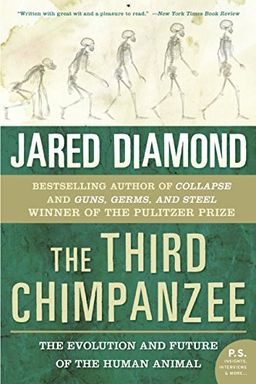
How did we, ordinary apes from Africa, come to dominate the entire planet—and possibly doom it in the process? In The Third Chimpanzee, Jared Diamond argues that humans are essentially the third species of chimpanzee, separated from our ape cousins by a surprisingly small genetic difference but set apart by a colossal behavioral leap. What distinguishes our species most, he contends, is not anatomy or intellect alone, but the cultural and evolutionary forces that gave rise to language, art, agriculture, and conquest—traits that have allowed us to shape the world, for better and for worse.
Drawing from anthropology, evolutionary biology, archaeology, and ecology, Diamond paints a sweeping portrait of humanity’s rise. He shows how tiny changes in our DNA produced language and creativity, how sexual selection shaped our racial and social diversity, and how our unique cultural powers unleashed both civilization’s grandeur and its self-destructive tendencies. Our capacity for cooperation and imagination made us the planet’s rulers—but also its greatest threat, capable of environmental collapse or nuclear annihilation.
From Ape to Human: Evolution’s Smallest Gap
Diamond begins with the genetic evidence: humans share over 98 percent of our DNA with chimpanzees. We are, in his phrasing, just one of three chimpanzee species—the common chimp, the bonobo, and us. What made us different wasn’t a gigantic leap in biology but a subtle reconfiguration of the brain, perhaps a mutation that enabled fine muscle control of the tongue and larynx. This adaptation unlocked language, which in turn unlocked cooperation, planning, and imagination. From this capacity, every distinctly human triumph, from cave paintings to space stations, eventually flowed.
(Diamond’s argument echoes ideas later popularized by Yuval Noah Harari in Sapiens: that language and storytelling allowed Homo sapiens to organize in vast groups and create shared myths. Both authors see language as evolution’s game-changer for social intelligence.)
The Great Leap Forward
Roughly sixty thousand years ago, something happened that transformed anatomically modern humans into behaviorally modern ones—a “Great Leap Forward.” Diamond describes this as the moment when our ancestors began creating art, tools, and trade networks, while their close cousins, the Neanderthals, faded into extinction. He credits this leap to the birth of true language, which not only let humans coordinate and plan but also imagine—the power to conceive tools before building them and to dream of gods before painting them on cave walls.
This shift turned us into an inventive species capable of cumulative culture. Before the Leap, stone tools changed little for a million years. Afterward, technology and art exploded: bone needles, flutes, ivory figurines, and sprawling cave murals, such as those at Lascaux, appeared. The human revolution had begun.
The Double-Edged Sword of Progress
Yet Diamond insists that our evolutionary gifts have brought peril as well as progress. Every human breakthrough—from spreading across continents to mastering agriculture—has come with unintended consequences. Humans wiped out megafauna on every continent they entered. Farming fed populations but also spawned disease, inequality, and environmental degradation. Our intelligence allows extraordinary cooperation but also industrial-scale killing: genocide, ecological collapse, and nuclear war. We are the only species that threatens its own mass extinction through its inventions.
“We are the only species that has enough power to destroy itself—and enough intelligence to know what it’s doing,” Diamond warns. The question is whether we will learn from our past or repeat the mistakes that have ended countless other species.
An Interdisciplinary Map of Humanity
Across the book, Diamond moves from the micro to the macro—from genetic mutations to global civilizations. Part One (“Just Another Big Mammal”) explores our origins, the Great Leap Forward, and the biological roots that tether us to our primate cousins. Part Two (“A Strange Life Cycle”) delves into human sexuality, racial diversity, and why we age. Part Three (“Uniquely Human”) examines our crowning cultural inventions—language, art, agriculture, and technology—and their dangerous offspring, such as drug addiction and environmental destruction. Finally, in “World Conquerors” and “Reversing Our Progress Overnight,” Diamond confronts our darker side: colonial conquest, genocide, and the risk of self-annihilation through pollution or war.
Through case studies—from the extinction of New Zealand’s moas to the genocide of Tasmania’s indigenous people—he shows humanity’s recurring pattern: rapid expansion followed by ecological or moral catastrophe. These cycles raise the haunting question of whether intelligence itself is a fatal adaptation.
Why It Matters Now
Diamond’s message resonates more urgently today than when he first wrote the book in the early 1990s. As climate change, nuclear tensions, and biodiversity loss intensify, his observation that we live under “two clouds”—nuclear war and environmental collapse—rings prophetic. He challenges us to confront our evolutionary inheritance: our brilliance at innovation and equal brilliance at self-destruction. Understanding our past as the “third chimpanzee” may be the only way to ensure we don’t become the last one.
Ultimately, The Third Chimpanzee is a mirror held to humanity: it shows how a slightly smarter ape built civilizations and symphonies, but also weapons and wastelands. Diamond’s challenge to you, the reader, is simple yet profound—can our species use its intelligence to save itself, or will our story end like that of so many others we’ve wiped from the earth?