
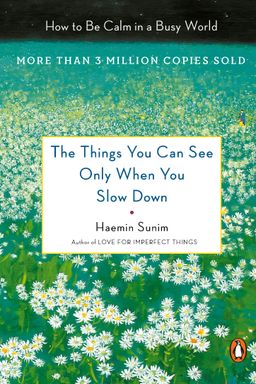
The Things You Can See Only When You Slow Down cover

The Things You Can See Only When You Slow Down

by Haemin Sunim

In ''The Things You Can See Only When You Slow Down,'' Haemin Sunim guides readers through the art of mindfulness in a fast-paced world. Discover how slowing down and practicing self-awareness can lead to genuine happiness, improved relationships, and a more fulfilling life.

Seeing Clearly in a Fast-Paced World

When was the last time you truly paused—without checking your phone, worrying about what’s next, or rushing to finish something? In The Things You Can See Only When You Slow Down, Zen monk Haemin Sunim invites you to take a long, gentle breath and consider this simple truth: clarity, peace, and happiness don’t come from doing more—they arise when you stop striving and slow down enough to see life as it really is.

Sunim argues that in our modern, hyperconnected world, the faster we move, the less we actually experience. Our obsession with productivity and success hides the richness of the present moment. The book, organized around eight broad themes—Rest, Mindfulness, Passion, Relationships, Love, Life, The Future, and Spirituality—blends Zen insight with gentle storytelling and practical guidance. His message is deceptively simple: when you change the pace of your attention, the quality of your life transforms.

Awakening from Busyness

Sunim starts with a universal challenge: the busyness epidemic. We believe the world around us is hectic, yet he shows that our true problem lies in the restless mind. “When the mind rests, the world also rests.” Through anecdotes from his own life as a monk and teacher, he illustrates that busyness is often a habit of thought—a form of resistance to the present moment. When we slow down, even ordinary sounds, faces, and feelings reveal depth and meaning.

The opening chapters combine Buddhist teachings with psychology: awareness—rather than control—is the key to peace. Like water in a vibrating bowl, our thoughts and emotions settle naturally once we stop stirring them. The book’s title captures this truth beautifully: the things you can see only when you slow down are those that were always before you, just blurred by haste.

Mindfulness as Loving Awareness

A central argument is that mindfulness is not an intellectual exercise—it is love expressed as presence. Sunim contrasts the modern concept of “managing emotions” with the Buddhist idea of “befriending them.” When you sit with anger, sadness, or jealousy without judgment, those feelings gradually reveal what lies beneath. He compares this to watching mud settle in a fish tank: if you stir the water trying to push it down, it only becomes cloudier. In stillness, everything clears by itself.

Unlike Western productivity guides that teach discipline through control (as seen, for example, in David Allen’s Getting Things Done), Sunim’s mindfulness is about compassionate witnessing. He invites you to separate feelings from words and observe the raw energy underneath. When seen with “pure attention,” energies morph rather than stagnate. This practice turns the mind into a mirror—reflecting everything but clinging to nothing.

The Mirror of Relationships

Sunim moves from the inner world to the interpersonal. He reminds us that relationships are where mindfulness and compassion prove real. Through stories of his students, friends, and his own interactions, he demonstrates that much of human conflict originates from pride, fear, and misperception. A Zen saying recurs throughout the text: “Lower your head, and you won’t bump into trouble.” Humility, he insists, is not weakness—it’s wisdom in action.

He uses parables to show how ego feeds suffering: gossip, judgment, or clinging to being “right.” Even when we attack others, he notes, it’s because we’re afraid. A consistent theme runs through the entire book—compassion is clarity. To see others truly, we must first slow our reactive minds. In doing so, we naturally forgive, because we recognize shared pain beneath every harsh word.

Love, Change, and Acceptance

In later chapters, especially “First Love” and “I Love Your Ordinariness,” Sunim explores love as a microcosm of mindfulness. He shares a vulnerable story about his first heartbreak—an American missionary who returned home to marry someone else. Through that experience, he realized that love’s beauty comes from presence, not possession. “Love is like an uninvited guest,” he writes. It appears when we stop clutching and leaves when we grasp too tightly.

Love and change intertwine in his philosophy. The pain of impermanence fades when you understand that everything—emotions, relationships, even sorrow—is a wave arising and disappearing within consciousness. What endures is awareness itself: the quiet witness that observes life’s impermanence with affection, not fear.

Slowing Down as a Spiritual Practice

Beneath the book’s gentle advice lies a profound spiritual truth: slowing down is a form of awakening. Sunim beautifully bridges Eastern contemplative practice and Western everyday life. Silence, he insists, is not emptiness—it’s fullness. In spiritual maturity, the lines between Buddhism and Christianity blur. He recounts visiting Taizé, a French Christian monastery, where monks’ chants and Buddhist meditation felt like “long-lost cousins.” Whether you pray or meditate, the heart of the practice is the same—a quieting of self to hear the divine stillness within.

“Wisdom,” he concludes, “is not something we have to strive to acquire. It arises naturally as we slow down and notice what is already there.”

The book ends where it began: an invitation to return to yourself. Your “original face,” before identity and worry, is pure awareness—peaceful, luminous, free. In an age defined by distraction, The Things You Can See Only When You Slow Down is both a mirror and a map, showing that inner stillness is not an escape from life but a new way of being fully alive.


Befriending Your Emotions

We often think emotions like anger or jealousy are enemies to be conquered. Haemin Sunim turns that perspective on its head. He invites you to befriend your emotions—to sit beside them, observe their energy, and learn from them instead of fighting. According to Sunim, most people try to suppress their emotions, but doing so only makes them stronger. Like pushing mud to the bottom of a fish tank, your effort stirs it up even more.

Witness, Don’t Wrestle

Sunim uses vivid imagery to make this clear. Imagine the anger rising in you as swirling mud. If you meddle, the water never clears. If you quietly step back, gravity and stillness do the work. Emotions are not permanent; their intensity fades when you stop identifying with them. The key is awareness without labels. When you drop words like “anger” or “hatred” and simply observe the sensations in your body—heat, tightness, pulse—you allow transformation to occur on its own.

This echoes the teachings of Jiddu Krishnamurti, whom Sunim quotes: “Pure attention without judgment is not only the highest form of intelligence but also the expression of love.” When you observe an emotion lovingly, you are not avoiding reality. In fact, you are staring directly into it. Awareness turns pain into understanding.

Compassion as Insight

Sunim deepens the practice with compassion. When you feel wronged, you can rage or you can look deeper. Once calm, you may realize that the person who hurt you is also suffering. “In our hearts,” he says, “reside both Adolf Hitler and Mother Teresa.” Which side you embody depends on which emotion you nourish. This isn’t moral relativism—it’s a reminder that every human heart carries seeds of cruelty and kindness.

By recognizing your shared humanity with those who anger you, empathy naturally replaces resentment. This spiritual maturity transforms how you see conflict—no longer as good versus evil, but as shared pain expressing itself differently.

Acceptance as Freedom

At the heart of befriending emotions lies acceptance of what is. Sunim contrasts the life of a typical person—defined by constant resistance—with that of an enlightened person—defined by deep acceptance. Awareness teaches you that emotions, people, and experiences are impermanent. Trying to control others, he warns, is futile when you can barely control your own mind. Like clouds in the sky, emotions pass. Witnessing this truth liberates you from their grip.

“Do not fight your negative emotions,” Sunim writes. “Observe and befriend them.”

Through this practice, the storms of your inner life become teachers, showing that awareness itself—the quiet space behind every emotion—is your real sanctuary.


Temper Your Eagerness

When passion burns too brightly, it can scorch rather than illuminate. In “Temper Your Eagerness,” Haemin Sunim shares his experience as a new professor eager to inspire his students with meditation and Buddhist philosophy. His zeal led him to assign extra work, plan frequent class outings, and pour boundless energy into teaching. But soon, students became fatigued and disengaged—a painful revelation that his enthusiasm had overwhelmed rather than inspired.

Passion Needs Wisdom

Sunim discovered an essential truth: enthusiasm without wisdom can become self-centered. What felt like devotion to teaching was, in part, a desire to prove himself. Once he pulled back and gave students space, their interest returned naturally. This insight is practical far beyond the classroom—whether you’re managing a team, parenting, or starting a new job, your passion must align with others’ capacity to receive it.

His conclusion is deceptively simple: it’s not the feeling of working hard that matters, but the outcome of your work. True wisdom discerns the line between commitment and compulsion. In Sunim’s view, self-awareness is what transforms effort into harmony.

Doing Good Quietly

The story expands into a broader meditation on growth and humility. The world values visible effort—late nights, busy schedules—but spiritual maturity asks: Am I attached to appearing hardworking? The danger lies in mistaking constant motion for progress. True passion, Sunim says, doesn’t clamor or boast—it moves quietly and steadily, like a bell whose sound travels far precisely because it’s struck with precision, not pride.

He draws a parallel with leadership and everyday relationships. The best teachers, mentors, or bosses don’t impose; they wait patiently for others to mature. Kindness, humility, and trust—not control—make influence last. In Buddhism, this is known as “skillful means,” or acting with awareness of timing and context.

"The most dangerous people are those who have passion but lack wisdom."

This chapter teaches balance: to work with devotion but without attachment, to serve with heart but without self-consciousness. As Sunim’s classroom proved, harmony arises not from unbounded effort but from mindful restraint—the art of doing less with more awareness.


The Art of Relationships

If mindfulness begins within, relationships are where its depth is tested. In “The Art of Maintaining a Good Relationship,” Sunim illuminates how closeness and distance must dance together for love and friendship to thrive. He likens it to sitting by a fire: too near and you burn; too far and you feel no warmth. Finding balance in relationships, he argues, is at the heart of happiness.

Managing Ego and Pride

One of Sunim’s most memorable anecdotes recounts a Korean scholar, Maeng Sa-seong, who sought advice from a Zen master. When Maeng arrogantly dismissed the master’s simple wisdom, the teacher demonstrated humility through action—pouring tea until it overflowed and advising Maeng to “lower your head, and you won’t bump into trouble.” The parable illustrates how arrogance poisons relationships. Pride blinds us to shared humanity, while humility clears the way for genuine connection.

Relationships falter not because others change but because we insist the world conform to our preferences. When you release control and choose empathy, tension dissolves. Sunim reminds us that people who exasperate us are “spiritual teachers in disguise” sent to help us grow.

Listening from the Heart

He contrasts superficial politeness with real listening. Sincere presence—listening without planning your response—cultivates intimacy. “Speak from the heart,” he advises, “for words that come from the head are never remembered.” This simple truth transforms daily communication: instead of debating who is right, prioritize being kind and connected. He also cautions against gossip, urge to correct others, or the need to have the last word—all ego’s attempts to affirm superiority.

Even forgiveness becomes practical wisdom rather than moral obligation. When you forgive, you don’t condone—you free yourself. Harboring resentment binds you to the very person you dislike. To forgive is to reclaim your energy.

“When you lower yourself, the world elevates you. When you elevate yourself, the world lowers you.”

Ultimately, healthy relationships are acts of mindfulness: moments when we become aware of others’ needs and remain tender with our own limitations. Through humility, listening, and space, connection becomes sacred rather than struggle.


Lessons of Love and Letting Go

Few authors write about love with such tenderness as Haemin Sunim. In the chapters “First Love” and “I Love Your Ordinariness,” he reveals that love’s beauty lies not in possession, but in the willingness to let it breathe. Through stories of his first heartbreak and countless encounters with everyday people, he presents love as an act of awakening—a sacred mirror that shows us our capacity for vulnerability and connection.

The Sacredness of First Love

As a young monk, Sunim fell in love with an American missionary. The relationship could not be pursued, yet through the longing he discovered something divine. He recalls Kahlil Gibran’s words about the joy and pain of love, realizing that such emotions are not obstacles to spirituality but doors into it. Love, he writes, is “an unknown god standing between two people”—a transcendent force that humbles the ego and expands the spirit.

Even heartbreak becomes grace. When his love married another, Sunim eventually replaced sorrow with gratitude for having experienced love’s vastness. Over time, pain gave way to reverence—the hallmark of true spiritual maturity.

Loving Without Control

He warns against confusing love with attachment. “Love her, not your feelings,” he reminds us. Real love honors balance and freedom; forcing affection breeds dependency. In a delightful analogy, he compares love to cooking: for flavor to deepen, ingredients need time to marinate. Similarly, relationships require patience, trust, and timing. Love born of calculation is fragile, but love born of sincerity endures.

Sunim also teaches discernment: when a relationship ends, choose gentleness over bitterness. “Be as gentle in ending a relationship as you were in starting it.” True proof of love, he insists, is the absence of malice afterward. Speaking ill of an ex only reveals lingering attachment. The ability to wish them well is the sign of real healing.

“The heart is slower than the mind,” Sunim says. “The mind knows you must part ways, but your heart does not.”

Love, in his vision, is not a fairy tale but a spiritual discipline—an opportunity to practice patience, awareness, and compassion. To love well is to allow space, to let go, and to bless what once was.


Purpose and the Future

How do you discover your calling in a noisy world filled with options and expectations? In later chapters like “One Word of Encouragement Can Change the Future” and “When You Look for Your Calling,” Sunim explores purpose not as a grand destiny but as a quiet process of self-awareness. His advice is deeply human: your path unfolds as you grow, not before.

The Power of Encouragement

Recalling his teacher Ms. Lee, who once told him, “You will be a great person who brings wisdom and happiness to many,” Sunim explains how a single act of belief can shape a life. Encouragement, he argues, is a powerful form of compassion—it sees potential before it manifests. Just as the Buddha’s prophecy of enlightenment inspired his disciples to persevere, Ms. Lee’s words inspired Sunim to become the teacher he is today. When you uplift others sincerely, you plant faith in their own capacity for goodness.

Finding Your Calling

Sunim offers practical wisdom for self-discovery: read widely to discover unfamiliar worlds; seek experiences instead of overthinking; embrace trial and error. Purpose, he says, emerges through interaction with life, not introspection alone. By observing what energizes you, who you admire, and how you contribute, your calling naturally reveals itself.

He contrasts living by your own heart with living to impress others. Much unhappiness comes from chasing images of success defined by family or society. Liberation starts when you stop performing and start listening inwardly. “Live your life not to satisfy others,” he writes, “but to fulfill what your heart desires.”

Confidence and Impermanence

He encourages readers not to wait until they feel entirely ready. “There is no such thing as being completely prepared,” he says—decisions are steps into the unknown that cultivate courage. Like a rhinoceros walking alone in Buddhist imagery, a purposeful life requires the willingness to stand apart from the herd. At the same time, success should be measured not by accolade but by integrity and freedom. “Your freedom,” he notes, “is more important than money.”

Purpose, in Sunim’s view, is discovered moment by moment—when your actions align with kindness, humility, and awareness.

The future, then, isn’t something you chase; it’s something you create through the mindfulness of today. Every encouraging word, every choice to slow down and listen, shapes a destiny far richer than any plan could promise.

Dig Deeper

Get personalized prompts to apply these lessons to your life and deepen your understanding.

Go Deeper

Get the Full Experience

Download Insight Books for AI-powered reflections, quizzes, and more.