
Idea 1
The Invisible Power of the Engineering Mind
Have you ever stopped to wonder how humanity built cathedrals long before anyone understood calculus or the science of materials? In The Things We Make, engineer and educator Bill Hammack argues that what makes this possible—and what continues to shape every technology around us—is not science or mathematics alone, but a distinct mode of thinking: the engineering method. He contends that from medieval masons to modern innovators, the true engine of progress is the use of rules of thumb—experience-based heuristics that enable creation even amid uncertainty.
Hammack’s central claim is deceptively simple: engineers solve problems with incomplete information using practical judgment rather than perfect knowledge. Their genius lies not in applying known science, but in working at the margins of the unknown to make functional solutions that fit the materials, energy, and cultural values of their time. Through vivid historical storytelling—from the medieval cathedrals of France to the light bulb wars of the 19th century and the microwave oven’s accidental rise after World War II—Hammack unveils the invisible method that binds centuries of human creativity.
Engineering vs. Science
The book begins with a striking comparison between the scientific method and the engineering method. While science seeks universal truths, engineering seeks usable solutions. Scientists ask “Why does it behave this way?”; engineers ask “How do we make it work?” In Sainte-Chapelle cathedral, 13th-century craftsmen built soaring arches without modern mathematics, relying instead on proportion rules passed orally from mason to mason. Hammack uses this to challenge the common notion that technology is simply "applied science." Instead, engineering operates as an independent philosophy—one that predates scientific theory and continues to thrive by embracing imperfection.
The Rule of Thumb Revolution
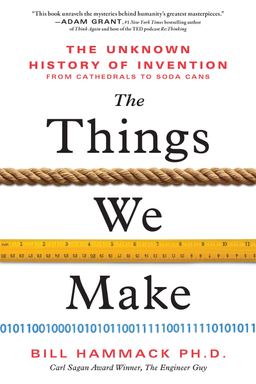
He calls these guiding principles “rules of thumb,” or heuristics—shortcuts that turn intractable problems into solvable ones. A head mason once sized cathedral walls using only a rope divided in thirds, transforming intuition into a physical design language. Modern engineers do the same, using simplified estimation methods to handle complex systems. These “rules” don’t guarantee exact results; they are flexible, contradictory, and context-bound. Yet when combined, they build skyscrapers, power grids, and spacecraft. Hammack’s insight here mirrors psychologist Gerd Gigerenzer’s defense of heuristics as powerful tools for decision-making under uncertainty—proof that imperfect knowledge can still yield brilliant outcomes.
Creativity and Failure as Method
Hammack reframes failure as the beating heart of engineering. From Josiah Wedgwood’s thousands of ceramic experiments to Edison’s endless trials with filaments, progress unfolds not by discovery alone but through iteration and adaptation. He highlights trial and error as one of three core strategies of the engineering mindset, alongside building on prior knowledge and negotiating trade-offs. Understanding why something fails is as important as why something works—because each failure sharpens intuition about what the next success might look like. (Historians like Henry Petroski, author of To Engineer Is Human, echo this idea: that engineering excellence grows through the disciplined study of flaws.)
Culture, Bias, and “Best” Design
When Hammack turns to design, he asks what “best” truly means. The Egyptian wine press and the Amazonian tipití—a woven Manioc squeezer—were each “best” within their cultures because they balanced local materials, labor, and needs. There is no universal best, only solutions shaped by context. He connects this to modern bias in design—from crash-test dummies modeled on men to algorithms optimized for average users—showing that every product embeds cultural values. The engineering method’s flexibility allows us to recognize and correct these blind spots, advocating for diversity as a way to expand the pool of available heuristics. More diverse perspectives mean more adaptive engineering.
From Uncertainty to Innovation
The engineering method’s true power lies in thriving amid uncertainty. Hammack tells of Osborne Reynolds visualizing turbulent flow with dye and smoke rather than waiting for complete scientific models—a story mirrored centuries later in Frances Arnold’s Nobel-winning work simulating biological evolution to create new enzymes. These examples reveal how engineers operate at the frontier of partly known phenomena, using intuition and iteration to achieve results before scientists can fully explain them. In this sense, engineering drives science forward rather than following it.
Technology as Moral Creation
Finally, Hammack situates engineering within ethics and human purpose. The microwave oven, born from wartime radar technology, became both a household convenience and a reflection of gendered labor divisions. It captures how technology reshapes society’s expectations—and how engineers must consider culture and morality alongside utility. Technology, he argues, isn’t a neutral force; it is a mirror of our choices. Understanding the engineering method empowers us to guide innovation responsibly, using simplicity and creative pragmatism not just to make things, but to make them right.
Across history’s cathedrals, turbines, ceramics, and electronics, Hammack exposes the invisible scaffolding of human ingenuity. His message is hopeful and practical: you don’t need perfect knowledge to change the world—only curiosity, resourcefulness, and the courage to work with what you have. The engineering method is not just how we build things; it’s how we build possibility itself.