
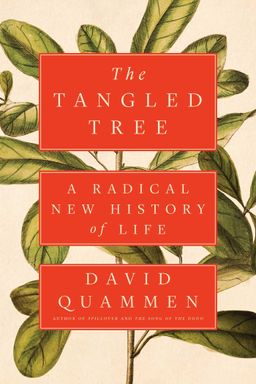
The Tangled Tree cover

The Tangled Tree

by David Quammen

The Tangled Tree by David Quammen explores the groundbreaking discoveries in evolutionary biology that have reshaped our understanding of life''s complexity. From horizontal gene transfer to the intricate web of life, this book delves into the scientific revolutions that challenge traditional views and reveal the profound interconnectedness of all living organisms.

Rewriting Life’s Map

How does life truly connect across billions of years? The book argues that our traditional view—the branching "tree of life" first drawn by Darwin—has evolved into a far more complex vision. From Darwin’s 1837 notebook sketch to modern molecular diagrams, the tree has grown into a multi-dimensional web joined by symbiosis, lateral gene flow, and molecular discoveries that blur simple ancestry. You learn how biology’s central metaphors have shifted from ladder to tree to network, and how those visual frameworks reflect deep conceptual changes in our understanding of evolution.

At its core, the book teaches you that evolution is both vertical and horizontal: descent with modification still drives lineage divergence, but genes, organelles, and even entire genomes can leap sideways. The text moves from Darwin’s drawings through molecular phylogenetics (Crick’s early protein comparisons, Pauling’s molecular clock), Carl Woese’s ribosomal discoveries of the Archaea, Margulis’s endosymbiotic mergers that birthed eukaryotes, to horizontal gene transfer mediating antibiotic resistance and shaping animal genomes. Each wave of insight redefines what “relatedness” means.

From metaphors to molecules

Darwin’s tree emphasized divergence, extinction, and continuity—species sprouting like twigs from older branches. Haeckel’s illustrated versions made that metaphor public; his trees celebrated natural history but exaggerated human centrality. Twentieth-century systematists refined the image with ecological diagrams and molecular data. What began as a visual heuristic turned into a powerful organizing tool—one increasingly reworked by the molecular revolution.

By the mid-twentieth century, molecular biology redefined ancestry. Francis Crick’s idea of “protein taxonomy” and Pauling & Zuckerkandl’s molecular clock introduced time-calibrated sequences. You learn how molecules like rRNA became evolutionary records: Carl Woese realized that RNA, part of every cell’s translation system, could trace history deeper than any fossil. When Woese used 16S rRNA to compare microbes, he uncovered the Archaea—a previously unknown domain distinct from Bacteria and Eukarya. That single insight fractured the old two-kingdom scheme and birthed a new molecular taxonomy.

Blurring of boundaries

The book then moves from classification to connection. Lynn Margulis revived and proved endosymbiosis: mitochondria and chloroplasts were once independent bacteria. When Doolittle and Gray sequenced organelle rRNA, they confirmed Margulis’s claim—the cell itself is a community. Endosymbiosis became the ultimate fusion event, merging genomes and redefining individuality. Horizontal gene transfer, meanwhile, shattered assumptions about linear descent: bacteria trade genes via transformation, conjugation, and transduction, as shown by Griffith, Avery, Lederberg, and Watanabe. Genes spread between species with startling speed, catalyzing antibiotic resistance and microbial adaptation.

Trees into webs

Ford Doolittle’s “Uprooting the Tree” papers illustrate this shift visually—a mangrove-like network replaces the neat oak. Evolutionary diagrams now include reticulations, representing fusion events and lateral transfers. Woese’s idea of a Darwinian Threshold defines a historical pivot: early evolution was network-like, chaotic with rampant gene sharing; only after translation stabilized did vertical descent dominate. The book pushes you to see that the tree metaphor itself must bend—life’s shape is a web of inheritance and exchange.

Deep origins and modern tools

At the deepest level, Woese introduced the progenote—a pre-cellular ancestor before accurate translation. Early life existed as communal genetic exchange rather than discrete species. The author contrasts this with modern CRISPR, where bacteria record viral invasions in their genomes and humans repurpose that mechanism for genome editing. The microbial logic of information sharing now underpins biotechnology’s most potent tool.

In sum, the book tells a continuous story: from Darwin’s tentative tree to molecular clocks, symbiotic mergers, and horizontal transfers that tangle life’s branches. You finish understanding that evolution’s geometry—its shape, flow, and connectivity—has changed with every scientific revolution. Life’s map is not a tree carved in stone but a living, recombinant network still sprouting new shoots from unexpected grafts.


Darwin’s Tree and Its Transformations

Darwin’s hand-drawn sketch in 1837 launched the most influential visual metaphor in science: the tree of life. That small diagram signified a mental revolution—that species evolve from common ancestors rather than being created separately. The book traces how that metaphor grew and diversified as biologists, artists, and molecular scientists reinterpreted it.

From ladder to branching form

Before Darwin, nature was pictured as an ascending ladder—the Great Chain of Being. Darwin turned the image sideways: not hierarchical ascent but branching divergence. Haeckel translated this abstraction into visual culture, sketching ornate trees to depict relationships among radiolarians, vertebrates, and humans. His trees popularized evolution but also implied directionality and human privilege, themes later corrected by molecular diagrams.

Educational and conceptual evolution

Twentieth-century taxonomy birthed alternative forms—Romer’s vertebrate trees, Whittaker’s five-kingdom cactus, Copeland’s cones—each reflecting different priorities: ecology, morphology, or phylogeny. The visual shift mirrored conceptual questions: What counts as a natural grouping? Are trees about ancestry, function, or ecological role? The author reminds you that every diagram embeds methodological assumptions.

Key reminder

When reading any evolutionary tree, ask what data shape its branches—morphological, molecular, ecological—and what biases those choices create.

Modern meaning

Today’s trees differ radically from Darwin’s sketch. They are graphical outputs of algorithms—rooted, unrooted, sometimes tangled webs. But their purpose is unchanged: to help you visualize connectedness. The metaphor has matured but not lost vitality. When you interpret a tree, you are decoding a layered history—from nineteenth-century philosophy to twenty-first-century data science.

In short, the tree of life remains biology’s most resilient metaphor. It evolved from poetic analogy into a data-driven instrument that continually reinvents itself as new evidence reshapes branches and roots.


Molecular Clocks and Ribosomal Records

The molecular age transformed evolutionary inference from art to algorithm. Mid-century pioneers—Francis Crick, Linus Pauling, and Emile Zuckerkandl—proposed reading evolutionary history directly from sequences of proteins and nucleic acids. They realized molecules change over time in measurable patterns; those small differences can serve as clocks ticking through deep time.

Crick’s conceptual seed

Crick suggested comparing protein sequences across species, initiating “protein taxonomy.” Pauling and Zuckerkandl formalized the idea as the “molecular clock”: if mutations accumulate at a roughly constant rate, molecular differences measure divergence time. This framework linked chemistry to paleontology and made molecular comparison an evolutionary instrument.

Carl Woese’s breakthrough

Carl Woese pushed molecular phylogenetics to its limit by focusing on ribosomal RNA. Unlike proteins, rRNA is universal and ancient—its slow-changing regions preserve the deep structure of evolution. Using manual sequencing methods in the 1970s, Woese found that some microbes (methanogens) were fundamentally distinct from known bacteria and eukaryotes. He defined a third domain: the Archaea. The result was not just a discovery but a reordering of life’s highest categories.

Why it matters

Molecular comparisons turned evolution into quantifiable history. You can now construct trees not from appearance but from information encoded in every cell. Yet models matter: different genes, rates, and assumptions yield different topologies. The molecular revolution empowered precision but demanded methodological rigor.

From Crick’s musings to Woese’s rRNA fingerprinting, this movement unified biology around sequence data. It showed that molecules are time capsules—each genome a layered fossil of evolution recorded in letters rather than bones.


Symbiosis and the Origins of Complexity

Lynn Margulis challenged the idea that complexity evolved only by gradual mutation and selection. She proposed that eukaryotic cells are biological mergers—chimera built from ancestral bacteria. The book explores how her theory of endosymbiosis changed our view of individuality and evolution.

Reviving a forgotten vision

Earlier thinkers like Merezhkowsky and Ivan Wallin suspected organelles had bacterial origins, but their ideas faded. Margulis resurrected them in 1967, arguing that mitochondria and chloroplasts are descendants of engulfed bacteria. Microscopy revealed double membranes and DNA rings, and molecular analyses by Ford Doolittle and Michael Gray later confirmed bacterial affinities: chloroplasts related to cyanobacteria, mitochondria to alpha-proteobacteria.

Consequences of merging

Endosymbiosis implies that evolution can proceed by fusion, not just branching. Margulis’s idea means your own cells house ancient partnerships. Organelle genomes provided proof—small circular DNAs inherited maternally. The book details how gene transfer from organelles to the nucleus reshaped genomic architecture (Martin’s “endosymbiotic gene transfer”).

Beyond mitochondria

Later discoveries—like Lokiarchaeota bridging Archaea and Eukarya—show that endosymbiosis remains central but unresolved. Who hosted whom? Did mitochondria drive complexity or hitch a ride with an already sophisticated host? The author emphasizes this question as one of evolution’s most active frontiers.

Margulis’s insight reframed individuality: living things are not pure lineages but composite communities. Evolution’s creativity lies as much in merger as in mutation.


Genes on the Move

While Margulis emphasized cellular mergers, another phenomenon—horizontal gene transfer (HGT)—reveals that genes themselves can migrate across species. The book details how discoveries from Griffith’s 1928 transformation to Watanabe’s 1960s R-factors exposed genetic exchange as a routine evolutionary and medical force.

Mechanisms of transfer

Transformation (DNA uptake), conjugation (plasmid exchange), and transduction (virus-mediated movement) compose the main routes. Avery proved DNA carries heredity; Lederberg discovered bacterial sex; Zinder revealed phage-mediated transfers. Together they underpin today’s antibiotic crisis—genes for resistance leap across species, creating MRSA and vancomycin-resistant strains.

Evolutionary implications

HGT erodes the boundaries between lineages. Some bacteria acquire hundreds of foreign genes, making genomes mosaics. Ford Doolittle’s work on “Uprooting the Tree” shows this process challenges the very metaphor of evolution as a tree. Instead of simple branching, microbes form webs of exchange.

Practical and medical stakes

For you, the consequences are tangible: controlling antibiotic resistance means monitoring gene ecology, not just treating infections. HGT explains rapid adaptation and the emergence of new pathogens. It also contributes to major evolutionary innovations—organelles, metabolic pathways, and hybrid organisms. The book warns that understanding microbial gene flow is essential for both evolutionary theory and public health.

Ultimately, HGT transforms your view of inheritance: genetic identity is fluid, community-driven, and constantly renegotiated through gene-sharing networks.


Mobile DNA and Viral Imprints

Genomes are not static libraries—they are habitats for mobile DNA and viral remnants. The book follows the trail from Barbara McClintock’s transposons in maize to human Alu and mariner elements, showing how jumping genes shape diversity and disease.

Transposons and their travels

McClintock’s discovery of "controlling elements" revealed that DNA can move within genomes. Modern studies show transposons are ubiquitous: Alu elements repeat over a million times in humans; mariner elements leap among animals. Feschotte’s “Space Invaders” transposon even jumped across mammal species, likely ferried by blood-feeding insects, illustrating that mobility extends beyond vertical inheritance.

Viral domestication

Retroviruses insert DNA into host genomes; if those insertions reach germline cells, they become permanent residents—endogenous retroviruses (ERVs). Humans carry roughly 8% ERV-derived DNA. Some viral genes evolved new purposes: Thierry Heidmann showed that viral envelope proteins became syncytins, essential for placenta formation in mammals. The fusion of viral and host functions exemplifies exaptation, the creative recycling of invasive elements.

Meaning for evolution

Mobile DNA and viral legacies reveal life’s porous genetic boundaries. They animate evolution, sometimes by causing instability, sometimes by inventing entirely new genes. The book situates them as natural analogues to cultural exchange—ideas jumping, mutating, becoming indispensable in new contexts. Your genome itself carries a historical archive of infections turned heritage.

So when you think of your DNA, imagine it not as static code but as a palimpsest of countless travelers, some destructive, others transformative. Mobility, not stability, is life’s constant.


Networks, Domains, and Deep Origins

The culmination of the book revisits classification and origin. Woese’s three-domain system—Bacteria, Archaea, and Eukarya—replaced earlier kingdoms and revealed microbial depth. But even that framework bends under the pressure of horizontal exchange. Evolution at its earliest stages may have lacked clear species boundaries.

From kingdoms to domains

Linnaeus’s two kingdoms expanded through Haeckel’s Protista and Whittaker’s five kingdoms, but rRNA analysis forced a new architecture. Woese, Kandler, and Wheelis proposed domains as the highest units, recognizing Archaea’s unique molecular signatures. This shift unified microbial and macro-organismic classification under a single molecular framework.

The progenote era

Woese’s progenote hypothesis describes a pre-cellular phase when translation was error-prone and genetic exchange rampant. Deep molecular signals blur there; trees become unrooted starbursts. Attempts to locate the universal root remain tentative. You are reminded that some early evolution may be beyond the tree metaphor—better represented as an interactive network of evolving systems.

Modern echoes

Today, microbial evolution, genome sequencing, and CRISPR technology reflect that ancient plasticity. Just as early cells traded genes freely, modern science now trades them intentionally. Woese’s warning against “engineering without vision” resonates: biology’s future depends on recognizing life’s inherent interconnectedness.

In essence, the book closes the circle—from the blurred origins of translation to our modern manipulation of it. The living world began as a network and is now consciously editing its own web.

Dig Deeper

Get personalized prompts to apply these lessons to your life and deepen your understanding.

Go Deeper

Get the Full Experience

Download Insight Books for AI-powered reflections, quizzes, and more.