
Idea 1
The Brain as a Storytelling Machine
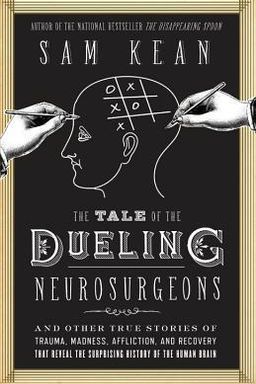
What makes your mind produce love, fear, vision, and belief—from chemistry and electricity? In The Tale of the Dueling Neurosurgeons, science writer Sam Kean reveals how physical changes within the brain generate the entire spectrum of human experience. Through vivid stories of accidents, diseases, and experiments, he shows the brain as both fragile and astonishingly adaptive: a storytelling machine that reassembles meaning from misfires and miracles alike.
The book’s trajectory: from chemistry to consciousness
Kean guides you from the brainstem to the cortex, from single neurons to moral judgment. Early chapters dramatize how small errors deep in the brain produce haunting experiences—like sleep paralysis or phantom limbs—while later stories trace the scientific evolution that connected anatomy, emotion, and self. Each episode—King Henri II’s jousting accident, H.M.’s amnesia, Cajal’s drawings, Penfield’s surgical confetti—embodies the shift from myth to neuroscience.
Interdependence and failure as teachers
Kean insists you can’t isolate a single brain region. Failures illuminate the architecture—Henri II’s trauma linked specific lesions with behavior; sleep paralysis revealed how ancient neural layers communicate; phantom pain proved that perception persists even when bodily input disappears. The general motif is bottom-up causation: a flicker in the pons or pituitary can echo all the way to consciousness. These pathologies form the microscope through which brain organization became visible.
From neurons to neurotransmitters
The narrative then descends to the cellular scale. Golgi’s silver stain and Cajal’s meticulous drawings transformed opaque tissue into visible neurons. Their clash—network versus individual cells—created the neuron doctrine that governs modern biology. Once neurons were discrete, scientists sought their means of communication. The argument between soups (chemical transmitters like Otto Loewi’s acetylcholine) and sparks (electrical impulses) evolved into today’s hybrid model: electrical spikes inside, chemical bridges between. This dual mechanism explains how circuits encode everything from motion to emotion.
Maps, circuits, and adaptable minds
Kean highlights pioneering cartographers—Inouye mapping the visual cortex, Penfield mapping motor and sensory areas. Their work revealed distributed networks: patches specialized but still cooperative. Later stories—James Holman’s blind echolocation or Bach-y-Rita’s sensory-substitution devices—extend that principle: the adult brain can reassign territory. Plasticity is the hero here: neurons rewiring around damage or deprivation, turning sound into sight, or mirror reflections into phantom relief.
Emotion, belief, and the moral brain
After the sensory and motor maps, Kean explores emotional circuits. Harvey Cushing’s pituitary work showcases the body’s hormonal dialogue with brain chemistry. Papez’s limbic loop, the amygdala’s fear alarms, and Damasio’s frontal-limbic balance explain why emotion steers reason. Cases of temporal-lobe epilepsy and Capgras syndrome show how the disconnection between feeling and knowing breeds either religious ecstasy or uncanny delusion. These stories make clear that emotional tags are not irrational—they are the scaffolding for rational choice.
Culture, ethics, and the biology of belief
Kean’s historical detours—from the cannibal rituals that spread kuru to courtroom debates on psychotic assassins—remind you that culture, ethics, and neuroscience intertwine. Prions overturn definitions of infection; personality-altering injuries challenge legal responsibility. When Scoville removed H.M.’s hippocampi or Penfield probed Ruth’s temporal lobes, they advanced science but exposed ethical gray zones. The book repeatedly warns that curiosity must coexist with compassion.
The self as a dynamic construction
In its later chapters—Phineas Gage’s personality fracture, Clive Wearing’s perpetual present, and split-brain experiments—the book crystallizes a central insight: the self is not a static entity but a networked process. Left and right hemispheres cooperate to create narrative coherence; when that thread snaps, coherence itself dissolves. Your mind is both narrator and character, weaving experience into identity moment by moment.
Core understanding
Kean uses the histories of brains gone wrong to explain brains working right. The lesson is humility and wonder: consciousness, emotion, and morality arise not from a single spark but from billions of coordinated chemical conversations. Every ghost, delusion, or miracle traces to tissue—and yet that tissue tells exquisite stories.