
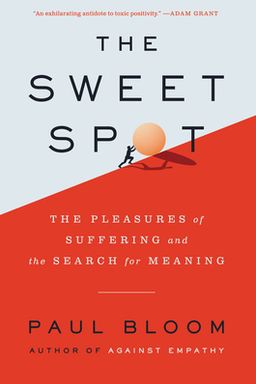
The Sweet Spot cover

The Sweet Spot

by Paul Bloom

The Sweet Spot challenges the pursuit of relentless positivity, revealing how discomfort and suffering can enrich life. Paul Bloom explores how strategically chosen pain can enhance pleasure and fulfillment, offering a fresh perspective on achieving a meaningful life.

The Paradoxical Power of Chosen Suffering

Why do we sometimes seek experiences that hurt? Why do people run marathons, watch horror films, or willingly sit through grueling cold plunges when comfort is just a choice away? In The Sweet Spot: The Pleasures of Suffering and the Search for Meaning, psychologist Paul Bloom explores one of life’s great paradoxes: that the things which make life meaningful often hurt, and that chosen suffering—pain and struggle we take on voluntarily—can be a profound source of joy, connection, and purpose.

Bloom’s central claim is that humans are not simple hedonists chasing pleasure and avoiding pain. Instead, we are motivated by a blend of desires—for pleasure, yes, but also for meaning, morality, and mastery. He calls this view motivational pluralism: the idea that the good life is not one of comfort and ease, but one that balances pleasure with purposeful struggle. This “sweet spot,” as Bloom calls it, is the zone where difficulty meets meaning, where suffering is neither overwhelming nor trivial, and where human flourishing truly emerges.

Two Types of Chosen Pain

Bloom distinguishes between two main forms of chosen suffering. The first is suffering for pleasure—what he calls benign masochism. These are experiences like eating spicy food, watching tragic films, or immersing yourself in a freezing lake after a sauna. Pain heightens pleasure by contrast, reminds us we are alive, and can even sharpen focus. The second type of chosen pain is suffering for meaning—the kind that comes with parenting, marathon running, activism, or finishing a masterpiece. This form reflects commitment to something larger than ourselves, an investment of effort and sacrifice that gives our lives coherence and moral depth.

Both kinds of pain, Bloom argues, are distinctly human. Unlike animals that avoid harm, we are creatures of imagination, able to weave narratives from discomfort. Pain becomes not just an unpleasant signal from the body, but a language for meaning-making—a way to prove strength, devotion, or love.

Hedonists, Moralists, and Meaning-Seekers

Western culture often idealizes happiness, but Bloom argues that happiness alone is an impoverished goal. The pure hedonist—someone obsessively maximizing pleasure—misses what most people actually seek: a sense of moral purpose, connection, and self-growth. Research from psychologists such as Daniel Kahneman and Ed Diener (whose work Bloom frequently cites) shows that life satisfaction and moment-to-moment happiness are completely different things. The richest lives, Bloom suggests, are not those filled with constant pleasure, but those where satisfaction coexists with struggle—where hardship serves a purpose.

Drawing inspiration from Viktor Frankl’s Man’s Search for Meaning and Mihaly Csikszentmihalyi’s Flow, Bloom shows that the good life lies not in avoiding discomfort but in choosing the right discomfort. A marathoner’s pain is glorious, a parent’s exhaustion noble, an artist’s frustration meaningful. Bloom calls this “the sweet spot”: the band of human experience between comfort and chaos where both joy and difficulty feed each other.

The Psychology of Suffering

Pain, in Bloom’s view, is not the opposite of pleasure but its partner. Neuroscience supports this: the brain’s reward and pain systems often overlap. As psychologist Paul Rozin found, people enjoy experiences like saunas or scary movies because they allow safe flirtation with danger. This “hurts so good” paradox activates pleasure once we reinterpret discomfort as voluntary and meaningful. Pain provides contrast, focus, and even transcendence.

But this pleasure-through-pain works only when the suffering is chosen and controlled. Pain imposed against our will—through trauma, loss, or oppression—rarely transforms into meaning. Bloom cautions against romanticizing suffering itself. Only when pain is embedded in purpose, when we can tell a story about why it was worthwhile, does it enrich our lives rather than break us.

Why This Matters

In a world obsessed with comfort and optimization, Bloom’s message feels almost countercultural: the happiest lives are not the easiest ones. From religion’s rituals of fasting to modern endurance sports, humans continually test the boundaries of endurance and meaning. Bloom wants us to see that the pursuit of a “good life” means embracing—not erasing—difficulty. Meaning and happiness, he concludes, are not competitors but collaborators: it hurts just as much as it’s worth.

Key Takeaway

A fulfilling life demands finding your own sweet spot—the balance between comfort and challenge, joy and suffering, pleasure and purpose. The goal isn’t to avoid pain, but to choose pain that serves meaning.


Benign Masochism: The Joy in Safe Pain

In Chapter Two, Bloom introduces the strange phenomenon of benign masochism: seeking pleasure through discomfort, fear, or even pain. From spicy curry to hot baths, sad songs to horror films, people around the world pay for experiences that hurt—but feel good. Why? Because pain, when chosen and controlled, can amplify pleasure, focus attention, and create contrast that makes comfort sweeter.

Pleasure from Contrast

Bloom relies on the contrast theory of pleasure. The brain values change, not constants—intensity, not stasis. A cold beer tastes better after a run; a warm bath feels heavenly after shoveling snow. We are wired to respond to differences, and pain creates the contrast that sweetness requires. The scientist Siri Leknes showed this in brain scans: moderate heat feels pleasant if we expect extreme heat beforehand. Pleasant pain isn’t contradictory—it’s contextual.

Pain even enriches memory. When you endure something difficult (like a mountain hike or icy swim), you later recall it more vividly and fondly. The discomfort becomes part of the story, defining the emotional “aftertaste” of achievement. That is why, Bloom jokes, nobody says they’d repeat a marathon for the fun of it—yet many do it again.

Pain as Focus and Escape

Pain isn’t just about heightening relief. It also focuses the mind. As Bloom writes, “A whip is a great way to get someone to be here now.” Intense sensations strip away distraction, shutting off wandering thoughts and self-conscious anxiety. Like meditative discipline, pain forces presence. That’s part of BDSM’s psychological appeal—what psychologist Roy Baumeister called escape from the self. Under controlled circumstances, physical pain provides mental clarity that mindfulness sometimes fails to deliver.

This helps explain why activities like martial arts, endurance athletics, or even cold-water therapy are described as “flow states.” The combination of strain, control, and competence silences internal chatter. Bloom argues that pain can act as a gateway to peace—a paradoxical path toward stillness.

The Role of Control and Consent

Crucially, benign masochism depends on choice. A sauna is bliss; being trapped in the desert is torture. Consent transforms pain’s meaning. Bloom uses this contrast to explore moral nuance around practices like BDSM, distinguishing consensual submission from genuine cruelty. The same physical sensations can be redemptive or horrific, depending on context and autonomy. “There are no safe words in torture,” he writes, underscoring that control is the dividing line between pleasure and trauma.

Why We Need Pain

Bloom also cautions that dulling pain entirely would be disastrous. People with congenital insensitivity to pain often injure themselves, proving pain’s biological necessity. Psychologically, pain gives life texture; it signals value. Even mild suffering—like effort, embarrassment, or failure—grounds us in reality and connects us to others. Pain, in Bloom’s formulation, is not the enemy of happiness but its foundation. When tempered by control, it becomes a source of delight.

Key Takeaway

Benign masochism teaches that pain itself can be good—when it’s safe, voluntary, and meaningful. Pleasure is often amplified not by adding comfort, but by briefly courting discomfort.


Imagination and Our Appetite for Darkness

Bloom devotes a major section to one of humanity’s strangest habits: our love of sorrow, tragedy, and fear in fiction. We flock to horror films, cry at sad music, and thrill at stories of suffering. Why? Because our imagination—the mental power to simulate possibilities—lets us safely play with pain.

Why Negative Feelings Feel Good

Drawing on David Hume’s idea of the “paradox of tragedy,” Bloom argues that negative emotions are not bugs in our psychology—they’re features. Fans of horror movies feel just as much fear as detractors, but they enjoy the fear. Pain, in this case, becomes aesthetic emotion. Sad movies, like This Is Us or the music of Adele, allow melancholy to be savored because it’s safely framed as fiction. We know nothing truly bad happens, so we can dive fully into feeling.

Even children reveal this appetite early. Anthropologist Vivian Paley recorded preschoolers creating stories of babies lost in dark forests, reveling in imaginative danger. These acts of pretend fear are not signs of morbidity—they are rehearsals for life’s real anxieties.

Stories as Safe Simulations

Imagination provides what Bloom calls an “emotional flight simulator.” As Stephen King once said, “We make up imaginary horrors to help us deal with real ones.” Fiction trains our moral and emotional reflexes, confronting us with betrayal, grief, and injustice without permanent consequence. When you weep for Anna Karenina or cheer for revenge in John Wick, you’re exploring moral boundaries from the safety of a couch.

This practice theory bridges fear and morality: imaginary suffering gives us practice facing evil and empathy toward others. The popularity of revenge tales—from Hamlet to superhero narratives—satisfies our moral hunger for justice while letting us question vengeance itself.

Our Fascination with the Forbidden

Bloom also delves into darker fantasies, including why women (and men) often fantasize about domination, submission, or taboo acts like incest in safe, fictional contexts. Using data from online searches and psychologist Ogi Ogas’s research, he shows how these fantasies express curiosity about power, control, and transgression more than desire for real violence. Fiction allows the moral mind to explore boundaries without harm—our fascination with evil, villains, and taboo strengthens our understanding of morality by testing it.

Moral and Emotional Expansion

Ultimately, Bloom views fiction not as escape, but as practice in empathy, courage, and reflection. Every sad song, every horror film, every tragic story is a playground for moral imagination. It’s how we learn to balance our craving for safety with our hunger for meaning. By imagining pain, we prepare to face it—and perhaps to transcend it.

Key Takeaway

We turn suffering into art because imagination transforms danger into discovery. Fiction, fantasy, and play let us safely test life’s hardest emotions, building empathy and wisdom through simulated pain.


Struggle and the Pleasure of Effort

Effort feels hard—but Bloom shows that it can also be delicious. In “Struggle”, he draws on research from psychology and neuroscience to explain why working hard, enduring frustration, or striving for mastery can be among life’s greatest pleasures. The paradox: we both hate and love effort.

The Effort Paradox

Humans naturally follow what Edward Thorndike called the “law of least work.” We avoid unnecessary exertion. Yet we also voluntarily engage in activities that require high effort—running marathons, solving crosswords, building furniture. Psychologists Michael Inzlicht and Daniel Mochon call this the “effort paradox”: effort is costly but valued. The more energy we invest, the more we care about—and enjoy—the outcome. This is the Ikea effect: people love objects they build themselves, even if they’re lopsided.

Why Effort Feels Good

Effort activates reward systems in the brain like a challenge-response loop. You feel a sense of control, autonomy, and mastery—the building blocks of intrinsic motivation. As philosopher Jeremy Bentham noted, humans crave not only pleasure but the “pleasures of skill.” Whether cooking a meal, writing a song, or finishing a grueling project, the satisfaction is inseparable from the struggle it required.

Bloom uses the example of flow psychologist Mihaly Csikszentmihalyi to explain why: challenge, clear goals, and feedback create absorption, where effort no longer feels painful. In this sweet spot—not too hard, not too easy—we lose ourselves in work that matters. Flow is pleasurable precisely because it demands effort.

Effort as Meaning

Beyond pleasure, sustained effort gives rise to meaning. Studies by Roy Baumeister show that people with meaningful lives report more stress, worry, and struggle than the happy-go-lucky. The discomfort of effort signals investment in something beyond momentary emotion. The janitor who sees her work as “helping heal patients” feels richer meaning than one who sees it as cleaning floors.

Still, Bloom cautions that flow and effort are morally neutral. Someone can experience blissful absorption building a bridge—or running a death camp. Pleasure in effort alone doesn’t guarantee goodness. For that, moral direction and reflection are essential.

Key Takeaway

Effort transforms pain into pride. Meaningful work demands struggle—but that struggle itself satisfies a deep human need for challenge, growth, and purpose.


Meaning Through Struggle: Climbing, War, and Parenthood

One of Bloom’s most powerful chapters explores three arenas where suffering and meaning intertwine: mountain climbing, warfare, and raising children. Each reveals how people willingly trade comfort for purpose—and how pain becomes proof of value.

Mountain Climbing: The Beautiful Misery

Climbers, Bloom notes (drawing on economist George Loewenstein), endure freezing, exhaustion, and terror “from end to end.” The experience is devoid of hedonic pleasure. Yet climbers seek it precisely because it’s difficult. The conquest provides a story of identity—proof of courage, endurance, and mastery. It’s suffering in service of transcendence. As one mountaineer said after losing his fingers to frostbite, “I traded my hands for a family, and it was a bargain I accept.”

War: Meaning Amid Danger

Soldiers, too, often describe combat as intensely meaningful despite its horror. Journalist Chris Hedges called war “a force that gives us meaning.” Volunteers join not just for patriotism but for belonging, challenge, or moral purpose. Actor Adam Driver once said he joined the Marines because it was hard. In war, men and women feel their lives matter absolutely—every choice charged with consequence. Yet Bloom warns that this same hunger for significance can make ideologies like Nazism or ISIS terrifyingly seductive, offering self-transcendence through violence.

Parenthood: “A Strange Admixture of Terror, Pain, and Delight”

Despite countless studies showing that children reduce daily happiness, parents rarely regret the decision. This paradox, Bloom explains, comes from meaning outweighing pleasure. Loving a child makes you vulnerable to unimaginable pain, yet that vulnerability defines life’s richest stakes. As author Zadie Smith writes, “It hurts just as much as it is worth.” Parenthood fuses love, endurance, and identity—an endless, often painful commitment that gives shape to a life story.

The Common Thread

In climbing, combat, and child-rearing, meaning arises from chosen struggle aligned with worthy goals. Pain is the proof of purpose, not its enemy. These pursuits share narrative coherence (each tells a story), impact (they change the world or self), and investment of self over time. To live meaningfully, Bloom suggests, is to continually choose your struggles wisely—and love them fiercely.

Key Takeaway

Meaning doesn’t eliminate suffering—it depends on it. The most purposeful lives transform pain into narrative, endurance, and love.


Sacrifice, Religion, and Unchosen Suffering

Not all pain is voluntary. In “Sacrifice,” Bloom asks a harder question: can suffering we do not choose—loss, trauma, injustice—ever be good for us? Religion, philosophy, and psychology all attempt to answer yes. Bloom dissects these comforting narratives while uncovering their limits.

Ritual Pain and Collective Meaning

Across cultures, religious rituals—from Hindu fire walking to Lent or Ramadan—use pain to unite people. Anthropologist Dimitris Xygalatas found that participants in extreme rituals (like being pierced by hooks) report deeper love and community afterward. Observers share empathy, creating what sociologist Émile Durkheim called “collective effervescence.” Pain binds groups because shared hardship signals devotion and trust.

The “Everything Happens for a Reason” Instinct

When tragedy hits, most people instinctively search for meaning. Bloom and his collaborator Konika Banerjee found that both religious and secular people often view major life events—good or bad—as “meant to be.” Psychologist Dan Gilbert calls this the “psychological immune system,” our mind’s way of restoring equilibrium after trauma by rewriting its narrative. A burn victim or prisoner might later say, “It was worth it because it led me here.” These reframings soothe pain, but they don’t always reflect truth.

Faith and the Value of Pain

Faith traditions sanctify suffering in various ways. Christians may see pain as divine discipline (“God’s megaphone,” said C. S. Lewis), or as sharing in Christ’s sacrifice. Hindu and Buddhist paths frame suffering as purification or detachment. These stories can bring comfort and moral direction—but Bloom warns that they risk glorifying misery. As the inventor of anesthesia learned, some believers even rejected pain relief, claiming that enduring agony honored God. Such thinking, Bloom argues, mistranslates virtue into masochism.

Resilience and Post-Traumatic Growth

What about the claim that suffering makes us stronger? Studies show that moderate adversity can indeed build resilience and compassion. However, extreme trauma more often destroys than ennobles. Survivorship bias—only hearing from those who recover—creates the illusion that “what doesn’t kill you” always strengthens. In truth, growth comes not from suffering itself but from support, connection, and meaning-making that follows it.

Key Takeaway

Unchosen suffering can reveal strength—but only when paired with community and purpose. Pain alone is not redemptive; what matters is the story we build around it.


Pleasure, Meaning, and the Sweet Spot of Life

In his closing chapter, Bloom pulls everything together. The good life, he insists, lies not at one extreme—hedonism or asceticism—but in balance. The ideal is a life rich in both pleasure and meaning—a harmonious blend of joy, connection, and chosen struggle.

Against Hedonism and Forced Happiness

Bloom critiques the modern obsession with “hacking happiness.” Research shows that people who chase happiness directly often end up lonelier and more depressed. Why? Because self-conscious pursuit of joy turns experience into measurement—like thinking about how well you’re kissing while you’re doing it. True happiness, he says, is a by-product of meaningful action, not a goal in itself.

Neither should pleasure be despised. Bloom’s pluralism embraces hedonia and eudaemonia—pleasure and purpose—as complementary. As one study found, those who integrate both (volunteering and enjoying good food) report the highest well-being. The sweet spot is not martyrdom or indulgence but alignment between what feels good and what matters.

Choosing Your Suffering

We can’t eliminate pain, Bloom reminds us, but we can choose which pain is worth it. Parenting, creative work, love, advocacy—these hurt, but they dignify us. Random misery, by contrast, only crushes. Like philosopher Robert Nozick’s thought experiment of the pleasure machine, a world of effortless bliss would feel empty because doing matters more than feeling.

The Human Miracle: Transcending Nature

In his closing reflection, Bloom marvels at humanity’s unique ability to transcend our evolutionary wiring. We evolved to chase survival and reproduction, but we built art, science, and compassion—acts that often defy self-interest. “We are fallen angels, not risen apes,” he writes. By choosing meaning over comfort, humans rebel against biology to create morality, beauty, and justice.

Final Insight

Pleasure makes life sweet, but struggle gives it shape. The art of living, Bloom concludes, is to find the equilibrium where joy and difficulty coexist—where chosen suffering serves love, growth, and meaning.

Dig Deeper

Get personalized prompts to apply these lessons to your life and deepen your understanding.

Go Deeper

Get the Full Experience

Download Insight Books for AI-powered reflections, quizzes, and more.