
Idea 1
The Moral Gravity of Forgiveness
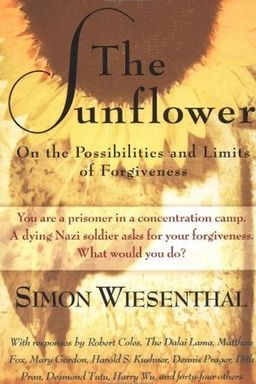
Can you forgive someone who has caused unthinkable harm—not just to you, but to millions of others? Can forgiveness stretch far enough to encompass genocide? These questions strike at the heart of Simon Wiesenthal’s The Sunflower: On the Possibilities and Limits of Forgiveness. Within its pages, Wiesenthal asks not only what forgiveness means, but whether it is ever truly possible after humanity has crossed the threshold into mass cruelty.
The story begins in a concentration camp, where Wiesenthal—an Austrian-Jewish architect turned prisoner—finds himself summoned from his suffering to the bedside of a dying SS soldier. The young man, named Karl, is consumed by guilt. He recounts a horrifying massacre in which he helped set fire to a building filled with Jewish families in Ukraine, shooting those who leapt from the windows, including a father holding a child. Now, tormented by the memory and by his approaching death, Karl begs Wiesenthal—any Jew—to grant him forgiveness so he can die in peace.
Wiesenthal’s response is silence. He listens, rises, and leaves the room without uttering a word. This silence becomes the foundation for one of the most profound moral questions of the twentieth century: Was his silence right or wrong?
A Living Dilemma
What differentiates The Sunflower from typical Holocaust testimonies is its philosophical depth. Wiesenthal doesn’t only recount a moment of moral confrontation; he invites readers into it. He asks, “What would you have done?” The reader becomes his moral companion, forced to face the same impossible question: can we forgive evil so immense that it defies comprehension?
In Book One, Wiesenthal narrates the encounter—the detailed path of Karl's confession, the flickering humanity between them, and his own internal turmoil. Book Two turns the story into a symposium: theologians, survivors, and philosophers from around the world—such as Jean Améry, the Dalai Lama, Desmond Tutu, Cynthia Ozick, and Mary Gordon—grapple with the dilemma. Each brings their own moral lens: Jewish, Christian, Buddhist, secular, philosophical.
Forgiveness and Its Boundaries
Wiesenthal’s silence embodies the book’s central theme—the collision of compassion and justice. His act challenges the very idea of forgiveness detached from responsibility. Forgiveness, according to Jewish ethics, is not a passive release but an active moral transaction. A person wronged must be asked for forgiveness directly, and only they may grant it. But what happens when the wronged are dead, when millions have been obliterated? For Wiesenthal, it wasn’t within his power to forgive crimes committed against others. His silence, though painful, was morally coherent.
The book juxtaposes this Jewish view with Christian theology, which often emphasizes unconditional forgiveness. Many Christian voices, like Father Theodore Hesburgh and Cardinal König, suggest forgiving as an act of divine grace—a reflection of God’s mercy that transcends human limits. Others, like Abraham Joshua Heschel and Cynthia Ozick, reject this as dangerous moral indulgence. Forgiveness without justice, they argue, risks sanctifying evil itself.
The Symbol of the Sunflower
The titular sunflower becomes Wiesenthal’s haunting metaphor. On the march through the city, he sees graves of German soldiers adorned with sunflowers, reaching toward light—symbols of connection between the dead and the living. He imagines butterflies carrying messages between heaven and earth. He realizes that no such flowers will ever bloom above Jewish mass graves. For him, there will be no sunlight, no remembrance, no voice reaching up from the earth.
This absence becomes the emotional counterpart to his silence. Just as the sunflower links the Germans to life and mourning, Wiesenthal’s silence reflects the void between victims and humanity—the moral dead zone created by genocide. The sunflower thus comes to symbolize impossible reconciliation: even death itself is not equal.
Why It Still Matters
Half a century later, the book’s questions illuminate modern conflicts—from Bosnia to Rwanda to apartheid South Africa. Desmond Tutu and the Dalai Lama remind readers that forgiveness can be a tool not just for spiritual peace but for societal renewal—but only when truth and justice accompany it. Jeanne Améry, a Holocaust survivor tortured by Nazis, insists that forgiveness without justice only perpetuates the crime. Cynthia Ozick warns that pity for perpetrators can turn brutal toward victims. Desmond Tutu adds that forgiveness is “not facile or cheap. It is a costly business.”
Wiesenthal’s question resonates today because it reveals how forgiveness depends on the moral balance between justice and empathy. Can we forgive if doing so erases accountability? Can humanity survive without learning to forgive, even imperfectly? The answers divide the contributors—and perhaps the readers themselves.
Ultimately, The Sunflower is not about whether forgiveness is possible—it is about the kind of world we create when we decide who deserves it. Wiesenthal’s silence lingers as both judgment and mercy, reminding us that how we respond to atrocity defines not just the perpetrators or victims, but the moral boundaries of our civilization itself.