
Idea 1
Escaping the Success Trap: Why Achievement Isn’t Freedom
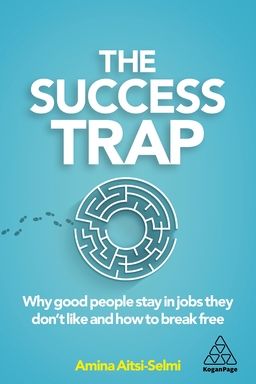
Have you ever looked at your seemingly successful career and asked yourself, “Why does this not feel like success?” In The Success Trap: Why Good People Stay in Jobs They Don’t Like, physician-turned-coach Amina Aitsi-Selmi argues that what we call “success” can often become a prison of our own making. The habits, identities, and beliefs that bring us professional recognition can later entrap us in lives that feel empty, anxious, and disconnected from meaning.
Aitsi-Selmi calls this paradox the Success Trap — the point at which the momentum of external achievement overrides your deeper needs for autonomy, purpose, and authenticity. She writes for high achievers—doctors, executives, lawyers, and creatives—who have ticked every box of traditional success yet find themselves wondering, “Is this it?” Drawing on science, psychology, and decades of coaching leaders across sectors, she guides readers on how to disentangle their identities from their titles and redefine achievement on their own terms.
The Paradox of Modern Success
Aitsi-Selmi begins by diagnosing a modern epidemic of disengagement. Her data tell a striking story: up to 85% of workers globally feel disengaged, and work consistently ranks among the least enjoyable daily activities—only slightly above being sick in bed. Yet we keep striving for promotions, pay raises, and external validation. She attributes this paradox to what she calls “the illusion of safety”: our primal brain mistakes status and salary for security, keeping us stuck even when we’re miserable.
This “illusion” is intensified by the volatility of the 21st-century workplace—the so-called VUCA world (Volatile, Uncertain, Complex, and Ambiguous). Artificial intelligence, economic instability, and the collapse of lifelong careers have turned the once-reliable career ladder into shifting sand. And yet, our psychological programming still clings to outdated myths: that working harder will save us, that a good job means security, that certainty equals safety. The result is anxiety, burnout, and the creeping sense that life might be passing us by.
Burnout, Identity, and the High Achiever’s Dilemma
Through case studies—like “Xena,” a respected doctor trapped in bureaucracy, and “Diana,” a world-class clinician whose success only magnified her restlessness—Aitsi-Selmi reveals the psychological mechanics of burnout. Often it begins when external rewards overshadow intrinsic values. Over time, high achievers conflate identity with productivity, performance with self-worth, until slowing down feels like failure.
She terms this the High Achiever Paradox: winning society’s game while losing your sense of joy. The achiever’s skills—discipline, resilience, perfectionism—become snares. Combined with imposter syndrome (“I’m not good enough”) and rescuer tendencies (“I must fix everything”), they form identity loops that perpetuate exhaustion and self-doubt. The trap isn’t the job itself; it’s the mental filter through which we interpret reality.
From Goal-Chasing to Creative Flow
Aitsi-Selmi’s remedy is not another productivity hack but a deep reboot of how we relate to work. She contrasts the mechanical goal-driven life—fueled by dopamine and external rewards—with the organic creative flow described by psychologist Mihaly Csikszentmihályi. Flow, she argues, is our natural state when we align challenge with skill and act from curiosity rather than compulsion. It’s not about setting more goals but about sculpting your life the way Michelangelo chiseled marble, patiently uncovering what’s already within.
The key is awareness: slowing down to notice the emotions and beliefs driving you. As she explains, “We can’t change what we can’t see.” Slowing down paradoxically accelerates growth by restoring creativity, presence, and calm decision-making. Drawing on neuroscience, Aitsi-Selmi describes how mindful awareness re-engages the prefrontal cortex—the part of the brain responsible for empathy and creativity—silenced by chronic stress and “toxic urgency.”
Unlearning and Rewriting the Inner Script
At the heart of the book lies the High Achiever Paradox Transformation (HAPI) process, a structured method for freeing yourself from limiting beliefs. It combines self-enquiry (questioning your thoughts) and self-mastery (observing and releasing emotions). Through reflective exercises—such as identifying the thought “I can’t say no” and testing it through curiosity—you move from autopilot to agency. The goal isn’t self-improvement but self-liberation: to see thoughts as stories rather than facts.
Aitsi-Selmi integrates insights from mindfulness, Stoicism, and neuroscience to show how awareness reprograms your mental filter. She argues that true transformation comes when you shift from controlling life’s outcomes to cultivating inner spaciousness and trust. From that space, purpose, mission, and values don’t need to be “found”—they naturally reveal themselves.
The Road Beyond: From Employee to Entrepreneur of Your Life
Once you learn to think beyond the Success Trap, the challenge is to act from freedom rather than fear. The final sections map the evolution from employee to entrepreneur—not necessarily by starting a company, but by adopting what she calls the entrepreneurial mindset of self-leadership. Entrepreneurs, Aitsi-Selmi explains, thrive amid uncertainty by treating careers as creative projects rather than rigid ladders. They play the infinite game—one that values curiosity, collaboration, and contribution over status or control (a concept echoing Simon Sinek’s The Infinite Game).
Why It Matters
Ultimately, The Success Trap is less a career manual than a manifesto for conscious living. It calls on you to replace the myth of “success equals safety” with the truth that safety comes from self-awareness. In a volatile world, your greatest security lies not in a title or paycheck but in your capacity to navigate uncertainty with creativity and compassion. If success once meant climbing the ladder, Aitsi-Selmi invites us to redefine it as building a life of purpose, autonomy, and joy—step by mindful step.