
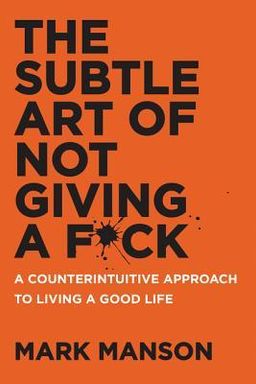
The Subtle Art of Not Giving a Fck cover

The Subtle Art of Not Giving a Fck

by Mark Manson

Mark Manson''s The Subtle Art of Not Giving a F*ck teaches us to focus on fewer, more meaningful priorities to lead a happier life. With a counterintuitive approach, Manson encourages readers to embrace their struggles and adopt values that truly matter, reducing stress and enhancing personal fulfillment.

The Subtle Art of Not Giving a F*ck: A Counterintuitive Approach to Living Well

What if trying to be happy is exactly what's making you miserable? That question lies at the heart of Mark Manson’s The Subtle Art of Not Giving a F*ck, a brash, funny, and deeply grounded look at what it means to live well in a world obsessed with success, happiness, and positivity. Beneath its provocative title, Manson offers something closer to modern stoicism—an antidote to the cultural sickness of caring about everything all the time.

Manson argues that the secret to a meaningful life isn’t endless self-improvement or positive thinking. Instead, it’s learning which things are truly worth your limited time, energy, and emotion—and letting go of the rest. We have, he says, a finite number of “f*cks” to give. The tragedy of modern life is that we waste them on trivialities: social media drama, validation from strangers, and a frantic pursuit of happiness that backfires into anxiety.

The Backwards Law of Happiness

At the book’s philosophical core is what Manson calls the “backwards law,” borrowed from Alan Watts: the more you desperately pursue positive experiences—riches, fame, happiness—the more you reinforce your sense of lacking them. Conversely, accepting negative experiences and limits tends to produce a counterintuitive contentment. As Manson puts it, “The desire for more positive experience is itself a negative experience. The acceptance of one’s negative experience is itself a positive experience.” In other words, stop obsessing about fixing how you feel, and start accepting that life kind of sucks sometimes.

This idea anchors the story of figures like Charles Bukowski, the alcoholic poet whose tombstone reads “Don’t try.” Bukowski’s success came not from trying to become a better person but from owning his flaws and writing about them honestly. Or as Manson summarizes, “Bukowski didn’t give a f*ck about success. He gave a f*ck about writing.”

Why Most Self-Help Advice Fails

Modern culture, Manson says, is driven by “The Feedback Loop from Hell”—a cycle where we feel bad about feeling bad, anxious about being anxious, and guilty about feeling guilty. Social media fuels this loop by showing only other people’s highlight reels, leaving us to assume that our own struggles signal failure. But, Manson insists, suffering isn’t a bug in the human system—it’s a feature. Life is an endless stream of problems; solving them is what makes us feel alive. Happiness is not what happens when everything is perfect—it’s what happens when we find meaningful problems to solve.

What Really Matters

Part of learning this “subtle art” is learning to say no—to stop giving a f*ck about trivial matters and start giving a f*ck about values that actually matter: honesty, responsibility, humility, and compassion. Suffering for the right things creates depth and meaning; suffering for superficial things only multiplies misery. As Manson puts it, pain is inevitable, but we get to choose the pain that’s worth it.

How This Philosophy Unfolds

Throughout the book, Manson dismantles some of the most cherished illusions of modern life. He shows how entitlement—believing we deserve good things without earning them—creates fragility. He teaches that failure, uncertainty, and rejection are not enemies but the path forward. He urges readers to accept responsibility for everything in their lives, even things that aren’t their fault, because that’s the only way to regain power over them. And he ends by confronting our ultimate limitation: death, the one truth that puts all other f*cks in perspective.

Why These Ideas Matter Now

Beneath Manson’s irreverence lies a serious cultural critique. Ours is a time of abundance and anxiety. We are drowning in choices, images of success, and calls to “be extraordinary.” But the endless chase for exceptionalism only breeds insecurity and self-hatred. Manson flips the script: “Not everybody can be extraordinary—there are winners and losers, failures and successes—and that’s okay.” Accepting this imperfection frees us from comparison and opens the door to genuine connection and inner peace.

In this summary, we’ll explore how Manson redefines happiness by teaching you to stop chasing positive emotions, embrace suffering, take radical responsibility, and accept your own fallibility and mortality. If you can learn to give fewer, better f*cks, he promises, you won’t just be happier—you’ll be freer.


Choose What to Care About

Manson begins with a deceptively simple question: what are you giving a f*ck about? In a culture that pressures you to care about everything—appearance, career, popularity, validation—the result is emotional exhaustion. You have a limited number of f*cks to give, and wasting them on trivial matters turns life into a string of frustrations.

The Feedback Loop from Hell

We feel bad about feeling bad, anxious because we’re anxious, guilty about being guilty. This “loop from hell” keeps us caught in cycles of self-loathing that feed consumerism and comparison. Social media worsens it: you scroll through highlight reels, bombarded with reminders that everyone else seems happier, richer, sexier, and more successful. According to Manson, the way out is not to replace these negative feelings with forced positivity but to stop giving a f*ck that you feel bad at all.

Key Quote

“The desire for more positive experience is itself a negative experience. The acceptance of one’s negative experience is itself a positive experience.”

The Subtleties of Not Giving a F*ck

Not giving a f*ck doesn’t mean apathy or indifference—it means focusing on what matters and being comfortable with being different. You must care about something more important than adversity or rejection; otherwise, you’ll collapse under pressure. Manson tells the story of his mother’s friend being cheated out of money—a moment where “not giving a f*ck” meant taking decisive, principled action to seek justice, not brushing it off. Mature people, he says, give fewer f*cks, but better ones.

Maturity and Selectivity

As you mature, you realize most problems don't deserve your energy. Giving fewer f*cks is an act of clarity: you stop obsessing about minor grievances (the rude cashier or a canceled TV show) and start investing in family, purpose, and integrity. This is what Manson means by practical enlightenment—knowing that suffering is inevitable, and you must choose the suffering that matters.

(For comparison, psychologist Viktor Frankl makes a similar argument in Man’s Search for Meaning: happiness arises not from pleasure but from purpose found through struggle.)


Happiness Comes from Solving Problems

Happiness, according to Manson, is not what happens when problems disappear—it’s what happens when you’re actively solving problems you enjoy. Problems never go away; they simply change or improve. Warren Buffett has money problems; the man at the convenience store has money problems. The difference is the quality of those problems.

The Purpose of Suffering

Pain serves a biological purpose—it teaches adaptation. Physical pain warns you not to touch the stove again; emotional pain warns you not to repeat destructive patterns. By coddling ourselves from discomfort, we lose this evolutionary advantage and turn fragile. Manson’s comic creation “Disappointment Panda” embodies this truth-telling spirit: his superpower is delivering uncomfortable realities that help people grow, like “Making money won’t make your kids love you.”

Avoidance and Victimhood

Manson identifies two destructive approaches to problems: denial (pretending problems don’t exist) and victim mentality (believing problems can’t be solved). Both feel good in the short term but create insecurity and helplessness later. True happiness depends on acknowledging your problems, accepting responsibility, and doing the hard work to solve them. Self-help gurus often sell illusions of instant happiness, which are really just forms of denial wrapped in motivational slogans.

Choosing the Struggle

The key question isn’t “What do you want out of life?” but “What pain are you willing to endure?” You want the reward of success—but do you want the grind required to get there? You want the joy of love—but do you want the discomforts of vulnerability and faith? Manson learned this in his own failed pursuit of being a rock musician: he loved the fantasy of fame but not the daily drudgery of practice and rejection. The life you want requires loving its struggles, not just its rewards.

Happiness, then, is “a form of action.” It unfolds through striving, failing, and solving one meaningful problem after another. Once you master that rhythm, you’ll stop chasing highs and start living for purpose.


You Are Always Choosing

In one of the book’s most empowering chapters, Manson reminds readers that you are always choosing—whether consciously or not. Everything that happens in your life involves a decision: how you interpret it, how you react to it, and what values you use to measure it. You may not control what happens to you, but you always control the meaning you give it.

Radical Responsibility

Manson illustrates this through the story of William James, an American philosopher who battled illness, failure, and depression until he made a daring experiment: for one year, he would act as if he were fully responsible for everything in his life. If things didn’t improve, he’d commit suicide. That choice changed everything. By taking ownership, he turned suffering into strength and eventually founded modern psychology. James proved that with great responsibility comes great power.

Fault vs. Responsibility

Manson makes a crucial distinction: fault is past tense; responsibility is present tense. You may not be at fault for your trauma, losses, or pain, but you’re responsible for how you respond now. He uses the example of a man cheated on by his girlfriend—his suffering wasn’t his fault, but only he could decide whether to cling to pain or rebuild his life. Taking responsibility doesn’t mean accepting blame; it means reclaiming control.

Victimhood and Choice

Blame is seductive—it gives temporary moral superiority and sympathy. But staying in victimhood consumes your potential. Manson calls this “victimhood chic,” a modern cultural addiction fueled by outrage media. Everyone feels oppressed, everyone claims trauma, and genuine victims get lost in the noise. The cure? Stop making pain your identity and start making choice your strategy.

You are always choosing, even when doing nothing. Knowing this makes you free—and terrifies you. But as Manson concludes, freedom without responsibility is meaningless; it’s just avoidance dressed up as rebellion.


You’re Wrong About Everything (But So Am I)

Certainty feels safe—but it’s toxic to growth. Manson argues that all progress in life stems from recognizing how wrong you are. We don’t move from wrong to right; we move from wrong to “slightly less wrong.” Each day’s assumptions become tomorrow’s lessons, and every belief should be open to revision.

The Illusion of Certainty

People cling to certainty because uncertainty feels like failure. Yet when you avoid doubt, you also avoid learning. Whether it’s a woman afraid to date because she fears rejection or a worker who avoids asking for a promotion out of fear he isn’t good enough, both are trapped by false certainty. Admitting doubt—“Maybe I’m wrong”—opens space for growth. Certainty, meanwhile, breeds entitlement and even evil: fanatics justify harm because they’re “right.”

Manson’s Law of Avoidance

“The more something threatens your identity, the more you will avoid it.” Whether success or failure, change shakes the self-image you cling to. You avoid launching that project or ending that unhealthy relationship because it would redefine who you think you are. Manson’s remedy is simple: “Don’t find yourself. Never know who you are.” The moment you lock into a fixed identity—smart, victim, nice—you stop evolving.

Humility and Self-Doubt

The antidote to dogmatic certainty is humility. Question your beliefs: “What if I’m wrong?” “What would it mean if I’m wrong?” “Would being wrong make my life better or worse?” These questions dismantle arrogance and build wisdom. As Aristotle said, “It is the mark of an educated mind to be able to entertain a thought without accepting it.” Being wrong often hurts—but it’s where growth is born.

Manson’s lesson: embrace doubt like oxygen. Because every truth you hold dear will eventually be proven false, growth isn’t becoming right—it’s becoming less wrong over time.


Failure Is the Way Forward

Failure isn’t just unavoidable—it’s essential. Manson writes that success stems from repeated failure and incremental correction. Like Picasso, who spent sixty years refining his craft until his napkin sketch was worth $20,000, we fail ourselves into mastery. Avoiding failure is like refusing to walk because you might fall.

Reframing Pain

In the 1950s, psychologist Kazimierz Dabrowski found that many World War II survivors viewed their suffering as transformational—they became more grateful, resilient, and grounded. Manson builds on this insight: “Pain is part of the process.” To grow, we must endure discomfort. Avoiding pain through pleasure or distraction deprives us of the lessons pain teaches.

Process Over Outcome

Goals are fleeting; the process endures. If your goal is to buy a house, after achieving it you lose purpose. But if your value is learning, creating, or connecting, those processes never end—they continuously offer meaning. Success comes from adopting values that generate constant opportunity for failure and improvement.

The "Do Something" Principle

Action creates motivation—not the other way around. When stuck, Manson advises: “Don’t just sit there. Do something.” Even small steps produce momentum and inspiration. Each failure becomes feedback. This principle helped him start his writing career; small acts of progress turned paralysis into passion. Acting even when uncertain is courage in practice.

Failure isn’t an obstacle—it’s a teacher. Every mistake clarifies what actually matters to you, and those small corrections add up to an extraordinary life.


Saying No and Creating Boundaries

In Chapter 8, Manson argues that meaning comes not from freedom or saying yes to everything—but from commitment and the ability to say no. Freedom without boundaries feels exciting at first but empties into chaos and shallow connections. Commitment, paradoxically, creates freedom.

The Necessity of Rejection

We live in an age where avoiding “no” feels like politeness, but avoidance kills authenticity. To value anything, you must reject what isn’t that. Manson’s travels taught him that cultures emphasizing honesty (like Russia’s bluntness) often nurture deeper trust than those obsessed with niceness. Rejection defines identity: choosing what you stand for requires rejecting what you don’t.

Boundaries in Relationships

Healthy relationships depend on clear boundaries between partners’ responsibilities and emotions. Poor boundaries create toxic patterns: victims blame others for their feelings, while savers take responsibility for other people's problems. These two types attract and sustain each other's dysfunction. Real love means helping someone solve their own problems—not doing it for them.

Freedom Through Commitment

After years of globe-trotting, Manson realized that absolute freedom means nothing. Living in fifty-five countries gave breadth, but not depth. Only through commitment—to a person, a place, or a craft—can life gain meaning. Every choice to focus on one thing rejects infinite alternatives, making your remaining life richer. “Breadth gives experience,” he writes, “but depth gives meaning.”

In short: your “no” protects what’s sacred. Say it often—and your “yes” will finally mean something.


Death and Something Greater Than Yourself

Manson ends where life itself ends—with death. His friend’s drowning at nineteen shattered his illusions and awakened him to the fragility of existence. This confrontation with mortality, he writes, is the ultimate clarifier of values. When you grasp the certainty of death, you stop sweating trivialities and start asking, “What will my legacy be?”

Confronting Mortality

Death is not just inevitable—it’s necessary for meaning. Without it, life would feel arbitrary. Manson borrows from anthropologist Ernest Becker’s The Denial of Death, arguing that humans cope with death anxiety by constructing “immortality projects”—religion, fame, family—to feel permanent. When these projects fail, existential panic returns. The only cure is acceptance: to embrace death as the boundary that gives shape to life.

Transcendence Through Values

You can escape death terror not by denial but by choosing values larger than yourself—love, creativity, contribution. These connect you to something enduring: humanity itself. Caring about what extends beyond your lifetime replaces narcissistic entitlement with humility and peace.

The Cape of Good Hope

Manson’s vivid scene at South Africa’s Cape of Good Hope captures the book’s spiritual crescendo. As he sits inches from a cliff edge overlooking the ocean, his fear morphs into joy. This, he says, is the moment of “alive awareness”—when you understand that life’s beauty comes not despite its end, but because of it.

Accept death, and you will accept everything. That’s the subtle art’s final liberation: fear nothing, because everything you love and everything you suffer is temporary—and that’s what makes it precious.

Dig Deeper

Get personalized prompts to apply these lessons to your life and deepen your understanding.

Go Deeper

Get the Full Experience

Download Insight Books for AI-powered reflections, quizzes, and more.