
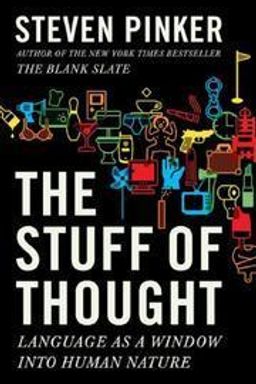
The Stuff of Thought cover

The Stuff of Thought

by Steven Pinker

In ''The Stuff of Thought,'' Steven Pinker explores language as a profound reflection of human nature. Delve into the complexities of linguistic patterns, uncovering how they influence perception, identity, and social interaction. From legal debates to cultural shifts in politeness, discover the dynamic power of words in shaping our world.

Language as a Window into Human Nature

Language is not just a communication tool—it’s a living map of how you think, feel, and interact. Steven Pinker’s central thesis is that the words and structures we use reveal the hidden architecture of thought itself. By examining everyday speech—from legal arguments and political statements to jokes and swearing—Pinker invites you to see language as a mirror reflecting cognition, emotion, morality, and culture.

Language as Cognitive Evidence

When President Bush said the British government had “learned” that Saddam Hussein sought uranium, that small verb changed the stakes—it implied truth, not rumor. Similarly, an insurance battle after 9/11 hinged on whether the attacks were one “event” or two. These cases expose how words encode mental frames; your word choices reveal how you carve reality into causes, events, and agents. Pinker’s point: linguistic detail is cognitive evidence.

Five Dimensions of How Words Map Minds

The book opens by tracing five relationships: between words and thought (conceptual frames), reality (truth commitments), community (social meanings like baby-name waves), emotion (taboos and swears), and relationships (indirect and polite phrasing). Together they form a microscope for human nature. You can observe intellectual framing in debates, emotional charge in curses, and power negotiation in politeness.

Language and Moral Cognition

Pinker extends the argument beyond semantics. Our grammar and metaphors reflect innate categories of space, time, and causation—Kant’s cognitive scaffolding updated by neuroscience and linguistics. Passives like “Mistakes were made” obscure agency, just as intransitives like “Bus exploded” erase blame. Grammar and morality intertwine because linguistic form shapes how you read responsibility and intent.

From Innate Concepts to Cultural Variation

Children acquire language by mapping verbs onto abstract conceptual patterns—motion, state change, causation. The learnability paradox (why do kids generalize but not overgeneralize?) shows that they are not memorizing phrases but hypothesizing frames. Cultural differences (like Chinese classifiers or Pirahã’s number limits) don’t rewrite cognition; they decorate universal conceptual primitives. Meaning lives in a “language of thought” shared across tongues yet flexibly expressed.

Emotion, Taboo, and Social Dynamics

Even profanity, names, and politeness games reveal deep structure. Swearing showcases the right hemisphere’s formulaic routines and the limbic system’s emotional surge—Pinker’s neurobiology of taboo. Baby names trace social imitation and status waves. Indirect speech exposes your embedded relational models (Communal Sharing vs Market Pricing). Each domain offers clues to how words encode not only logical but emotional reasoning.

Language as an Escape Hatch

In the end, Pinker turns Plato’s cave on its head: you are confined by cognitive silhouettes—objects, events, causes—but language helps you climb out. Through metaphor you re-map one domain onto another (time as space, argument as war); through combinatorial grammar you create infinite new frames. Education and institutions expand your conceptual range, teaching you to critique and recombine inherited metaphors. The study of language, therefore, is both a science of mind and a toolkit for intellectual freedom.

In sum, Pinker’s argument connects politics to philosophy, grammar to cognition, and culture to neural design. Language is a living record of how humans model reality—a window through which you can watch thought happen.


Frames, Metaphor, and Event Construal

One of Pinker’s central ideas is framing—the mental process by which you define what counts as an “event,” “cause,” or “agent.” Frames explain why multiple verbal forms can describe the same physical reality yet feel different. In the 9/11 insurance debate, lawyers chose incompatible frames: one treated the terrorist plot as a unified event, the other separated the tower collapses. The concept isn’t linguistic trivia—it’s cognitive reconstruction.

How Frames Work

A frame focuses attention, bundling actors, goals, and causal chains. Pinker shows this using verbs like “load”: “Hal loaded hay into the wagon” versus “Hal loaded the wagon with hay.” Both describe identical motion, yet each highlights a different participant. Frames thus operate as the gears connecting syntax to conceptual semantics.

Spatial Metaphors and Conceptual Piggybacking

We think in spatial terms even for abstract concepts: shifting meetings “forward,” counting events, and talking about “climbing out of debt.” These metaphors exploit our physical intuitions, allowing thought to manipulate time, quantity, and morality as if they were tangible spaces. Cognitive linguists like Lakoff and Johnson inspired this model; Pinker builds on it with empirical rigor.

Insight

Frames and metaphors are not stylistic—they are the machinery through which reality is conceptualized and communicated.

Why Frames Matter for Creativity and Politics

Frames allow reinterpretation: scientists reframe problems, politicians rename taxes as “fees,” and conversationalists soften requests with “Could you...?” Understanding frames helps you see how moral or ideological disputes often arise from competing construals. In both science and rhetoric, reframing opens mental freedom—and misframing leads to misunderstanding.

When you tune into frames, you begin to detect hidden cognitive commitments behind words. Language becomes a diagnostic of how minds carve the same world differently.


Space, Time, and Causality

Pinker revives Kant’s insight that human cognition imposes space, time, and causality on experience. We don’t perceive the world directly; we structure it through these cognitive lenses, and language encodes those lenses. Grammar thus reflects moral reasoning and physical imagination simultaneously.

Space: Topology Over Geometry

Spatial prepositions like “in,” “on,” and “under” reveal how we prioritize causal contact over metric relations. Experiments show people judge “a light bulb in a socket” by functional fit rather than geometry. English squeezes infinite positions into discrete categories—contact, containment, path—because that’s what matters in action.

Time: Tense and Aspect

Language packages time in coarse intervals—past, present, future—and describes the internal texture of events using aspect. “She climbed” versus “She was climbing” reveals different viewpoints on causation. Pinker’s analysis of Clinton’s legal hair-splitting over “is” illustrates how tense and aspect affect truth conditions and social inference.

Causality: From Forces to Responsibility

We attribute causation intuitively. Len Talmy’s “force dynamics” explain verbs like “push,” “help,” or “prevent,” where agents and patients interact as physical and moral forces. Phillip Wolff’s and Michotte’s experiments show people and even animals detect these dynamics visually. Causation feels direct and moral—a shove off a ledge is worse than failing to prevent the same fall.

In all cases, language doesn’t mirror physics; it reveals the human physics of intention, contact, and consequence—the scaffolding of responsibility.


Verbs, Constructions, and How Children Learn

Children’s language acquisition provides Pinker’s strongest evidence that verbs reflect conceptual structure rather than arbitrary rules. Kids learn that verbs slot agents, patients, instruments, and goals according to principles of causation and motion. This ability unfolds through creative generalization and rule restraint—the learnability paradox.

Alternations and Frames

Verb alternations (“spray water on the roses / spray the roses with water”) reveal reconstruals—either motion to a goal or change of state. Children predict these patterns without memorizing every verb. Melissa Bowerman’s diaries and wug tests with invented verbs (“moop”) prove that kids reason conceptually, applying semantic microrules derived from perception and action.

Cognitive Microclasses

Pinker organizes verbs into microclasses shaped by physics and psychology: contact verbs (“rub,” “smear”) alternate easily; gravity verbs (“pour,” “drip”) resist; attachment verbs (“nail,” “glue”) also resist due to their construal of completion and fixation. Syntax mirrors the mind’s physics of force and purpose.

Learning as Conceptual Mapping

Children discover language through mapping—not by memorization but by aligning verbs to mental structures of space and causation. You can trace this development as conceptual primitives (motion, contact, change) integrate into grammar. Learning a verb is learning how the mind organizes reality into thinkable chunks.

Pinker’s synthesis resolves decades of debate: words are learned through constraints imposed by universal cognitive structure, not endless trial and error.


Meaning, Names, and Social Reference

Understanding what words mean leads into philosophy. Pinker contrasts three theories—Extreme Nativism, Radical Pragmatics, and Linguistic Determinism—and integrates Kripke and Putnam’s insights about reference. Words are social anchors, not private symbols.

Rejecting Extremes

Extreme Nativism (Fodor) imagines thousands of innate word concepts; Pinker finds that implausible—meanings decompose into shared primitives like cause, motion, and agenthood. Radical Pragmatics overemphasizes context and fails to explain rule-like alternations. Linguistic Determinism (Whorf) exaggerates language’s power: Pirahã number words don’t erase number cognition, and spatial memory is flexible.

Names and Genealogical Chains

Kripke’s “rigid designators” and Putnam’s “Twin Earth” show meanings depend on historical chains and external reference. “Water” isn’t just what’s in your head; it’s H₂O fixed by communal dubbing. The case of Shakespeare’s authorship or identity theft (“Murray Klepfish”) proves that names connect via social continuity, not dictionary definition.

Social Naming and Cultural Trends

The waves of baby names demonstrate linguistic epidemiology: trends spread through imitation and avoidance, following mathematical models of contagion. Phonesthetic patterns and social class dynamics shape which names rise or fade (“Aiden,” “Nevaeh”). Naming thus blends cognitive templates with social diffusion.

Meaning emerges at the intersection of mind and society—structured by conceptual primitives but sustained by cultural transmission.


Emotion, Taboo, and the Neuroscience of Swearing

Profanity seems trivial, but its survival in aphasia and its cross-cultural universality make it a window into emotional cognition. Pinker connects swearing to neurobiology, evolution, and social function.

Brain Systems for Taboo

Aphasic patients who lose propositional speech often retain curses and fixed formulas. The right hemisphere stores holistic sequences; basal ganglia gate vocal release; the amygdala supplies emotional voltage. Tourette’s coprolalia demonstrates how deeply embedded these circuits are—spontaneous, multimodal, and affect-laden.

Semantic Wells of Profanity

Historically, taboo words recruit five semantic sources: divinity (Goddammit), death and disease (plague), effluvia (shit, piss), sex (fuck), and hatred (slurs). Each taps primal emotions—fear, disgust, and aggression. These roots explain why euphemisms evolve as moral boundaries shift; “oh my gosh” inherits “God.”

Uses and Grammar of Swearing

Pinker classifies five uses: descriptive, idiomatic, abusive, emphatic, and cathartic. Each recruits different cognitive circuits—reflexive “shit!” bursts differ from emphatic “this is fucking great.” Even syntax morphs: “fuck” becomes an infix (“in-fucking-credible”) or a non-imperative curse formula. The linguistic flexibility mirrors its emotional depth.

Far from being verbal junk, swearing exposes the anatomy of affect and cultural taboo—where language meets limbic impulse.


Politeness, Vagueness, and Social Strategy

Indirect speech is not accidental—it’s evolved strategy. Pinker fuses Grice’s pragmatics with game theory and Alan Fiske’s relational models to show how people navigate social hierarchies while preserving plausible deniability.

Implicature and Face

Grice’s maxims guide conversational inference. You can say “Could you pass the salt?” instead of “Pass the salt” because indirectness protects face—autonomy and approval. Brown and Levinson’s theory adds layers: positive politeness (solidarity), negative politeness (deference), and off-record hints preserve harmony while achieving goals.

Strategic Ambiguity and Game Theory

Pinker extends this pragmatics using Thomas Schelling’s game framework. When you offer a bribe implicitly (“Maybe we take care of it here”), a corrupt partner sees intention while an honest one can deny it. Vagueness serves asymmetrical payoffs—success if understood, safety if not. This explains diplomatic wording, flirtation, and negotiation across cultures.

Relational Models and Taboo

Alan Fiske’s four relational templates—Communal Sharing, Authority Ranking, Equality Matching, Market Pricing—govern interaction. Mixing them creates taboo: paying family members or discussing prenups feels wrong because it violates communal fusion. Indirect speech preserves these boundaries, allowing incompatible logics to coexist politely.

Politeness and vagueness thus reveal moral psychology at work—language becomes a negotiation between clarity and social survival.


Language and Conceptual Freedom

At the book’s close, Pinker celebrates language as humanity’s cognitive escape hatch. Though born with limited categories—objects, events, causes—you transcend them through metaphor and composition, creating unbounded thought.

From Cave to Scaffold

Plato’s cave metaphor recurs: your innate mental system shows only shadows—simplified causal packages. But language provides tools to step outside. Conceptual metaphors let you reframe abstract realms using spatial or physical logic; grammatical combinatorics enable novel synthesis. Together, they generate infinite new expressions from finite means—Noam Chomsky’s insight reimagined cognitively.

Education and Institutions

Escaping cognitive confinement requires cultural scaffolding—schools, science, debate—that teach recombination and criticism. These institutions rewire primitive intuitions (like number limits or moral binaries) through linguistic abstraction. Words become instruments for modeling the unseen mechanisms of the world.

The Practical Moral

Language both limits and liberates. It exposes the mental defaults that bias judgment and provides conceptual machinery to rise above them. The ethical payoff is humility: recognizing that every belief and label is a frame to be examined, refined, and sometimes escaped.

For Pinker, studying language isn’t academic indulgence—it’s enlightenment practice. Each word you analyze becomes a rung on the ladder out of Plato’s cave of cognitive illusion.

Dig Deeper

Get personalized prompts to apply these lessons to your life and deepen your understanding.

Go Deeper

Get the Full Experience

Download Insight Books for AI-powered reflections, quizzes, and more.