
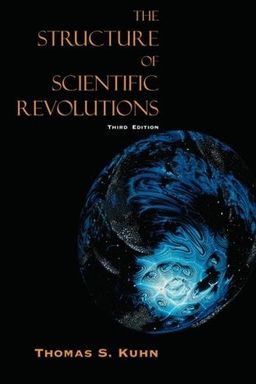
The Structure of Scientific Revolutions cover

The Structure of Scientific Revolutions

by Thomas S Kuhn

Thomas S. Kuhn''s ''The Structure of Scientific Revolutions'' reveals how scientific advancements occur not through gradual development but through revolutionary paradigm shifts. This groundbreaking study challenges the conventional view of scientific progress, offering readers a new perspective on how knowledge evolves.

Paradigms and the Structure of Scientific Revolutions

What if the history of science is not a smooth path from ignorance to truth, but a series of dramatic reorientations in how you see the world? In The Structure of Scientific Revolutions, Thomas Kuhn argues that science advances not through steady accumulation but through periodic revolutions—moments when the fundamental framework guiding research, or paradigm, is replaced by another.

Kuhn asks you to rethink what counts as progress and rationality in science. By examining the lived history of scientific work rather than its polished textbook versions, he reveals how periods of normal science—routine puzzle-solving within an accepted paradigm—alternate with crises and revolutionary shifts that restructure entire disciplines. These shifts, he claims, aren’t merely theoretical substitutions—they transform vocabularies, perceptual habits, instruments, and even what scientists mean by data.

From History to Philosophy: A New Lens

Kuhn begins as a historian of science, not just a philosopher. He insists that textbooks distort our picture of science by sanitizing its struggles. Textbooks portray Newton, Lavoisier, and Einstein as simply adding facts to an ever-growing edifice. History, by contrast, shows that each redefined what counts as a legitimate problem, instrument, or observation. By reintroducing the historical record, Kuhn transforms philosophy of science from a logic of justification into a theory of practice and change.

Key Concepts: Paradigm, Normal Science, and Revolution

A paradigm isn’t just a theory—it’s an entire world-view shared by a scientific community: methods, exemplars, metaphysical assumptions, and standards of legitimate research. Normal science is the disciplined, puzzle-solving work you do within that framework—highly productive but conservative. Over time, however, anomalies arise—observations the paradigm cannot assimilate. When enough accumulate, crisis ensues. Out of crisis come new paradigms, often proposed by younger or less-invested researchers. If the new paradigm reorganizes the field successfully, a scientific revolution occurs.

For instance, the transition from Ptolemaic to Copernican astronomy, from phlogiston to oxygen theory, and from Newtonian to Einsteinian mechanics exemplify Kuhn’s structure. In each, data considered normal under the old system acquire new meanings under the new one. The same phenomena persist, but you come to “see” a different world.

Incommensurability and Perception

Central to Kuhn’s vision is incommensurability—the claim that successive paradigms are sometimes mutually untranslatable. Because vocabulary, standards, and exemplars shift, you may find that arguments between paradigms resemble speaking different languages. The concept draws on gestalt psychology: as with the duck-rabbit figure, the same stimulus can be seen in incompatible ways. Scientists, too, learn to “see differently” after adopting a new paradigm. Herschel seeing Uranus as a planet, or Lavoisier reinterpreting gases, are examples of perceptual reorientation rather than mere conceptual change.

Why It Matters

Kuhn’s work redefines your understanding of progress, rationality, and truth. Science, he argues, evolves not teleologically toward a fixed truth but adaptively, favoring paradigms that solve more puzzles. Progress remains real but historically situated—each paradigm solves old problems while generating new ones. His argument doesn’t deny truth or objectivity but embeds them in the social and cognitive practices of communities. In doing so, Kuhn reconnects epistemology with history and psychology, showing that to understand science you must study how scientists learn to see, reason, and persuade.

Kuhn’s revolution is conceptual: he replaces the image of science as cumulative logic with one of dynamic, community-driven evolution—part rational inquiry, part social transformation, part perceptual reeducation.

As you move through his stages—pre-paradigm fragmentation, normal science, anomaly, crisis, revolution, and normalization—you see not chaos but a patterned evolution. Scientific progress isn’t linear or guaranteed, but it is resilient. Each new paradigm, by reorganizing what scientists can see and say, makes the world scientifically visible anew.


From Textbooks to Real Science

Kuhn starts by showing that textbooks conceal the true dynamics of science. You probably learned physics or chemistry as a neat accumulation of facts, but those materials are pedagogical fictions. They omit the rivalries, debates, and confusions that preceded consensus. By presenting the current paradigm as an inevitable product of progress, textbooks create what Kuhn calls a retrospective illusion.

The Sanitized Narrative

Textbooks simplify history by rewriting past thinkers as precursors to the present. Galileo appears as a Newtonian before Newton existed; Boyle is reinterpreted as a proto-chemist despite rejecting the concept of absolute elements. This anachronism erases legitimate alternative worldviews and makes scientific revolutions look like gradual refinements rather than radical breaks.

Pre-Paradigm and Post-Paradigm Stages

When science is young—before a unifying paradigm exists—multiple schools compete. For example, early electricity had effluvium, fluid, and attraction-based theories coexisting. Once a dominant framework emerges (like Franklin’s), a paradigm forms, and the field’s energy channels into normal research. From then on, the paradigm defines legitimate questions, instruments, and standards. The historian’s job, Kuhn insists, is to recover those lost pre-paradigm pluralities and understand why one became dominant.

For you, this means that understanding science historically reveals its contingent, human texture. Each generation rewrites its past, but if you read original sources and recover previous paradigms, you’ll see how deeply our current knowledge depends on forgotten debates and educational conventions.


Normal Science and Puzzle-Solving

Once a paradigm is established, most scientific work shifts to normal science: the disciplined extension and articulation of that paradigm. Far from seeking novelty, normal science aims for precision, prediction, and puzzle-solving. You inherit a language of exemplars—solved problems, experimental setups, and conceptual templates—that show you how to proceed. Your daily work is to apply those patterns to new puzzles.

Science as Puzzle Culture

Kuhn defines a puzzle as a problem with a known solution in principle and fixed rules for reaching it. The value lies not in surprise but in execution, like playing chess within defined moves. Labs, instruments, and problem sets embody that culture. For example, measuring inverse-square electrical force, improving precision in spectroscopy, or tuning Atwood’s machine—all are normal problems that refine rather than overturn theory.

Exemplars and Tacit Knowledge

When you solve textbook problems, you learn tacit knowledge—how to see analogies and ignore irrelevant details. This skill cannot be formalized; it’s learned by example. The community’s exemplars thus constitute its method. (Later thinkers like Michael Polanyi and Peter Galison developed this theme: science rests as much on craft tradition as on explicit rules.)

Normal science’s stability is its strength and weakness. It allows cumulative progress, but it also blinds practitioners to anomalies. Yet, paradoxically, that same precision works creates the data that eventually expose the paradigm’s limits and set the stage for revolution.


Anomalies and the Path to Discovery

Discovery, Kuhn says, begins not with inspiration but with anomaly—observations that don’t fit established expectations. The scientist’s first impulse is to doubt the data, not the theory. Only after persistent failure to assimilate results does a genuine discovery process begin. This is why discovery takes time: both perception and concept must adapt.

From Anomaly to Recognition

Examples abound: oxygen was isolated by Scheele and Priestley but only conceptualized by Lavoisier; Roentgen noticed X-rays as an unexplained screen glow; the Leyden jar emerged from instrument anomalies. In each case, what counted as discovery depended on the conceptual framework that made new interpretation possible. Discovery is thus social and temporal, not a private eureka moment.

Perception and Cognitive Frames

Kuhn uses gestalt psychology and Bruner-Postman’s experiments to argue that scientists “see” through conceptual filters. Subjects misrecall anomalous playing cards until repeated exposure forces reclassification. Similarly, scientists assimilate data that contradict their paradigm until anomalies accumulate and perception shifts. Discovery occurs when seeing and knowing reorganize together.

When you next read of a sudden scientific leap, remember that it’s the endpoint of this prolonged process of anomaly recognition, theoretical reinterpretation, and communal assimilation.


Crisis and Scientific Revolution

Kuhn’s revolutionary cycle reaches its turning point in crisis. When anomalies multiply and can no longer be ignored, the confidence that governs normal science erodes. Standards blur, debates multiply, and scientists venture speculative projects they once dismissed. Out of this turmoil emerges a revolutionary reorganization.

How Crisis Develops

Ptolemaic astronomy’s deteriorating accuracy drove astronomers to Copernicus. Phlogiston chemistry fractured as more gases were discovered and weight relations contradicted expectations. These are not mere “failures of data” but technical breakdowns: the paradigm’s puzzle-solving machine jams.

Extraordinary Research and Innovation

In crisis, younger or peripheral scientists—less constrained by habit—explore new frameworks. Galileo’s thought experiments, Einstein’s redefinition of simultaneity, or Heisenberg’s quantum mechanics exemplify this phase. During such times, conceptual and even philosophical reasoning returns to prominence, exposing old assumptions as problematic.

Crisis is thus not chaos but the necessary incubation of novelty. It generates revolutionary science—the phase where a new paradigm redefines normality itself.


Paradigm Shifts and Seeing Worlds Anew

A scientific revolution replaces one world of scientific practice with another. After such shifts, Kuhn says, scientists quite literally work in a different world: not because nature changed, but because the framework for recognizing, classifying, and valuing facts did.

Paradigms Define Worlds

Paradigms provide symbolic laws, models, metaphors, and exemplars. They act like an operating system that determines what the scientific “desktop” displays. You perceive through it: a Newtonian sees forces; an Aristotelian sees tendencies; an Einsteinian, spacetime curvature. When paradigms change, familiar data acquire different meanings. Galileo’s pendulum or Lavoisier’s oxygen are different not because of new senses but because new categories illuminated them.

Incommensurability and Communication

Different paradigms can be incommensurable: their key terms (“mass,” “acid,” “planet”) shift in meaning, preventing direct comparison. Arguments across paradigms resemble translation efforts, relying on persuasion and metaphor more than deduction. Over time, education and institutionalization ensure the new language becomes second nature to its practitioners.

In essence, scientific revolutions are perceptual revolutions. Like learning to interpret a gestalt or to wear inverting lenses, your training in a new paradigm changes your world’s visual and conceptual texture.


Choice, Persuasion, and Community Conversion

When paradigms compete, logic alone cannot decide. Scientists evaluate using shared but differently weighted values: accuracy, consistency, simplicity, scope, and fruitfulness. Yet because these criteria lack a universal algorithmic application, paradigm choice resembles persuasion—even conversion.

Persuasive Proof and Problem-Solving Power

History shows how persuasion works. Lavoisier’s oxygen theory solved weight anomalies and allowed quantitative chemistry; Fresnel’s wave theory predicted the Poisson spot; Dalton’s atomic model unified chemical ratios. These successes, not demonstrations of logical superiority, won hearts. Over time, younger scientists who adopt the new paradigm and produce fresh exemplars consolidate its authority.

Sociology of Revolution

Conversion spreads as training shifts: textbooks and education embed the new exemplars. Max Planck’s observation that science advances “funeral by funeral” captures this sociological dimension. Revolutions end not when every individual is convinced but when a community sustains new norms and reproduces them through education and practice.

Thus, scientific revolutions unfold as collective negotiations between empirical success, cognitive readiness, and generational change.


Progress and the Evolutionary Image of Science

Kuhn ends by redefining progress. Science advances, but not toward an ultimate truth. Instead, it evolves by adapting to new problems and environments, like Darwin’s species improvising against selective pressures. Each paradigm is a successful adaptation, not a final endpoint.

Evolution Without Teleology

Progress occurs “away from” older frameworks that no longer handle emerging puzzles. New paradigms preserve parts of their predecessors yet reconfigure meaning and scope. Einstein did not simply add corrections to Newton—he redefined space, time, and mass. In that sense, science shows cumulative problem-solving ability without converging on a fixed ontology.

Science as Reliable but Human

For Kuhn, objectivity lies in community discipline, peer evaluation, and shared exemplars. Progress persists because scientific communities form insulated but self-correcting ecosystems. New theories are selected for practical fruitfulness and explanatory breadth, not metaphysical certainty.

In Kuhn’s evolutionary metaphor, science improves problem-solving power through adaptive revolutions, not inevitable ascent to truth.

Your takeaway: treat science as a dynamic organism rather than a ladder to reality. It progresses through the resilience of communities that blend precision, tradition, and creativity. That human mixture is the true source of scientific growth.

Dig Deeper

Get personalized prompts to apply these lessons to your life and deepen your understanding.

Go Deeper

Get the Full Experience

Download Insight Books for AI-powered reflections, quizzes, and more.