
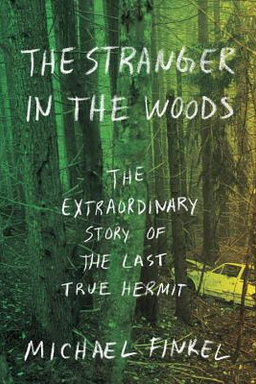
The Stranger in the Woods cover

The Stranger in the Woods

by Michael Finkel

The Stranger in the Woods recounts Christopher Knight''s extraordinary 27-year survival in Maine''s wilderness. This compelling narrative explores his choice of solitude, his ingenious survival tactics, and the profound questions about human connection and isolation.

The Search for a Life Beyond Society

What would happen if you walked away from everything—your family, your job, and the noise of modern life—to live entirely alone in the woods? In The Stranger in the Woods, journalist Michael Finkel investigates this radical question through the story of Christopher Knight, the so-called “North Pond Hermit,” who disappeared into the forests of Maine for twenty-seven years without human contact. Knight’s solitude defies every modern assumption about connection, belonging, and sanity.

Finkel contends that Knight’s life reveals both the beauty and the cost of complete withdrawal from society. The author examines how one man’s renunciation of the modern world exposes deep questions about freedom, the meaning of human contact, and the paradox of loneliness. Knight’s story—equal parts adventure, philosophy, and psychological case study—invites you to confront the essence of solitude and the boundaries of being human.

The Enigma of Christopher Knight

Knight vanished in 1986 at age twenty, abandoning his car deep in rural Maine. For the next quarter century, he lived unseen in a secret campsite surrounded by boulders and hemlocks. He subsisted by stealing supplies—food, propane, batteries—from vacation cabins, careful not to leave footprints or clues. When he was arrested in 2013, authorities discovered that he had committed over a thousand burglaries but never harmed anyone. Knight’s feat was astonishing and impossible in equal measure. He never spoke to another person except for a single word—“Hi”—to a hiker in the 1990s.

While the world saw him as a recluse or criminal, Finkel saw him as a living parable for humanity’s ancient struggle: can meaning be found by being rather than doing? Knight’s silence seemed like a rebellion against the endless noise and busyness of modern civilization. His life posed a haunting question about happiness—if total solitude brought him peace yet required theft and isolation, what does that say about the human need for society?

Finkel’s Investigation and Friendship

After Knight’s arrest, Finkel wrote him letters, sparking an unlikely correspondence. Their exchanges revealed that Knight was intelligent, self-aware, and literary—he read widely in the woods, from Shakespeare to military history. But he also suffered, describing his jail confinement as worse than twenty-seven winters in Maine. Through his letters and eventual interviews, Finkel discovered Knight’s guiding philosophy: stoicism—the belief in mastering emotion and enduring hardship quietly. Knight insisted he wasn’t insane or anti-social; solitude was simply his way of being true to himself.

The book unfolds as Finkel’s search to understand whether Knight’s total isolation was spiritual perfection or psychological collapse. By exploring Knight’s childhood in a private, rural Maine family obsessed with self-sufficiency, Finkel draws parallels between upbringing, personality, and withdrawal. We see how a quiet boy became a man allergic to human contact, driven by a desire to disappear.

Solitude Versus Sanity

The book goes beyond biography into the philosophy of isolation. Finkel compares Knight to ancient hermits and modern loners—from Lao-tzu’s Taoist sages to Thoreau at Walden Pond, and even to the Desert Fathers of Egypt. Yet Knight surpasses them all: he is perhaps the most solitary known human in history. Finkel juxtaposes solitude’s blessings—clarity, peace, heightened perception—with its curses: suffering, guilt, and alienation. The hermit’s life becomes a mirror for our modern obsession with busyness and connection.

“Solitude bestows an increase in something valuable,” Knight told Finkel. “When I applied it to myself, I lost my identity. I became irrelevant.”

Knight’s reflection captures the paradox at the heart of Finkel’s investigation: solitude strips away ego but also human meaning. His freedom is complete but costly.

Why This Story Matters Today

Finkel’s narrative resonates because our world is increasingly noisy, connected, and restless. Knight’s retreat represents an extreme reaction—a man who said “no” to everything society demands. His story invites readers to consider what might be gained by quiet and what might be lost. Can solitude clarify who we are, or can it make us vanish entirely? Knight’s life and Finkel’s pursuit of meaning become a meditation on the tension between independence and belonging, sanity and self-realization.

In the following ideas, you’ll explore Knight’s childhood roots of isolation, his ingenious methods for survival, the philosophical depths of his solitude, and the psychological implications of choosing silence over speech. Together, they form a modern parable on the human need for connection—and the haunting beauty of escaping it.


The Making of a True Hermit

Christopher Knight didn’t set out to be a legend. He grew up in central Maine in a reserved but loving family that prized self-reliance and privacy. His father, a former Navy man, taught his sons to fix anything, grow food, and never depend on others. His mother was quiet, bookish, and emotionally restrained. Conversation was rare, affection rarer. Knight absorbed a truth that would shape his entire life: in this family, silence was virtue.

From Quiet Childhood to Radical Isolation

His schoolmates remembered him as quiet, “wicked smart,” yet cut off. He joined no clubs, skipped the prom, and avoided sports. Even as a teenager, he preferred reading technical manuals and Time-Life history books to socializing. This solitude wasn’t rebellion—it was comfort. After finishing a technical course on electronics near Boston and working briefly as an alarm installer, Knight abruptly quit his job, ignored his parents, and drove south in his new Subaru Brat. Somewhere on that road trip, he decided to never return.

He drove until the gas gauge neared empty, parked his car in a forest, left the keys in the console, and walked north into Maine’s wilderness. “I just tossed the keys,” he later told police. He didn’t plan a destination. His goal, paradoxically, was to get lost.

The Instinct to Vanish

Knight’s motivation defied logic. He wasn’t traumatized, addicted, or avoiding a crime. “It’s a mystery,” he admitted. Finkel frames Knight’s disappearance through three archetypes of hermits found in history: protesters, who reject society’s corruption; pilgrims, who seek divine enlightenment; and pursuers, who chase self-knowledge and creativity. Knight fit none perfectly. He didn’t leave in anger, worship, or ambition. His withdrawal was instinctual—a pull toward self-erasure.

He walked indescribably deep into the forest until he found a place so tangled with trees and rocks that even hunters avoided it. This became his home for twenty-seven years. His purpose, Knight said, was simple: “I wanted to be alone.”

Comparing Hermit Traditions

Finkel situates Knight within a lineage stretching from Lao-tzu to Thoreau. Unlike Thoreau, who left Walden to dine with friends, Knight held complete solitude without assistance. In this, he resembled the Buddhist sadhu or the Christian anchorite, not as philosopher but practitioner. Yet Knight rejected every organized religion or ideology. He practiced Stoicism—the belief that joy and suffering are natural, and the self must control emotion. “There was no one to complain to in the woods,” he said, “so I did not complain.”

Knight’s path stripped him of all possessions except awareness. As Finkel writes, “He had what he had, and nothing more.” He became a living experiment in what it means to exist without social mirrors.

Lessons from Vanishing

Knight’s story shows that isolation isn’t only a physical act—it’s psychological. His retreat mirrors modern desires to disconnect from overstimulation, but on an extreme scale. Where others might try a digital detox or silent retreat (like Finkel’s own Vipassana meditation experience), Knight burned the bridge completely. He represents the fantasy of absolute freedom and its harsh truth: in solitude, you lose not just distraction but identity.

Understanding how Knight became a hermit helps you grasp why he stayed—driven not by hatred for others but by a need for peace that society could no longer provide. His silence wasn’t madness; it was method. It was the expression of an inherited creed: make do alone.


The Psychology of Solitude and Sanity

Can solitude make you wise—or destroy you? Finkel explores Knight’s mental world with rare sensitivity, asking whether a person who avoids all human contact for decades can remain mentally sound. The book contrasts serenity and suffering, suggesting that solitude is both medicine and poison depending on dosage.

Silence as Clarity

Knight claimed he “was never lonely.” For him, silence sharpened senses and erased the barrier between self and nature. He knew every sound of the forest—frogs, loons, and even the “bowling-alley rumble” of cracking lake ice. Studies Finkel cites support this effect: quiet boosts cognition, lowers stress hormones, and may even encourage new brain-cell growth (based on research from Duke and Chiba University). Knight’s solitude became an environment for extreme mental focus, much like monks or meditators.

Isolation as Torture

Yet when Knight was jailed, his solitude turned into confinement. The same silence that once freed him now imprisoned him. He called jail “Bedlam”—so loud, dirty, and crowded that it broke his peace. Psychologists Finkel interviewed compare his condition to sensory overload in autistic individuals, suggesting Knight may have traits of schizoid personality disorder or mild autism spectrum disorder. Experts like Jill Hooley and Thomas Frazier debate these diagnoses but agree that he was not insane. He simply had a mind wired for stillness and routine.

Living alone for decades might sound impossible, yet Knight functioned flawlessly. He planned meticulously, adapted creatively, and followed an ethos of total self-sufficiency. Psychologists concluded he possessed “complete competency.” His solitude wasn’t delusion—it was discipline.

The Thin Line Between Sanity and Genius

Finkel reframes the hermit not as madman but visionary. Like Nietzsche or Jung, Knight saw civilization’s “common denominator of stench” and refused it. Still, his peace carried pain. His winters were perilous; hunger and cold brought him near death. And the loneliness he denied found expression in tears after his arrest, when Finkel recorded Knight crying about missing his sister with Down syndrome. “I was prepared to die out there,” Knight confessed.

Knight’s solitude shows that sanity isn’t about interacting with others—it’s about maintaining inner order. The hermit’s mind may look irrational from outside but inside, it’s structured and purposeful.

What His Story Reveals About You

Knight’s psychological journey forces you to examine your own relationship with solitude. Do you crave quiet or fear it? He suggests that silence is uncomfortable because it exposes the self—unfiltered, unperformed. While isolation can wound, it can also heal. The lesson is not to replicate Knight’s extremity but to recognize that brief solitude restores sanity in a world that constantly erodes it.

Finkel turns Knight’s life into a mirror: in solitude we discover the edges of our mind. Too much silence and we dissolve; too little and we never listen. Knight simply crossed the line that most of us resist approaching.


Surviving in the Maine Wilderness

Survival without human support demands a genius for adaptation, and Knight perfected it. He built a hidden camp the size of a living room, walled by boulders and camouflaged tarps, invisible even a few steps away. He lived under the forest canopy for nearly a decade before anyone found him. Finkel’s vivid portraits of his camp combine technical ingenuity with spiritual precision.

A Master of Stealth

Knight moved only at night, avoiding moonlight. He memorized every root and rock over miles of terrain, never breaking a twig or leaving a footprint. He described secrecy as “a fragile state—one print undone and forever finished.” He stole only what he needed: batteries, propane, canned food, books. At the Pine Tree summer camp for disabled children, he found his main pantry, breaking in hundreds of times yet leaving no damage. Officers installed cameras and alarms; none caught him until 2013, when new sensors finally detected motion in the kitchen.

When arrested, Knight was wearing stolen Lands’ End jeans and carried over a thousand burglary counts. Yet even victims acknowledged his restraint. He took candy and coffee but left sentimental valuables. He had a moral code—“If it looks valuable, I will not steal it.”

Ingenious Systems of Daily Life

Knight’s camp had an internal logic like a minimalist home. Magazines formed subfloor bricks; a tent within a tarp shelter kept him dry; rainwater collected in barrels through improvised funnels. He cooked on a propane stove, poured water through coffee filters to purify it, and used Purell for hygiene. He never lit a fire—the smoke could betray him. His bathroom was two logs over a pit; his ceiling was woven hemlock. He built redundancies for everything—multiple flashlights, watches, and bedding—to survive harsh winters.

The Discipline of Cold

Winters in Maine test endurance like few places on Earth. Knight survived without heat, burrowing into layered sleeping bags and waking at two a.m. to shovel snow or pace to prevent freezing. He stockpiled food and propane in autumn, “harvest season.” Below minus twenty degrees, he said, “you purposely don’t think.” The only prayer he admitted was during lethal cold—“at negative twenty, there are no atheists.”

His survival wasn’t mere endurance—it was ritual. Knight turned the mechanics of existence into sacred practice, as if his daily chores replaced religion.

Living Off Modernity’s Scraps

Ironically, his sustenance depended on the civilization he rejected. His dump of plastic packaging tells a story of contradictions—mac & cheese, marshmallows, and Mountain Dew. He escaped humanity but ate its leftovers. His diet ruined his teeth yet never his body; isolation shielded him from disease. Finkel calls him “cleaner than you”—because he caught no germs, never got sick. Knight’s health proved his radical idea: alone, you are free even from biology’s contagions.

His survival techniques show how mastery of environment merges with philosophical resilience. Knight lived in quiet defiance of modern life’s comforts, crafting his own civilization out of stolen fragments and solitude.


The Meaning of Silence

Silence, Knight discovered, is a language. For him, it wasn’t emptiness but revelation. Finkel describes how years of quiet changed Knight’s perception—he moved from hearing nature’s chaos to sensing its order. Silence became both his nourishment and his teacher.

Silence as Connection, Not Absence

In isolation, Knight felt boundaries dissolve: “There was no need to define myself. I became irrelevant.” This paradox—losing self yet gaining awareness—echoes mystics from Emerson to Buddhist nun Tenzin Palmo, who spent twelve years meditating in a Himalayan cave. Finkel compares Knight’s mental transformation to her insight: in solitude, the self doesn’t collapse but expands into everything. Silence allowed Knight to merge with the forest, perceiving the subtle rhythm of seasons as his own heartbeat.

Science Behind Stillness

Modern neuroscience validates Knight’s experience. When silence is deliberate, the brain doesn’t shut down—it activates deeper centers, increasing memory and perception. Finkel connects this to MRI studies of monks and to Nicholas Carr’s work on attention. For Knight, silence was not a break from life but a full immersion into it. Without mirrors or clocks, he lived “in the perpetual now.”

Freedom and Its Cost

Yet silence exacted a price: irrelevance. Knight’s total separation meant no witness to his existence. At times he wept, feeling himself vanish from memory. Unlike Thoreau, he wrote nothing; unlike hermit monks, he offered no wisdom. His truth was non-verbal, stripped of identity. “Solitude increased my perception,” he said, “but when I applied it to myself, I lost my identity.”

Solitude, Finkel concludes, makes us see what we are without performance—yet if carried too far, it erases who we are altogether.

The Lesson for Modern Life

In a hyper-connected age, Knight’s silence holds a warning. Frantic communication may dull thought, but total quiet can dissolve meaning. The challenge lies in balance—to cultivate moments of silence without forsaking the ties that grant us purpose. Finkel closes with Knight’s only explicit advice after decades of introspection: “Get enough sleep.” Simplicity itself becomes wisdom.

Knight’s silence teaches that inner peace isn’t found by fleeing the world but by creating stillness within it—a lesson that reverberates beyond the forest, into every noisy mind.


The Hermit as Mirror for Society

Knight’s story unsettled everyone who heard it because it reflected our contradictions. The people of North Pond admired and despised him: some offered land to live freely; others called him a liar who deserved prison. Finkel uses these reactions to show how we project our fears and fantasies onto outsiders. The hermit becomes society’s mirror.

Contrasting Reactions

To victims of his thefts, Knight was a violator. He invaded cabins, disrupted peace, and stole comfort. Yet others saw a saint of simplicity. As one camp director said, “He was a thief of necessity.” Those who craved silence sympathized; those who prized community condemned. Knight embodied everything we love and hate about living alone.

Public Fascination

After his arrest, Knight became a folk hero. Songs, art, and documentaries celebrated his defiance. Offers of marriage, money, and land poured into the Maine jail. Society romanticized what it could not comprehend. Yet Knight refused every offer. The world’s attention was the exact prison he fled. “I have nothing to say publicly,” he declared.

Why We Fear the Hermit

Finkel connects this tension to history: solitary people have always been both revered and persecuted. The Desert Fathers were saints, but medieval anchorites were considered dangerous. Being alone challenges social control—it implies freedom from rules. Knight’s existence reminded us of our dependency on noise and belonging. He made us uneasy because he showed that happiness might not require others at all.

The Hermit’s Modern Meaning

Today, solitude is scarce yet glorified. We romanticize minimalism and mindfulness while surrounding ourselves with screens. Knight’s retreat is the extreme end of this spectrum: the total rejection of modern life’s false abundance. His story urges reflection on what we actually need for contentment—perhaps less than we think.

Knight’s lesson isn’t to abandon the world but to question its grip. He proved that solitude has power, yet its perfection arrives only when freely chosen and humanely balanced.

By turning one man’s isolation into reflection, Finkel transforms the hermit from recluse into philosopher—a figure reminding you that freedom begins not with flight but with awareness of what truly binds you.

Dig Deeper

Get personalized prompts to apply these lessons to your life and deepen your understanding.

Go Deeper

Get the Full Experience

Download Insight Books for AI-powered reflections, quizzes, and more.