
Idea 1
The World Behind a Piece of Sushi
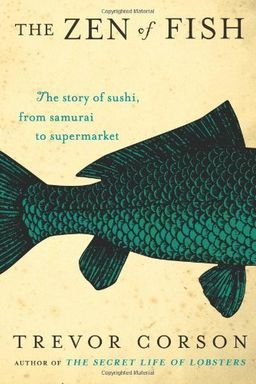
When you pick up a piece of sushi—its gleaming slice of fish, its pristine mound of rice—do you ever wonder about the stories behind it? What histories, people, and traditions had to intertwine to bring this simple bite to your plate? In The Story of Sushi (originally titled The Zen of Fish), Trevor Corson takes us deep into that world, revealing that sushi is far more than a modern dining trend or a symbol of Japanese minimalism. It is, in fact, a complex interplay of science, culture, craftsmanship, and personal transformation.
Corson argues that sushi—both as food and as cultural practice—embodies centuries of evolution, fusion, and adaptation. Behind its elegance lies a rich story of bacterial alchemy, fish migration, human apprenticeship, and cross-cultural exchange. Through the journey of Kate Murray, a struggling young American enrolled at the California Sushi Academy, he illuminates how making sushi is not just about mastering recipes but about embracing a discipline of patience, humility, and transformation.
A Fusion of Science and Spirit
The book’s core argument is simple but profound: sushi connects the modern eater to an ancient chain of biological and cultural processes. From the molecular breakdown that creates umami to the rigorous discipline of Japanese knife training, Corson insists that sushi belongs equally to the worlds of chemistry and spirituality. You can’t separate the scientific understanding of mold and fermentation from the traditional reverence for order, precision, and respect for nature that defines Japanese culinary aesthetics.
In the miso factory that Kate visits, for instance, the humble fungus Aspergillus oryzae emerges as the microscopic architect of flavor. It transforms rice and soybeans into miso, soy sauce, and rice vinegar—all essential elements of sushi. Corson turns this into a revelation: sushi literally depends on the controlled decomposition of organic matter. In his hands, food science becomes poetry—the unseen life that gives rise to taste.
The Apprentice’s Journey
Through Kate’s eyes, you experience the discipline demanded by sushi training. Under the sharp gaze of Zoran Lekic—an Australian-Yugoslav ex-bodybuilder turned sushi prodigy—she learns that sushi-making is as much about mental clarity as it is about knife skills. Every cut, every roll, every shout of “Irasshaimase!” reflects both Japanese cultural practice and personal resilience.
Corson deliberately contrasts Kate’s insecurity and emotional instability with the exacting precision of sushi school. Her knives rust, her cucumbers collapse, and her confidence falters. Yet, in that struggle, we witness the universal theme of learning a craft as a path to self-reinvention. The sushi bar becomes not just a workplace, but a dojo—a place to confront ego and to find balance through repetition and humility.
Cross-Cultural Reinvention
Sushi’s journey from Japan to America is another key layer of Corson’s story. Toshi Sugiura, founder of the California Sushi Academy, is portrayed as a cultural revolutionary—a Japanese chef who dared to Americanize an art form once guarded by centuries-old apprenticeship codes. By training Western students in what had always been a secretive, male-dominated craft, Toshi disrupted culinary tradition but also preserved it through expansion. His classroom becomes a microcosm of modern globalization: a place where authenticity and innovation collide.
Corson uses this collision to ask an implicit question: What does it mean to honor tradition in a world where boundaries blur? Just as sushi itself evolved from fermented rice dishes to fresh fish delicacies, so too must the culture of sushi evolve to survive in Los Angeles, New York, and London. The sushi bar becomes a living metaphor for cultural hybridity—where an Irish-Italian girl can learn a Japanese craft under an Australian teacher in California.
Why It Matters
At its heart, The Story of Sushi asks you to rethink how you engage with food. It’s a meditation on how knowledge—scientific, cultural, emotional—shapes the way we taste and understand what’s on our plates. Corson’s work resonates with themes explored in Michael Pollan’s The Omnivore’s Dilemma: that what we eat is never just fuel, but a reflection of identity, values, and interconnected life forms.
When you finish reading, sushi will never look the same. You’ll see the centuries of human labor behind every shimmering slice of tuna, the invisible colonies of microbes that give rise to its flavor, and the modern individuals—like Kate—whose lives are subtly remade by the art of raw fish and rice. More importantly, Corson shows that food, when deeply understood, is a teacher. It can restore health, build discipline, and reconnect us to something deeper than appetite—the rhythm of transformation shared by all living things.