
Idea 1
Humanizing Philosophy and the Search for Meaning
What is philosophy for, and how can it serve real life? In The Story of Philosophy, Will Durant answers by reuniting thought and humanity. He aims to rescue philosophy from technical obscurity and restore it as the connective tissue of civilization—as the art that interprets knowledge and gives it moral direction. He writes not as a specialist cataloguing doctrines but as a storyteller presenting thinkers as living personalities whose ideas shaped their times.
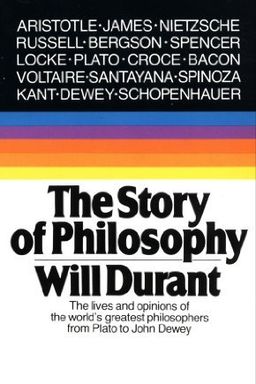
Durant’s core argument is that philosophy must be made human again—grounded in life, intelligible to non-specialists, and useful for the public mind. To do this, he centers on great figures—Plato, Aristotle, Bacon, Spinoza, Voltaire, Kant, Schopenhauer, Spencer, Nietzsche, Bergson, Croce, Russell, James, Dewey—treating each as a beacon of intellectual evolution. The result is not a dry history of abstractions but a dramatic panorama of how human reason has sought order, justice, and meaning.
Philosophy as Synthesis and Civic Intelligence
For Durant, philosophy’s function is synthesis. Science dissects and analyzes; philosophy puts the pieces together. He divides it into five interrelated fields: logic (clear thinking), esthetics (the sense of beauty), ethics (the art of right living), politics (the organization of society), and metaphysics (inquiry into ultimate reality). You need all five, because analysis alone produces means without ends—science tells us how to build weapons, but philosophy tells us whether to use them. In this view, philosophy mediates between technical knowledge and civic wisdom, linking the expert’s discoveries to the citizen’s moral horizon.
The Story as Human Drama
Durant sets the story in motion with Greece, where Socrates and Plato turned inquiry from nature to the soul and the state. Their successors—Aristotle in the Lyceum, Bacon in the laboratories of the new science, Spinoza in quiet Dutch exile, Voltaire in the cafés and courts of Enlightenment Europe—each wrestled with crises of meaning. Philosophy becomes an unfolding conversation about power and virtue, freedom and justice. It advances by transforming problems: Plato’s ideal city becomes Aristotle’s empirical study of constitutions; Bacon’s induction replaces scholastic dogma; Spinoza’s rational ethics rebuild religion on knowledge; Kant restores limits and dignity to reason itself.
(Note: Durant’s method here mirrors H. G. Wells’s popular history work; both believed that synthesis is a civic service. Durant’s originality lies in translating abstract metaphysics into biographies of ideas.)
The Modern Turn: Experience and Experiment
As the story moves forward, philosophy becomes increasingly pragmatic. Bacon’s New Organon inaugurates a world where experiment replaces syllogism; Kant limits reason to stabilize knowledge; Spencer extends evolution to social and ethical life; Bergson revives intuition against mechanistic science; and the Americans—James, Dewey, and Santayana—turn thought toward lived experience and democratic reconstruction. In Durant’s narrative, this is progress: the liberation of the intellect from both superstition and sterile logic.
At the same time, Durant warns against a technocratic civilization stripped of meaning. Science can conquer but not console; without philosophy, power loses moral compass. Every great thinker in this story faces that tension—how to wed knowledge to goodness. From Plato’s philosopher-king to Dewey’s civic reformer, wisdom is imagined as public service.
Style, Aim, and Enduring Relevance
Durant writes warmly and accessibly because he wants philosophy to attract the lay reader. His prose avoids abstraction; instead, he brings ideas to life in context. The risk—superficiality—he accepts gladly if it means recreating philosophy as an adventure of the mind. His civic goal is clear: a literate democracy must have philosophical literacy. When you understand general ideas—justice, freedom, beauty, truth—you are better prepared to interpret events, policies, and yourself.
Through this mission, The Story of Philosophy becomes a book about civilization’s conscience. By narrating the dialogue between reason and life—from Athens to modern America—Durant invites you to see yourself as part of that lineage: a potential participant in the human quest for wisdom. Philosophy, he argues, is not a museum of opinions but an unfinished project of becoming human—again and again, in every age.
At its core, Durant’s story tells you that philosophy is neither remote nor obsolete. It is the ongoing effort to make understanding serve life—to join insight with action, knowledge with virtue, and the mind with the world it seeks to comprehend.