
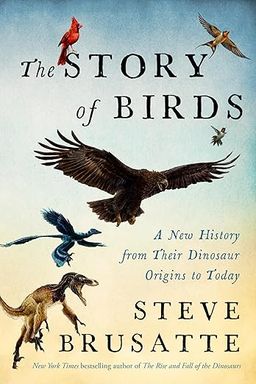
The Story Of Birds cover

The Story Of Birds

by Steve Brusatte

The paleontologist gives an evolutionary history of birds that explains how they began to fly and survived millenniums.

Catastrophe, Innovation, and Dinosaur Rule

How do mass disasters and small innovations conspire to reshape life on Earth? In this book, Steve Brusatte argues that dinosaurs didn’t simply outcompete everything in their path; they rose, diversified, and eventually fell because Earth itself kept changing the rules. Planetary shocks—volcanism, climate swings, asteroid strikes—opened and closed ecological doors, while stepwise anatomical upgrades (upright posture, air sacs, feathers, sensory refinements) let certain lineages sprint through those doors when chance offered them a way in.

You watch this argument unfold from the ground up: literally from Polish trackways where archosaurs first stride onto a emptied Permian stage, through Triassic riverbeds packed with crocodile-line rivals, into Jurassic flood basalts that rewrite the cast list, and onward to Cretaceous laboratories where tyrannosaurs upgrade their senses before bulking up into superpredators. The story culminates in the Chicxulub impact—instantaneous catastrophe followed by mammalian ascent—and closes with clear lessons for a planet now facing rapid, human-caused change.

Shocks reset the evolutionary board

Brusatte begins at the end-Permian crisis (~252 Ma), when Siberian flood basalts spewed ash and greenhouse gases that suffocated oceans, scorched land, and erased ~90% of species. In the rocks at Zachełmie, Poland, you see the switch from tranquil mudstones to coarse, storm-torn layers—a local signature of global collapse. This wipeout cleared ecological space. Erect-limbed archosaurs, efficient movers with high endurance, seized the chance to proliferate (note: this echoes Elisabeth Vrba’s turnover-pulse hypothesis—environmental shocks catalyze bursts of origination).

Small steps, big outcomes

The book makes evolution tangible by emphasizing incremental change. In Poland, narrow, digitigrade Prorotodactylus tracks chart the shift from sprawled Permian gaits to upright dinosauromorph strides. In Argentina’s Ischigualasto, bones of Eoraptor and Herrerasaurus (~230 Ma) lock in the next step: true dinosaurs with a few added skeletal novelties. You don’t jump from lizard to T. rex; you accumulate small tweaks that, together with opportunity, add up to a new body plan.

Competition vs contingency

Through the Triassic, dinosaurs share landscapes with diverse crocodile-line archosaurs (pseudosuchians) that dominate many niches. Quantitative analyses of morphological disparity show pseudosuchians exploring wider body-plan space than dinosaurs. Only when Pangea rifts and the Central Atlantic magmatic province eruptions trigger the end-Triassic extinction do dinosaurs vault to dominance. Paul Olsen’s Newark Basin track record captures this turnover vividly: dinosaur footprints balloon in size and frequency just after the lava pulses.

Innovation bundles power giants

Jurassic sauropods reach sizes no land animal has matched. The reason isn’t one magic trait but a synergistic package: ultra-long necks (big feeding envelopes), fast growth (bone histology), and birdlike air sacs (efficient breathing, heat dumping) inside lightened, pneumatic skeletons. Modern tools—photogrammetry, 3-D modeling, limb allometry—pin mass estimates and biomechanics to data, while Scottish trackways on Skye freeze behavior into stone.

Tyrannosaur arc: senses first, size later

From Kileskus and Guanlong to Yutyrannus and Timurlengia, tyrannosaurs begin small and feathered, experimenting regionally before a Late Cretaceous size explosion. CT scans and inner-ear anatomy suggest upgrades to hearing, balance, and brain regions preceded gigantism. T. rex then perfects a head-first attack toolkit: a bone-crushing bite (Erickson’s 13,400 N tooth test), a skull engineered by evolution to resist its own forces (Emily Rayfield’s FEA), muscular but short arms (Sara Burch), and flow-through lungs. The result is an ambush specialist that’s smart for a dinosaur (EQ ~2.0–2.4), with golf-ball-sized olfactory bulbs and binocular vision.

Feathers and the bird blueprint

Liaoning’s "Pompeii-style" fossils reveal that feathers originate in non-bird dinosaurs as filamentous insulation and displays, later elaborating into aerodynamic surfaces. Wings likely served display, brooding, and thermoregulation before flight (ornithomimosaurs with quill knobs; Zhenyuanlong with ornate but nonflying wings). Multiple lineages toyed with aerial solutions—Microraptor’s four wings, Yi qi’s membrane—before true birds consolidated flapping flight (Archaeopteryx remains the oldest clear bird).

Extinction, survival, and today’s stakes

Chicxulub’s asteroid impact ends the non-bird dinosaurs in a day, then a season-long "nuclear winter" collapses food webs. Survivors are small, generalist, often burrowing or aquatic; mammals rapidly diversify, as shown in New Mexico’s San Juan Basin (Torrejonia among early primate kin). The lesson for you is sobering and practical: dominance is fragile, timing is everything, and multiple stressors can tip robust systems into failure (compare to modern climate and biodiversity crises).

Key Idea

Evolution’s big winners aren’t always the best competitors; they’re often the best survivors when Earth’s rules suddenly change—and the ones carrying the right innovations when the door swings open.


From Ruin to Archosaurs

Brusatte starts where the old world ends: the end-Permian mass extinction. Beneath Siberia, a mantle hot spot tears open the crust and floods the planet with basalt, ash, CO2, and toxins for hundreds of thousands of years. In Poland’s Holy Cross Mountains, the Zachełmie outcrops record the mayhem as a sudden shift from quiet mudstones to storm-swept deposits—a local page in a global disaster that erased most species and neutered ecosystems.

Why archosaurs were primed to win

After the wipeout, ecological space reopens. Among survivors, some reptiles refine a crucial design: columnar, under-the-body limbs. This erect posture supports efficient locomotion and endurance breathing, allowing active hunting in a hot, seasonal world (contrast with sprawled Permian holdovers). These archosaurs split into two main lines—pseudosuchians (crocodile-line) and avemetatarsalians (bird-line)—the latter spawning dinosauromorphs and then dinosaurs.

Footprints before skeletons

When bodies are rare, traces tell the tale. In Stryczowice, Poland, Prorotodactylus trackways are narrow, digitigrade, and three-toed, with reduced outer toes—signatures of upright, bird-line archosaurs. Track geometry lets you infer anatomy: long legs, bunched middle toes, and a center-of-mass poised for running. It’s like watching a film frame by frame as posture shifts from belly-dragging to stilted strides.

Bones anchor the timeline

In Argentina’s Ischigualasto (~230 Ma), fossils of Eoraptor and Herrerasaurus ground the transition. Eoraptor, perhaps omnivorous, and Herrerasaurus, a primitive theropod-like carnivore, are true dinosaurs—distinguished by subtle skeletal novelties in the hip, vertebrae, and limb muscle attachments. The border between dinosauromorph and dinosaur is fuzzy by convention, but the point is clear: small, fast, lightly built animals stepwise assembled the dinosaur body plan.

Why this sequence matters for you

You see how big transitions really happen: catastrophe clears the board; survivors with the right preadaptations advance; incremental anatomical shifts accumulate into new designs. It’s not a miracle fossil; it’s a stack of modest clues—narrow prints here, a humerus scar there—stitched across continents and millions of years. This is evolution as detective work, not myth-making (compare to Neil Shubin’s Your Inner Fish on spotting transitional mosaics).

The early dinosaur look and lifestyle

Dinosauromorphs were dog-sized, with long tails, slender limbs, and three-toed feet. They grew fast, likely hunted small prey, and lived in humid belts while equatorial deserts stayed hostile. Think agile opportunists, not lumbering behemoths. The big sauropods and apex tyrants arrive much later; here, speed and stamina are the winning currencies in a recovering world.

Key Idea

Trace fossils convert posture and behavior into data. In Poland, you can literally walk the evolutionary ramp from post-extinction burrows to the first upright, three-toed steps of future dinosaurs.


Triassic Contest, Jurassic Takeover

Dinosaurs don’t seize the Triassic by storm. For tens of millions of years, they coexist with and often live in the shadow of crocodile-line archosaurs—pseudosuchians that diversify into armored aetosaurs, long-snouted phytosaurs, and top predators like rauisuchians. Brusatte and colleagues quantify this using morphological disparity: across hundreds of skeletal traits, pseudosuchians occupy more body-plan space than dinosaurs during the Triassic. Diversity and design experimentation favor the croc-line winners, not the upstart dinosaurs.

Ghost Ranch: a snapshot of imbalance

At the Hayden Quarry (Ghost Ranch, New Mexico), river-channel deposits (~212 Ma) entomb a community dominated by pseudosuchians and amphibians. Dinosaurs like Coelophysis and Tawa are present but rare. The Chinle “Rat Pack” (Randall Irmis, Sterling Nesbitt, Nathan Smith, Alan Turner) reexamined long-held identifications and found many supposed early dinosaurs were actually croc-line archosaurs or near-dinosaur cousins—overturning a bias that had inflated dinosaur prominence in these beds.

Convergence muddies the water

Effigia, a croc-line archosaur from Ghost Ranch, evolved a bipedal, toothless, beaked skull—eerily dinosaurian. Such look-alikes, widespread in the Triassic, tell you that similar ecological problems often produce similar solutions. But similarity in shape is not equality in fate. When crisis hits, ancestry, physiology, and chance sort survivors from casualties.

When Earth tips the scales

At the Triassic-Jurassic boundary, Pangea begins to tear, and the Central Atlantic magmatic province (CAMP) erupts. You can touch the consequences in North America: the Palisades sill looms over the Hudson; the Watchung basalts step across New Jersey. In the Newark Basin, Paul Olsen’s meticulous track surveys show a turnover: pre-eruption strata feature small Grallator tracks and many croc-line traces, but after lava pulses and extinction, dinosaur prints (Eubrontes, Atreipus, early sauropod Otozoum) dominate and grow larger.

Opportunists, not ordained emperors

Dinosaurs don’t outcompete pseudosuchians straight up; they out-survive them. The extinction disproportionately removes many croc-line forms, and dinosaurs expand into vacated niches during the Early Jurassic. That’s contingency in action. For you, it’s a reminder to question “superiority” stories: timing and external shocks often matter more than marginal performance advantages (Stephen Jay Gould made a career of underscoring such historical contingency).

Key Idea

The Triassic wasn’t a dinosaur dynasty—it was a contested landscape where croc-line archosaurs held the upper hand until volcanism and climate upheaval flipped the script.


The Sauropod Gigantism Engine

If you want to understand an evolutionary moonshot, study sauropods. Brontosaurus, Brachiosaurus, and their kin reached 30–70+ tons on land, a feat no mammal has matched on terra firma (whales outsource weight to water). Brusatte shows that sauropod size wasn’t a single trick but a bundle of complementary innovations that, once combined, made runaway gigantism feasible and then hard to reverse.

Long necks, short moves

A sauropod’s cathedral-like neck expands its “feeding envelope,” letting it browse a vertical swath of vegetation without relocating the entire body. That saves energy in landscapes where food is patchy. Neck elongation coevolved with tiny heads (reduced chewing hardware) and massive, columnar limbs—an efficient crane on a living chassis.

Air sacs and hollow bones

Like birds, sauropods had flow-through lungs with air sacs. Evidence lies in pneumatic fossae and hollowed vertebrae. This system moves oxygen efficiently and dumps heat, both essential for giant bodies. Pneumaticity also lightens the skeleton without sacrificing strength, keeping mass growth within biomechanical limits (note: pneumatic lightening parallels avian flight solutions, repurposed here for heft, not lift).

Rocket-fueled growth

Bone histology reveals rapid juvenile growth. Sauropods blasted through vulnerable sizes, reaching multi-ton masses in decades rather than centuries. Fast growth reduces predation windows and supports population turnover even when adults mature slowly (a different route than mammalian, chew-and-process herbivory).

Measuring the giants

Modern methods replace guesswork. Photogrammetry stitches overlapping photos into accurate 3-D models of skeletons; limb-bone allometry correlates shaft robustness with body mass. Both approaches converge on tens-of-tons estimates for many Jurassic sauropods and >50 tons for some Cretaceous titanosaurs. On Scotland’s Isle of Skye, lagoonal trackways record herd-sized sauropods strolling across tidal flats—behavioral confirmation that these giants occupied varied habitats.

A package deal with ecosystem effects

Gigantism reshaped ecosystems—trampling, nutrient cycling via vast gut throughput, and long-distance foliage pruning. Once air sacs, long necks, fast growth, and pneumatic skeletons coalesced, selection favored even larger sizes (economies of scale in energy and predation resistance). The lesson for you: game-changing power often comes from bundling complementary innovations (think technology stacks), not from any single silver bullet.

Key Idea

Sauropod gigantism is an emergent property: necks extend reach, air sacs fuel and cool, pneumaticity trims weight, and fast growth locks in scale—together enabling body sizes that redefine what land life can be.


Continents Shape Dinosaur Worlds

Dinosaur communities are products of moving continents, rising seas, and shifting climates. In the Late Jurassic, land connections keep faunas relatively cosmopolitan: sauropods, stegosaurs, and allosaurids recur from North America’s Morrison to Portugal, China, and Tanzania. As the Cretaceous progresses, tectonics and sea level carve the globe into regional theaters, and distinct cast lists emerge.

From uniformity to provinciality

By the latest Cretaceous, North America splits into two landmasses by the Western Interior Seaway—Laramidia (west) and Appalachia (east). Europe becomes archipelagos; India rafts north as an island. These barriers throttle gene flow, so evolution runs local experiments. Tyrannosaur apexes arise in Laramidia and Asia, while southern continents (Gondwana) feature different rulers: carcharodontosaurs early on, then abelisaurids alongside long-lived titanosaurs.

Case studies across the map

Hell Creek (Montana region) preserves a terminal-Cretaceous snapshot: Triceratops dominates (~40% of fossils), Tyrannosaurus is ~25%, with Edmontosaurus, pachycephalosaurs, dromaeosaurs, and a menagerie of small vertebrates. South America and Brazil lack tyrannosaurs entirely; instead, you meet titanosaurs (Austroposeidon, Dreadnoughtus) under abelisaurid rule. Europe’s islands produce dwarfed and peculiar forms—Magyarosaurus (a dwarf sauropod) and Balaur bondoc (a stocky, two-toed raptor)—validating Franz Nopcsa’s island rule a century after he proposed it.

Winners rotate through time

Clades rise and fall with geography and climate. Stegosaurs wane in the Early Cretaceous, replaced by ankylosaurs and iguanodonts. Carcharodontosaurs dominate the mid-Cretaceous in parts of Gondwana, later ceding northern supremacy to bulky tyrannosaurids. Even early dinosaurs had climatic limits—Triassic equatorial aridity excluded them until conditions shifted (Ghost Ranch and other Chinle sites help reconstruct those belts).

What this means for you

No single "Age of Dinosaurs" existed; there were many, each shaped by plate motion measured in centimeters per year that still rewired climates, coastlines, and corridors within a few million years. If you mentally place T. rex on every continent, you miss the point: provinciality, not uniformity, is the rule (a lesson equally applicable to today’s biogeography under shifting climate zones).

Key Idea

Plate tectonics isn’t background scenery—it is a primary driver that filters who can move, adapt, and dominate where, producing a patchwork of dinosaur worlds.


Tyrannosaurs, From Feathers To Force

The tyrannosaur saga runs from small, feathered sprinters to the Late Cretaceous monarch, T. rex. Middle Jurassic fossils like Kileskus (Siberia) and Guanlong (China) show early tyrannosauroids as gracile, long-legged, often crested hunters. Dilong bears filamentous feathers; Yutyrannus scales that up—9–10 meters long and fuzzy—signaling that insulation and display predate flight across theropods. These big Early Cretaceous forms represent side branches, not direct ancestors of Rex, but they map the clade’s early range and experimentation.

Senses first, giants second

A key mid-Cretaceous fossil, Timurlengia, preserves an informative braincase. CT data point to enhanced auditory capacity (elongate cochlea) and expanded brain regions for sensory processing. Brusatte argues that tyrannosaurs upgraded their sensory and cognitive toolkit before scaling up in mass ~84 Ma onward. That sequence matters: a smart hunter that hears, smells, and tracks well gains more from later muscle and skull investments.

The bone-crunching machine

Greg Erickson’s hydraulic experiments with a bronze-aluminum T. rex tooth replicated a half-inch-deep puncture in cow pelvis (~13,400 N; ~3,000 lb). Emily Rayfield’s finite element analyses show a skull built like an aircraft fuselage: fused nasals acting as a stress sink, interlocking sutures, thick orbital bars, and a robust lower jaw cross-section that disperse the recoil from those punctures. The package—massive jaw muscles, reinforced skull, thick, serrated teeth—supports puncture-and-pull feeding that processes bone routinely (contrast with Allosaurus’s slashing strategy).

Arms, lungs, movement

Sara Burch’s reconstructions reveal that T. rex’s short arms were muscular and well-anchored—tools for clutching prey close while the head did the lethal work. Vertebral pneumaticity implies birdlike flow-through lungs, enabling high oxygen turnover. But mass imposes limits: John Hutchinson’s models place adult speeds at ~10–25 mph with modest agility. Picture an ambush specialist: a patient stalk, a short burst, a devastating bite, then a bone-splintering coup de grâce.

Brains and senses refined

CT endocasts (Larry Witmer; Balanoff & Bever) give Tyrannosaurus an EQ ~2.0–2.4—smart for a dinosaur and comparable to primates in relative terms (humans are off the charts at ~7.5). Darla Zelenitsky’s measurements show oversized olfactory bulbs—about golf-ball-sized each—indicating excellent smell. Inner-ear anatomy supports sensitivity to low-frequency sounds and fine balance, while partially forward-facing eyes allow depth perception. Forget the movie myth: a motionless you wouldn’t be invisible to Rex.

Diversity to the end

Even late in the Cretaceous, tyrannosaurs vary. Qianzhousaurus from Ganzhou (“Pinocchio rex”) sports a long, narrow snout—evidence of niche partitioning within the apex guild. Tyrannosaurs aren’t a monolithic template; they’re a clade exploring skull shapes, sizes, and hunting styles within the constraints of their sensory-forward design.

Key Idea

T. rex wasn’t inevitable. It’s the late-blooming outcome of early feathered origins, mid-Cretaceous sensory upgrades, and a final morpho-functional crescendo that forged the most formidable bone-crusher on land.


Growing Up Tyrannosaurus

Dinosaurs weren’t static; they reinvented themselves as they aged. In tyrannosaurs, growth is so dramatic that juveniles and adults almost live as different species ecologically. Greg Erickson’s histological work sliced bones to count annual rings—lines of arrested growth—and produced curves showing lifespans in decades, not centuries. The headline: during a teenage surge (~ages 10–20), T. rex packed on about 1,700 pounds per year—nearly 5 pounds a day—demanding extraordinary caloric intake and pushing physiology to the edge.

The skull’s metamorphosis

Thomas Carr documented ontogenetic changes across an exhaustive cranial dataset. Hatchlings and juveniles had long, slender snouts, lightly built skulls, and narrow, blade-like teeth—ideal for quick bites and small prey. As they matured, sutures tightened, muscle scars deepened, jaws broadened, and teeth transformed into robust, banana-shaped pegs. The adult skull becomes a vise built for puncture-and-pull feeding. This is genuine metamorphosis: a light, cursorial hunter morphs into a heavy, bone-crushing ambusher.

Age-based niche partitioning

Because bodies and abilities change so much, juveniles and adults likely ate different prey and used different tactics. That reduces intraspecific competition and lets one species fill multiple ecological roles. In modern ecosystems, you’d call this ontogenetic niche shift; in Hell Creek, it may have helped T. rex become both ubiquitous and ecologically dominant across life stages.

Social hints and group behavior

Mixed-age tyrannosaur bonebeds and tracksites suggest some degree of group living (debated, but tantalizing). If juveniles were the sprinters and adults the finishers, coordinated packs could have combined speed and crushing power—a division of labor akin to wild canids and hyenas. The Burpee Museum’s Jane (a superb juvenile T. rex) anchors the idea that teenage tyrants were narrow-snouted, fast, and deadly in their own right.

Costs of growing fast

Rapid growth stresses bodies. Teenage tyrannosaurs may have been more vulnerable to disease and injury—a “live fast, die young” pattern captured by Erickson’s mortality curves (the “James Dean” analogy). Yet the payoff is high: reach giant size quickly, shrink the window of vulnerability, and monopolize top-predator roles for a decade or more.

Method as message

This life-history story emerges from methods you can visualize: cutting bone thin sections, mapping growth rings like a dendrochronologist, and tracking skull landmarks across dozens of specimens. It’s a forensic reconstruction of a life lived in phases—one animal wearing different ecological hats as its skeleton rewires itself with age.

Key Idea

Ontogeny isn’t just growth; it’s strategy. By changing form and function across life stages, T. rex expanded its ecological footprint and buffered itself against competition.


Feathers, Wings, and Bird Origins

Feathers didn’t debut with birds, and wings didn’t start with flight. The Liaoning fossil beds of northeastern China—ashfalls that entombed animals with exquisite detail—reveal a parade of feathered dinosaurs that piece together how integument, wings, and eventually flight evolved. This is the strongest vindication yet of the Huxley–Ostrom hypothesis: birds are dinosaurs, and avian traits assembled step by step among their theropod ancestors.

From fuzz to quills

Early forms like Sinosauropteryx show simple, hairlike filaments—protofeathers suited for insulation or display. In maniraptorans (the group closest to birds), feathers gain branching complexity and stiff central shafts, becoming pennaceous quills capable of aerodynamic work. Yet many quilled dinosaurs were too heavy or anatomically constrained to fly (e.g., Zhenyuanlong): feathers served display, brooding, and thermoregulation first.

Color, display, and the wings-before-flight idea

Jakob Vinther’s melanosome studies extract pigment organelles from fossil feathers, reconstructing patterns and iridescence. If wings were bright billboards, sexual selection likely drove their early evolution. Ornithomimosaurs with quill knobs strengthen the case: they sported elaborate forelimb feathers for non-flight functions, later co-opted by some lineages as aerodynamic control surfaces.

Multiple aerial experiments

Microraptor glides on four wings (hindlimbs feathered into airfoils). Yi qi tries a bat-like membrane wing. Anchiornis may show early flapping potentials. These experiments suggest flight evolved via branching, iterative paths, not a single ladder. Archaeopteryx, from the Late Jurassic, anchors the earliest clear bird but still mixes dinosaurian teeth and tail with avian flight feathers.

The deeper bird blueprint

Traits we associate with birds—wishbone (furcula), air sacs, brooding behaviors—appear among non-bird theropods. Birds inherit a modular kit long in assembly; flight is the last major module to lock into place. For you, it’s a vivid example of exaptation: structures evolve for one role and later power something transformative (Stephen Jay Gould’s favored term).

Why this changes your mental picture

Once you see fuzzy tyrannosaurs (Yutyrannus), four-winged raptors, and grounded but winged show-offs, the clean bird–dinosaur split dissolves. Birds aren’t descendants of dinosaurs—they are dinosaurs, the only lineage to fly through the K–Pg bottleneck and keep going.

Key Idea

Feathers and wings evolved first for insulation and display, then were co-opted for aerodynamics. Flight emerged as a messy, brilliant side-effect of prior evolutionary investments.


Asteroid, Aftermath, and Our Future

The curtain falls fast. Walter Alvarez’s iridium-rich clay at Gubbio, shocked quartz grains, spherules, and the buried Chicxulub crater confirm a colossal impact ~66 Ma. In minutes to hours, a fireball scorches continents, ejecta rains glass beads, and earthquakes hammer the globe. Tsunamis roar across coasts. Then the sky darkens: soot and dust choke sunlight, photosynthesis falters, and food webs snap. Deccan Traps volcanism likely amplifies the greenhouse tail—disaster stacked upon disaster.

Selective death, selective survival

Non-bird dinosaurs are mostly large, surface-dwelling, and dependent on high primary productivity with slow reproductive cycles. Wrong traits for a months-long darkness and cold. Survivors skew small, generalist, burrowing or aquatic, with flexible diets and faster breeding: mammals, turtles, crocodilians, some birds. Timing worsens the blow—some herbivore groups were already declining, likely making ecosystems brittle when the asteroid hit (Hell Creek preserves the run-up right to the boundary).

Recovery and mammal rise

In New Mexico’s San Juan Basin, Tom Williamson’s teams document the earliest Paleogene rebound. Within a few hundred thousand years, forests regrow, lakes reteam, and mammals diversify. Torrejonia, a nimble, puppy-sized primate relative ~3 million years post-impact, hints at arboreal niches reopening. The age of mammals isn’t a slow burn; it’s a sprint through doors the asteroid blew open.

Contingency as the rule

If the rock had missed or struck a different substrate or season, the outcome might have shifted (e.g., less sulfate vapor, milder winter). Evolution’s path isn’t prewritten. Dinosaurs were resilient across 150+ million years, yet one bad day, compounded by prior stress, ended their reign. That’s not failure—it’s physics and chance asserting themselves over biological success.

Modern echoes and responsibilities

Today’s drivers—CO2 rise, habitat fragmentation, invasive species—operate more slowly than an asteroid but can converge catastrophically. The fossil record’s warning is blunt: when multiple stressors align, even dominant clades fall. Your actionable takeaway: reduce compounding pressures (emissions, land-use change), build ecological buffers (connectivity, diversity), and monitor early-warning signals (productivity declines) to avoid tipping points.

Key Idea

The end-Cretaceous extinction is both a crime scene solved and a user manual for crisis: identify compounding shocks, understand trait-based vulnerability, and act before systems cross thresholds.

Dig Deeper

Get personalized prompts to apply these lessons to your life and deepen your understanding.

Go Deeper

Get the Full Experience

Download Insight Books for AI-powered reflections, quizzes, and more.