
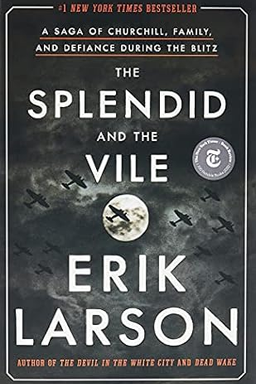
The Splendid and the Vile cover

The Splendid and the Vile

by Erik Larson

The Splendid and the Vile offers a riveting account of Winston Churchill''s first year as Prime Minister, highlighting his leadership during World War II''s darkest days. Erik Larson masterfully captures Churchill''s strategic genius, unyielding spirit, and the nation''s resilience amidst the relentless Blitz.

Leadership and Survival in Britain’s Darkest Hour

How does a leader hold a country together when defeat seems inevitable? This book traces Britain’s perilous months between May 1940 and mid‑1941—when Winston Churchill’s arrival as prime minister, the fall of France, the Battle of Britain, and the Blitz tested not only military power but morale, ingenuity, and moral will. It’s a study in leadership under fire, scientific improvisation, national psychology, and the fragile alliance with the United States that ensured democratic survival. The story unfolds like a mosaic: political crisis, secret laboratories, burning cities, and midnight telegraphs between London and Washington all share the same heartbeat of urgency.

Churchill Takes Command

On 10 May 1940, amid parliamentary rebellion and the German blitzkrieg in the Low Countries, Winston Churchill walks into history. Neville Chamberlain’s fall and Lord Halifax’s refusal set the stage for Churchill to become prime minister—the moment he calls “walking with destiny.” What follows is not magic but method: he fuses theatre and administration. He names himself minister of defence, demands one‑page memoranda, stamps files with “ACTION THIS DAY,” and bombards ministers with minutes at all hours. Leadership here means compression—the ability to turn feeling into movement, speeches into strategy, and personal energy into institutional drive.

Britain Alone

France collapses in June; Dunkirk rescues 338,000 men against every expectation. Yet Churchill’s words—“wars are not won by evacuations”—underline the paradox: survival without victory. France’s armistice gives the Luftwaffe airfields on the Channel coast; invasion is now possible. Civil defence planners panic about mass graves, gas attacks, and morale. Amid blackout and rationing, the British public braces for what seems inevitable. Out of this dread comes a collective discipline—gas masks beside beds, trench graves prepared, and blackout curtains pinned—the groundwork for the stoic endurance that later astonishes observers.

Science and the Technological War

Modern war arrives as laboratory experiment. Dr. R.V. Jones, the young physicist at Air Intelligence, uncovers Germany’s radio‑beam navigation (“Knickebein”) and convinces a skeptical Frederick Lindemann (the “Prof”) and ultimately Churchill to act. Countermeasures—code‑named “Aspirin” for the German “Headache”—jam and bend enemy signals. Bletchley Park’s decrypts amplify these efforts. You grasp how a few scientists can change national destiny by translating obscure physics into practical defense. In parallel, Lord Beaverbrook brings the same manic urgency to industry, raiding depots, creating “Action Squads” to salvage wrecks, and using publicity (“Spitfire Funds”) to mobilize emotion as labor power.

From Dunkirk to the Blitz

After France’s fall, Churchill orders the tragic strike at Mers el‑Kébir, destroying French ships to keep them from Nazi hands—1,297 sailors die. It’s the clearest example of moral pain as strategic logic. Then Göring unleashes “Adlertag,” believing the Luftwaffe can annihilate the RAF. Radar, home‑ground advantage, and resilient pilots confound him. When British bombers hit Berlin, Hitler retaliates by turning air war into city war; London, Coventry, and other cities endure nightly infernos. The X‑system beams and pathfinder units (KGr 100) bring technical precision to terror—parachute mines, incendiaries, and the “logic of fire.”

Morale as a Weapon

Churchill’s genius lies in grasping that morale equals materiel. He visits smoking streets, weeps with survivors, and broadcasts words that bind private suffering to collective identity. His rooftop watches during raids, his French‑language “frog speech,” and his February 1941 broadcast (“Give us the tools”) aimed at America—all use language and symbolism as instruments of strategy. Public theatre becomes realpolitik: morale at home, persuasion abroad. Even his eccentricities—the siren suit, the bath dictations, the whiskey habits—create continuity and legend in the midst of ruin.

Allies, Propaganda, and the Turning of Opinion

Diplomacy becomes the second front. After Harry Hopkins’ mission with Roosevelt’s blessing (“Whither thou goest…”), Lend‑Lease reshapes the transatlantic relationship. Churchill orchestrates perception; Roosevelt reframes economics into morality (“get rid of the silly old dollar sign”). In parallel, Goebbels wages psychological war, turning Coventry and London into propaganda currency while suppressing Berlin’s own wartime trauma. When Rudolf Hess flies solo to Scotland, the absurdity of the act exposes cracks in the Nazi image and offers Britain a propaganda reprieve. War of words becomes as decisive as the war of machines.

Civilians and the Culture of Endurance

While bombs fall, individuals make life livable: Myra Hess’s concerts, black‑market eggs, shelter gossip, forbidden romances. Diaries capture both fatigue and defiance. The Café de Paris bombing, the May 10 1941 raids that destroy the Commons chamber and 250,000 books in the British Museum, and tragedies like the City of Benares shape the nation’s emotional terrain. Yet people dance, laugh, and volunteer. Churchill mirrors them—half performer, half coordinator—turning embodied defiance into collective identity. His style fuses personal theatre and administrative command, proving that survival depends as much on symbol as on steel.

By the summer of 1941 Britain stands bloodied but intact, its spirit sharpened by ordeal, its lifeline to America opening, its scientists and citizens alike transformed into combatants. The book’s deeper argument is that victory was never purely military: it rested on leadership that made urgency infectious, on a bureaucracy forced to innovate, and on an island people learning, hour by hour, that clarity, courage, and communication could deflect more than bombs. In that alchemy of emotion and intellect, Churchill’s Britain discovered not only how to fight alone but also how to teach the modern world what democratic endurance looks like under siege.


Churchill’s Command and Method

Churchill’s leadership style fuses speed, theatre, and granular control. You notice that his first instinct as prime minister is administrative: unify military and political authority under himself as Minister of Defence. He demands short memos, bans jargon, and covers his desk with adhesive labels reading “ACTION THIS DAY.” Work happens in bed, bath, or railcar. Typists, secretaries like Elizabeth Layton, and military aides like Pug Ismay become extensions of his mind. His relentless correspondence turns emotion into execution—a system that translates urgency into habit.

The Performance of Power

Behind the desk work lies performance. Churchill cries privately at Britain’s danger, then delivers oratory that electrifies parliament and citizens alike: “blood, toil, tears and sweat,” “we shall fight on the beaches.” He understands morale as currency: speeches, visits, and symbolism sustain the socio‑political metabolism during defeat. To his staff he plays ringmaster—dramatizing orders, praising instantly, or rebuking with volcanic wit. This performative style, irritating to bureaucrats, jars the machine into life. (Compared with leaders like Roosevelt or De Gaulle, he operates more as dramatist than administrator—a necessary adaptation for a nation of listeners.)

The Circle of Eccentrics

He relies on vivid characters: Lindemann (“the Prof”) translates science into policy; Beaverbrook drives production with reckless intensity; Ismay mediates between political impulse and military process. Churchill tolerates and even cultivates eccentricity—Bren gun in car, cigars on duty, two hot baths daily—because eccentric energy, once harnessed, beats committee caution. His leadership laboratory rewards immediacy: results in hours, not weeks. It is this mindset that propagates through ministries, forcing Britain’s ossified bureaucracy to behave like a startup state powered by urgency rather than order.

In studying his method you learn an enduring principle: crisis leadership works when communication compresses, emotion is transmuted into motion, and presence becomes contagious. Churchill’s management metaphorically—and sometimes literally—throws sparks: he makes others feel the heat that keeps a cold bureaucracy alive.


The Island Prepares for War

Long before the first bombs fall, Britain anticipates catastrophe. Planners across the 1930s accept Stanley Baldwin’s grim formula—“the bomber will always get through.” Civil defence therefore becomes an experiment in national psychology: how do you educate millions to live with the certainty of danger? By 1939 thirty‑five million gas masks are distributed; leaflets such as Beating the Invader dictate behavior down to turning road signs or scattering broken vehicles in fields. Even the moon becomes strategic—the feared “bomber’s moon.”

Public Fear and Bureaucratic Planning

Officials model horror in spreadsheets: projected casualties of 200,000 dead in week one; twenty million square feet of “coffin wood.” Local authorities dig trench graves and schedule mass burials. Psychologists and Mass‑Observation diarists measure morale, assuming panic inevitable. Yet when the Blitz arrives, the opposite occurs: exhaustion replaces hysteria. Fear institutionalizes into habit—curtains pinned tight, sleep snatched in cellars, ration cards clipped by candlelight. Policy’s success lies less in perfect planning than in cultural acclimatization. Preparedness becomes identity.

This pre‑bombing era demonstrates that national readiness is as psychological as logistical. The systems—gas mask, blackout, leaflet—are props in a rehearsal that teaches citizens their lines before the play of war begins.


From Dunkirk to Defiance

France’s collapse is the first crucible of Churchill’s premiership. You watch him shuttling between London and Reynaud’s cabinet rooms in Briare and Tours as German armor reaches the Channel. Choices are brutal: send more RAF fighters to France and risk Britain’s defence, or pull back and preserve the island fortress. He chooses preservation. The reward is Dunkirk—Operation Dynamo—which rescues over 338,000 men by flotilla of destroyers, trawlers, and “little ships.” “Wars are not won by evacuations,” he cautions, but survival transforms into morale.

After the Miracle: Strategic Solitude

With France’s armistice, Britain stands alone. The German fleet can now operate from French ports; invasion feels imminent. Inside Churchill’s circle some—Halifax especially—still whisper of mediation. Churchill silences them with oratory and resolve, binding Cabinet unity through words. When he orders Operation Catapult—the Mers el‑Kébir assault on the French fleet—he commits one of the war’s most morally painful acts: to sink a former ally’s ships to deny them to the enemy. Twelve hundred French sailors die; Churchill weeps privately, the price of secure seas paid in heartbreak. Yet Parliament erupts in applause—the country sees in this cruelty proof of survival instinct.

Dunkirk and Mers el‑Kébir together forge Britain’s new identity: pragmatic mercy tempered by ruthless necessity. You learn that moral anguish does not preclude correct strategy—sometimes it validates it.


Science, Signals, and the Invisible Front

While bombers and fighters dominate headlines, another war rages on electromagnetic waves. Dr. R.V. Jones detects Germany’s radio‑beam system guiding bombers; Lindemann cross‑examines the physics and, once persuaded, secures Churchill’s full backing. The result is an escalation of invisible duels—“Headache” versus “Aspirin,” and later the German X‑system against British “meaconing” (masking and retransmitting beams to mislead bombers). Each night’s raid becomes a blind chess match between engineers.

Bletchley, 80 Wing, and Innovation at Speed

Bletchley Park’s decrypts feed warnings to radar filter rooms, while No. 80 Wing operationalizes jamming and decoy fires known as “Starfish Sites.” Countermeasures evolve in real time; night‑fighter tactics and airborne radar close the gap. By May 1941, operational losses to bombers drop over 90 percent. This transformation—from helplessness to technological parity—demonstrates how learning loops shorten under existential threat. The Prof’s obsessive minutes, Jones’s field experiments, and RAF pilots’ feedback form one continuous laboratory of survival.

When you trace this thread, you see the modern idea of “innovation under pressure” born in the Blitz: a networked defense where information replaces armor as the decisive shield.


Industrial Mobilization and Psychological Warfare

Lord Beaverbrook’s Ministry of Aircraft Production recalibrates resistance from consumption to creation. He disperses factories, seizes depots, and treats output statistics as front‑page stories. Fighter production soars by over 40 percent within months, achieved through bricolage—salvage teams, night shifts, cannibalized parts. He simultaneously champions publicity stunts: downed German planes paraded, towns sponsoring “Spitfire Funds.” Manufacture becomes myth. At the same time, Goebbels weaponizes narrative—mocking Churchill as reckless gambler and trumpeting Coventry’s fate as divine retribution. Each side learns that morale economics rival material economics.

Dispersal and Civil Defence in Industry

When Luftwaffe raids intensify, Beaverbrook fragments megafactories into webs of cottages, garages, and barns—sacrificing efficiency for survival. His opponents call it chaos; historians later call it resilience. He even flirts with banning air‑raid sirens to prevent idle hours. Industrial policy becomes civil defence by other means. In contrast, propaganda offices fight rumor at the civilian level, using Mass‑Observation and censorship units to steer conversation. Truth management is no less industrial than assembly lines—it, too, requires production quotas of reassurance.

You finish this section realizing that total war fuses factory and psyche: the same management techniques that push aluminum output also sustain belief that victory remains possible.


The Blitz and Human Resilience

From September 1940 through May 1941 the Blitz becomes Britain’s nightly trial. Londoners sleep in Tube stations or not at all; ration queues coexist with nightclubs; love affairs bloom under sirens. Disasters like the Café de Paris bombing or the destruction of the Commons on May 10 personalize devastation but do not break morale. Myra Hess’s concerts at the National Gallery, tea by candlelight, and even dangerous liaisons are part of psychological survival. Fear turns into ritual—“Carry on London” an unspoken religion.

Private Grief, Public Strength

Mary Churchill’s diaries, Pamela’s scandals, Randolph’s debts—personal dramas mirror the nation’s volatility. Churchill’s own daughter dances after the Café de Paris blast, a gesture both shocking and emblematic: vitality as defiance. Civilians face tragedies such as the torpedoing of the City of Benares, killing seventy evacuee children, which ends overseas evacuation programs. Yet each calamity produces adaptation. Blitz London becomes a microcosm of democratic endurance—messy, emotional, yet unbroken.

You come away understanding that morale is not the absence of fear but the coordination of millions of small acts of composure. The British home front teaches that collective poise can substitute for superiority in numbers or weapons.


Alliances, Diplomacy, and the Atlantic Bridge

Survival ultimately depends on crossing the Atlantic gap between sympathy and support. Harry Hopkins’s visit in early 1941 redefines the alliance through intimacy. His frail body and blunt humor disarm ministers; his pledge “Whither thou goest” assures Churchill of Roosevelt’s resolve. Out of this rapport springs Lend‑Lease, formalized by Roosevelt’s appeal to “remove the silly old dollar sign.” Churchill matches rhetoric with symbolism, timing his “Give us the tools” broadcast to influence Congressional debate. By March the bill passes; material flows follow.

From Hopkins to Harriman

Averell Harriman arrives soon after as Lend‑Lease expediter, blending managerial discipline with diplomacy. His missions to Chequers and Bristol, his guarded press demeanor, and his cooperation with Beaverbrook cement operational trust. Behind these visits lies a psychological axis: America’s gradual transfer from observer to participant. Propaganda and charm make strategy. Even scandals—Pamela Churchill’s liaison with Harriman—reflect the intimate texture of alliance‑building, where personal and political lines blur.

By mid‑1941 the British bridge to Washington stands firm, the empire reimagined as partner in an “arsenal of democracy.” The book closes with this hard‑won connection: through charisma, storytelling, and technical exchange, beleaguered Britain converts isolation into interdependence—a model for coalition leadership in every subsequent crisis.

Dig Deeper

Get personalized prompts to apply these lessons to your life and deepen your understanding.

Go Deeper

Get the Full Experience

Download Insight Books for AI-powered reflections, quizzes, and more.