
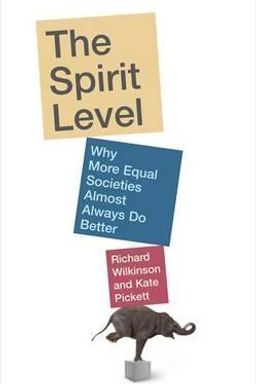
The Spirit Level cover

The Spirit Level

by Richard Wilkinson & Kate Pickett

The Spirit Level uncovers how inequality is a hidden driver of today''s societal issues, impacting everyone. Through compelling research, Wilkinson and Pickett demonstrate how fostering equality can improve health, trust, and creativity, offering solutions to global challenges.

Why Equality Determines a Society’s Wellbeing

Why do people in materially wealthy countries feel so stressed, distrustful, and unhappy? In The Spirit Level: Why Greater Equality Makes Societies Stronger, epidemiologists Richard Wilkinson and Kate Pickett offer a provocative answer: it’s not wealth itself, but the gap between rich and poor that determines how well societies function. They argue that once a country achieves basic prosperity, further growth adds little to human wellbeing—what matters instead is how evenly those riches are shared.

The authors spent decades analyzing data linking income inequality to social outcomes across rich nations and U.S. states. Their conclusion is startling yet intuitive: countries with smaller income gaps—like Japan and the Scandinavian nations—score better on almost every measure of social health. They have lower rates of crime, mental illness, obesity, teenage pregnancy, and imprisonment, and higher levels of trust, happiness, and community life. By contrast, more unequal societies such as the United States and the United Kingdom display widespread anxiety, weak social bonds, and poor health outcomes.

The End of Material Growth

Wilkinson and Pickett begin with a question that sits at the heart of modern economies: Does economic growth still make us happier or healthier? Their research suggests that once societies reach a comfortable standard of living, further growth contributes little to life expectancy, happiness, or overall wellbeing. The 20th century’s triumph of technological advancement produced paradoxical results—greater abundance alongside rising depression, obesity, and loneliness. For example, Figure 1.1 in the book shows that while Japan and Greece have roughly half America’s income per capita, they enjoy similar life expectancies. The curve of progress flattens, signaling that wealth has done all it can.

This realization shifts attention from absolute wealth to relative status. Within each country, people’s health and happiness decline with each rung down the social ladder. Yet between rich countries, average incomes make little difference. The authors use this paradox to reveal what really drives wellbeing: inequality itself.

How Inequality Gets Under the Skin

The heart of The Spirit Level lies in exploring how inequality shapes psychology. Humans evolved to be acutely sensitive to social hierarchy and status, and when inequality widens, our sense of worth and security erodes. Wilkinson and Pickett share fascinating findings: in societies with greater income gaps, cortisol levels—a stress hormone—rise, depression increases, and trust collapses. Jean Twenge’s research at San Diego State University found that modern Americans are far more anxious and narcissistic than their grandparents were, trapped in what the authors call a “social evaluative threat”—a constant fear of being judged.

These dynamics play out in every social domain. In more unequal societies, friendships weaken, competition intensifies, and people retreat into consumption as a substitute for status. As social psychologist Thomas Scheff wrote, “shame is the social emotion,” and inequality magnifies shame. Whether through humiliation at work, fear of social failure, or the drive to display success through consumption, inequality “gets under the skin,” influencing both physical and mental health.

The Widespread Costs of Inequality

Throughout the book, the authors emphasize that inequality affects everyone—not just the poor. Rich and poor alike suffer from weakened social trust and more fragile human connections. In communities where inequality is high, parents face greater stress, friendships are rarer, and even the affluent report higher rates of anxiety. The authors compile graphs showing how inequality predicts rates of crime, obesity, mental illness, disaster response failures, and even social mobility. From Hurricane Katrina’s chaotic aftermath to rising imprisonment rates, the evidence consistently points to one culprit: a divided society.

Each chapter of The Spirit Level dives into a specific manifestation of this divide—violence, mental health, education, community trust, and more. Squarely based on decades of epidemiological data, the authors describe inequality as “social pollution”: something that contaminates the entire fabric of life, not just one segment of the population. Whether it’s adolescents bullied into self-doubt or adults numbing themselves through consumerism, inequality drives a shared sense of unease that bleeds into the health of the whole nation.

A Blueprint for a Better Society

What can societies do? Wilkinson and Pickett urge governments and citizens to view equality not as utopian fantasy but as practical necessity. Greater equality builds trust, reduces violence, and cultivates cooperation—the qualities every democracy needs to thrive. Whether through progressive taxation, stronger unions, or employee-owned companies (as in the authors’ call for workplace democracy), equality becomes the foundation for a better social environment. Political or economic systems can vary, but the outcome is clear: more equality means better human flourishing.

This book’s impact has extended far beyond academic circles—it helped spark civic initiatives like the UK Equality Trust. Ultimately, The Spirit Level invites you to rethink what progress means. Real advancement comes not from producing or consuming more, but from narrowing the distance between us. A society is strongest, Wilkinson and Pickett remind us, when its members are not rivals scrambling for dominance but equals working toward shared dignity. In an age of plenty yet deep division, their message feels as vital as ever: equality isn’t simply moral—it’s the key to collective sanity.


Material Success, Social Failure

The authors begin their argument by addressing a deceptively simple paradox: why are people in rich nations often miserable despite unprecedented wealth and comfort? Drawing on historical and epidemiological data, Wilkinson and Pickett show that humanity has reached the end of what economic growth can do for wellbeing. Once we’ve satisfied basic needs—food, shelter, education—further increases in average income no longer translate into higher happiness or longer life expectancy. Instead, inequality has become the defining fault line of modern life.

The Plateau of Progress

Over thousands of years, economic growth transformed existence from subsistence survival into material sufficiency. But in the world’s wealthiest nations, tangible indicators of progress—life expectancy, happiness, safety—have plateaued. Wilkinson and Pickett illustrate this with graphs showing diminishing returns: countries more than twice as rich as others often enjoy no better health. They remind readers that diseases of poverty (cholera, tuberculosis) have been replaced by diseases of affluence (obesity, heart disease), signaling that prosperity itself is no longer the cure.

The key insight here is a turning point in history: we have hit the “end of an era.” Economic growth cannot fulfill emotional or social needs. Instead, we must turn to questions of relational and psychological wellbeing. As British economists and psychologists like Richard Layard (author of Happiness) have argued, the modern world creates abundance without satisfaction. The authors echo this sentiment, showing that collective wellbeing depends more on equality of conditions than on the abundance of goods.

The Broken Society

Wilkinson and Pickett highlight how, by the 2000s, both Britain and America faced what politicians called a “broken society.” But what’s broken isn’t just economics—it’s relationships. Surveys show people crave a life “more centered on values, community, and family” but feel trapped in an individualistic race for advancement. The irony is that personal striving, encouraged by market competition, fractures the social fabric it depends on. The authors argue that this isn’t about moral failure—it’s a structural problem born of inequality itself. A society chasing status inevitably erodes trust.

Their analysis goes beyond material dissatisfaction to describe psychological exhaustion: overconsumption, overeating, anxiety, and addiction fill the void left by weakened human connection. The loss of social cohesion pushes both rich and poor toward self-medication—through drugs, luxury goods, or endless scrolling on modern equivalents of consumption. Wilkinson and Pickett connect these trends to decades of research in public health, puncturing the myth that rising GDP can restore social integrity.

Rethinking Progress

The authors conclude that continued faith in growth alone—our collective “economic religion”—is misplaced. Just as the Industrial Revolution’s engine of progress once lifted millions out of poverty, today’s challenge lies in transforming social structures to heal emotional poverty. Equality, they suggest, can achieve what GDP no longer can: emotional security, mutual respect, and trust. They invite readers to imagine a “post-growth society” not defined by possessions but by connection, where people measure success not against neighbors’ wealth but by the strength of their communities.

For you, the takeaway is simple: if you want a better life, it’s not just about earning more; it’s about living in a society where people value each other as equals. As the authors put it, material progress has given us comfort—but equality can finally give us peace.


How Inequality Shapes Human Behavior

Wilkinson and Pickett make a compelling psychological argument: inequality doesn’t just separate wallets—it rewires minds. When income gaps widen, people shift from cooperation to comparison, becoming hyper-aware of how others judge them. This tension breeds anxiety, narcissism, and a pervasive sense of inadequacy that corrodes mental health and relationships.

The Rise of Social Anxiety

Drawing from psychologist Jean Twenge’s 40-year meta-analysis, the authors show that anxiety scores among American students have soared since the 1950s. People today report more nervousness and depression even during times of prosperity. Why? Because modern success demands constant social evaluation—your worth is measured by your income, home size, or career prestige. The book explains that these “social evaluative threats” activate physiological stress responses, raising cortisol and undermining health.

In experiments at UCLA, psychologists Sally Dickerson and Margaret Kemeny discovered that stress hormones rise most sharply when people feel watched, judged, or compared—precisely the pressures intensified in unequal societies. Humans, they say, are “driven to preserve the social self.” So every instance of comparison, humiliation, or failure feels like an existential blow. The authors argue that inequality magnifies these experiences daily, creating a climate of mistrust and self-consciousness.

Status and Shame

Wilkinson and Pickett borrow from sociologist Thomas Scheff’s insight that shame is the fundamental social emotion. In a hierarchical society, shame and pride become instruments of control—people at the bottom internalize feelings of inadequacy while those at the top reinforce superiority. They describe crime, violence, and overconsumption as direct attempts to regain respect in a culture obsessed with status. The book cites psychologist Alfred Adler: “To be human means to feel inferior.” In more unequal societies, this inferiority becomes chronic, fueling aggression and despair alike.

Contrasting examples illustrate how culture modifies these instincts. In Japan, one of the most equal societies, people tend toward modesty and self-criticism; success is attributed to teamwork and luck. In the U.S.—one of the most unequal—people prefer self-promotion, seeing confidence and ambition as virtues. Both attitudes mirror their societies’ structures: inequality fosters competitiveness, while equality encourages humility. (Psychologist Hazel Markus’s research on cultural models of the self echoes this pattern.)

From Community to Isolation

The authors trace rising anxiety to the breakdown of community. As mobility and competition fragment stable social ties, people lose the comfort of mutual recognition—the sense of being known and accepted. “Modern identity,” they write, “is cast adrift in the anonymity of mass society.” In this void, status becomes the fragile substitute for belonging. The more unequal our surroundings, the harder we must fight to prove worth—through wealth, work, or image—and the lonelier we become. In essence, inequality transforms everyday life into a verdict on your value.


The Costs of Inequality

After mapping how inequality affects individual psychology, Wilkinson and Pickett quantify its social costs. They compile vast cross-national data sets showing that unequal societies consistently suffer higher rates of nearly every social problem: poor physical health, obesity, low trust, violence, imprisonment, and educational failure. Whether comparing 23 developed nations or the 50 U.S. states, the patterns hold—the wider the income gap, the worse the outcomes.

Trust and Social Connection

In one striking finding, the percentage of people agreeing that “most others can be trusted” varies sixfold across rich countries—from 66% in Sweden to barely 10% in Portugal. Among U.S. states, trust ranges from 67% in North Dakota to 17% in Mississippi. As inequality widens, the public’s faith in one another collapses, producing fear and social withdrawal. Robert Putnam’s research (Bowling Alone) supports this, showing that civic engagement declined simultaneously with rising income gaps. Trust, he explains, is the glue of cooperation—and inequality dissolves it.

The authors quote political scientist Eric Uslaner’s conclusion that “trust cannot thrive in an unequal world.” Using decades of survey data, Uslaner demonstrates that inequality precedes mistrust, not the other way around. When people live in fairer societies, they give more—to charities, strangers, and even foreign nations. Scandinavian countries, for instance, contribute four times more in development aid than the most unequal states.

Mental and Physical Health

Rates of mental illness are three to five times higher in more unequal nations. The U.S., U.K., and New Zealand top the charts, while Japan and Germany report far fewer cases. These trends persist even after adjusting for income or healthcare spending, proving that inequality directly undermines wellbeing. Wilkinson and Pickett link chronic stress and “status anxiety” to physiological wear and tear—elevated cortisol, high blood pressure, and immune suppression. In more equal societies, people literally live longer.

Physical health mirrors this pattern: research from the Whitehall civil servant studies in Britain found that even among well-paid professionals, those lower in hierarchy died younger. Illness follows the gradient of social rank itself. In unequal societies, that gradient steepens, creating what the authors call a “social pollution effect” that harms everyone, including the wealthy.

Social Breakdown

Inequality fractures societies on every level—from family life to crime rates. Wilkinson and Pickett show that more unequal countries experience higher obesity, teenage births, and imprisonment, each a symptom of deeper relational stress. The vicious cycle of deprivation perpetuates poverty across generations: despair breeds impulsivity, early childbirth, and low educational achievement. Ultimately, inequality is costly even for the comfortable—it reduces public safety, erodes cooperation, and raises collective stress. The authors sum this up powerfully: “Inequality acts as a social toxin.”


Equality and the Human Condition

By the book’s later chapters, Wilkinson and Pickett turn philosophical, tracing humanity’s capacity for cooperation. They argue that empathy and reciprocity are our natural instincts—qualities disrupted by inequality. When people live as equals, they trust, share, and nurture friendship; when hierarchy intensifies, dominance replaces connection.

Friendship vs. Status

The authors contrast two forms of social organization. In egalitarian settings, relationships revolve around mutuality and gift exchange—as anthropologist Marshall Sahlins famously described, “gifts make friends and friends make gifts.” In hierarchical settings, relationships hinge on coercion and display: people compete for recognition rather than cooperation. This binary captures the moral core of the book—the choice between trust and dominance.

Drawing from primatology, they compare humans to our closest relatives, chimpanzees and bonobos. Chimps live under strict male hierarchies; bonobos, by contrast, rely on sharing, sexual play, and emotional bonding to defuse conflict. Humans, the authors suggest, inherit both tendencies—but equality activates our bonobo side, fostering empathy and peace rather than aggression.

Brains Built for Connection

Neuroscience reinforces this idea. Research on mirror neurons—brain cells that mimic others’ actions—show humans are inherently wired for empathy. When you observe someone in pain or joy, your brain simulates it, enabling compassion. Similarly, hormones like oxytocin foster trust and bonding. In one experiment, participants dosed with oxytocin were significantly more willing to invest in strangers. These biological findings exemplify how social environments shape health: equal societies nurture connection, while unequal ones breed fear and isolation.

Social Pain and Exclusion

Wilkinson and Pickett conclude that inequality doesn’t merely divide wealth—it divides hearts. Studies show the same brain regions activated by physical pain light up when people feel socially excluded. Inequality, in this sense, constantly wounds the psyche. The book’s message becomes universal: to heal our bodies, minds, and communities, we must heal the divide between us. Equality restores not just fairness but our inherent humanity.


From Inequality to Sustainability

In the book’s final section, the authors connect equality to another global challenge—climate change. They argue that the pursuit of endless consumption, driven by social competition, makes sustainability impossible. To save both humanity and the planet, societies must curb inequality and redefine progress.

The Link Between Carbon and Class

The richer you are, the more you consume, and thus the more carbon you emit. Wilkinson and Pickett show that the top income groups in every country leave an ecological footprint many times larger than the poor. Fair environmental policies, they argue, must therefore target inequality itself—through mechanisms like tradeable carbon quotas that reward low consumers and charge high ones. Environmental fairness mirrors social fairness: sustainability depends on shared responsibility.

Consumerism as Social Competition

Perhaps the most original element of this section is the authors’ diagnosis of consumerism as a symptom of inequality. Drawing from economist Robert Frank’s idea of “luxury fever,” they argue that status competition fuels wasteful consumption. People buy not to satisfy needs but to prove worth. In equal societies, the pressure to signal status weakens, allowing deeper values—community, creativity, sustainability—to flourish. Advertising and celebrity culture prey on insecurity; equality could release us from their grip.

Toward a Cooperative Future

The book concludes with optimism. Equal societies, the authors insist, are more cohesive, more generous, and better equipped to tackle global problems through collaboration. They envision a “weightless economy” where knowledge and digital innovation replace wasteful material consumption. In such a world, democracy extends into workplaces through employee ownership and cooperative enterprise, rooting equality deeply into daily life. As they remind us, equality is not merely about redistributing money—it’s about building trust capable of sustaining humanity itself.

Dig Deeper

Get personalized prompts to apply these lessons to your life and deepen your understanding.

Go Deeper

Get the Full Experience

Download Insight Books for AI-powered reflections, quizzes, and more.