
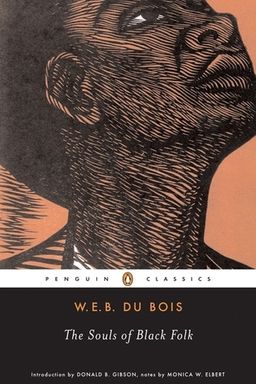
The Souls of Black Folk cover

The Souls of Black Folk

by WEB Du Bois

Published in 1903, ''The Souls of Black Folk'' by W.E.B. Du Bois examines the enduring impact of slavery on African Americans, exploring themes of racism, segregation, and the struggle for civil rights. Through poignant analysis, Du Bois illuminates the socio-economic and psychological challenges faced by Black Americans, offering profound insights into the quest for equality.

The Problem of the Color Line

Have you ever wondered what it truly means to live in a world that sees you first through the color of your skin, before recognizing your humanity? In The Souls of Black Folk, W. E. B. Du Bois challenges readers to confront this question—a question that defines not only the African American experience but also the moral soul of America itself. Du Bois argues that the central problem of the twentieth century (and, by extension, our own age) is the problem of the color line—the invisible yet pervasive divide separating races, minds, and souls.

For Du Bois, this book is more than a collection of essays—it is a map of spiritual struggle. He contends that behind every civil right and social reform lies a deeper question: how can a people forced beneath a "veil" of racial prejudice discover their humanity, their voice, and their rightful place in the modern world? His central concept of double-consciousness—the sense of always seeing oneself through the eyes of others—remains one of the most piercing metaphors for racial identity ever written.

A Nation Divided by Vision

Du Bois begins with the paradox of being “an American, a Negro; two souls, two thoughts, two unreconciled strivings,” trapped in the body of one person. For African Americans, selfhood was fragmented by the brutal legacy of slavery and the hypocrisy of a country that preached freedom while practicing exclusion. This dual identity forced Black people to constantly balance their hopes for citizenship with the crushing reality of racial subjugation. Through this lens, every chapter of the book becomes a meditation on how a people behind the Veil learn to transform suffering into spiritual strength.

The Souls Behind the Statistics

Across fourteen essays, Du Bois takes readers on a journey—from the spiritual yearnings of freed slaves to the systemic failures of Reconstruction and the moral compromise of leaders like Booker T. Washington. He examines education, labor, religion, and art not as policy questions but as struggles for dignity. For instance, in his critique of Washington, Du Bois insists that submission to segregation and economic servitude cannot redeem a race—it must cultivate souls, not just laborers. Similarly, in chapters like "Of the Meaning of Progress" and "Of the Coming of John," Du Bois transforms individual stories into parables about a nation’s conscience. Each essay asks whether America will recognize that Black striving is not a threat but a mirror of its own moral test.

A Mirror for Humanity

Du Bois’s vision blends sociology, autobiography, and prophetic philosophy. He believed that the spiritual striving of Black folk held lessons for all humanity—that out of bondage and sorrow could rise a new ideal of brotherhood. He wrote with a poet’s precision and a philosopher’s clarity, describing emancipation as both a physical and psychological revolution. Yet he warns that freedom without equality breeds despair: the promised land of justice will remain a mirage until the color line dissolves. His “Sorrow Songs”—spirituals born from slavery—embody this paradox, merging grief with transcendent hope. For Du Bois, these songs represent the true American music, the only art form to unite beauty with truth.

Why It Still Matters

Reading The Souls of Black Folk today, you encounter not just a historical document but a living challenge. Du Bois asks: can America fulfill its democratic promise while denying the humanity of millions? His insights about identity and prejudice echo through the work of later thinkers—from James Baldwin to Ta-Nehisi Coates—who continue to wrestle with what it means to be seen and unseen at once. Du Bois invites every reader, regardless of race, to step behind the Veil and confront the ways we define ourselves and others. His message is timeless: to heal the color line, we must cultivate not only equality but empathy—the recognition that the souls of Black folk are, and always have been, the souls of America itself.


Double-Consciousness and the Veil

Du Bois introduces one of the most enduring ideas in social thought: double-consciousness. This is the feeling of always seeing oneself through the eyes of others, measuring one’s soul by the tape of a world that views it with pity or contempt. Every Black person in America, he writes, lives with this inner conflict—an identity split between being an American and being a Negro, between belonging and exclusion.

Living Behind the Veil

Du Bois calls the boundary separating Black life from white perception the Veil. It’s invisible yet omnipresent—a social and psychological screen that distorts humanity. Behind the Veil, Black Americans develop a kind of second sight: they understand not only themselves but also how America sees them. This “double vision” produces both immense cultural creativity and unbearable pain. Du Bois likens it to trying to combine two souls without tearing them apart.

At War With Oneself

To survive within this dual identity requires strength that many societies underestimate. Du Bois describes his own early experience of racial revelation—a moment when, as a child, a white girl refused his greeting card. That instant of exclusion became the moment he realized he was a problem, not a person. For millions of others, this awakening defines their consciousness: they begin to live not simply as individuals, but as social mirrors reflecting a world’s prejudice. The tragedy of double-consciousness is that it destroys the wholeness of the self, yet also creates empathy and insight. It is both wound and wisdom.

A Human Problem Beyond Race

Du Bois reminds readers that this conflict is not unique to race—it’s a universal struggle for self-definition in the face of judgment. Many have applied his concept to cultures divided by class, gender, or colonialism (Frantz Fanon later expanded this idea to colonized people worldwide). Du Bois’s theory is ultimately a meditation on freedom: to be free, one must reconcile the internal and external images of oneself. True progress, he says, means living both identities fully—to be a Negro and an American, without contradiction.

“Between me and the other world there is ever an unasked question... How does it feel to be a problem?”

Du Bois’s metaphor of the Veil continues to resonate because it captures the enduring spiritual cost of racism. Yet, he insists, the purpose of Black striving is not to destroy the Veil but to lift it—through culture, intellect, and moral strength. Behind the Veil lies not shame but possibility: the dream of a world where no one is a “problem,” and every soul can see itself clearly.


The Freedmen’s Bureau and the Dawn of Freedom

Du Bois dedicates one of his longest essays to analyzing the short-lived but monumental Freedmen’s Bureau, established in 1865 after the Civil War. He views it not merely as an administrative agency but as one of the most daring human experiments in history—the attempt of a modern nation to lift four million formerly enslaved people into citizenship.

What the Bureau Tried to Do

Designed to oversee labor relations, education, and justice for freedmen, the Bureau was America’s first institution devoted to social reform on a national scale. Its leader, General Oliver O. Howard, sought to guide a broken people from bondage into democracy. Du Bois praises its humanitarian purpose but laments that Congress gave it few funds, vague powers, and little support from white Southerners.

Successes and Failures

The Bureau’s victories were profound yet partial: it built schools, hospitals, and industrial programs, and nurtured the first generation of Black teachers—the “crusade of the New England schoolma’am.” At the same time, Du Bois details its collapse under political pressure, local corruption, and violence. Former Confederates saw it as tyranny; Northern politicians viewed it as temporary charity. In truth, Du Bois argues, it should have been made a permanent institution of justice, a national school of citizenship. Instead, it died young, leaving a legacy of unfinished reconstruction.

Lessons for the Future

Du Bois’s historical account becomes a warning about what happens when reform lacks moral stamina. The Bureau tried to build an interracial democracy in an environment of hatred—it was humanity against history. Its failure taught Du Bois that freedom without land, justice, and education is hollow. He concludes that Reconstruction was less an era of corruption than an opportunity squandered by a nation unwilling to institutionalize equality. The freedmen were made “wards” rather than citizens—their chains broken but their rights still bound.

By tracing the Bureau’s story, Du Bois establishes the broader theme of The Souls of Black Folk: African Americans were never freed completely—they were freed into a society that despised their freedom. He shows that emancipation without empathy creates ghosts rather than people, and that the “dawn of freedom” is always followed by the test of compassion.


The Education of a Race

Education, for Du Bois, is the crucible where the human spirit is refined. In essays like “The Training of Black Men” and “The Wings of Atalanta,” he argues that true progress requires more than teaching manual skills—it demands cultivating the soul. He sees schools and universities not as factories for workers but as cathedrals for thinkers and leaders.

Beyond Industrial Training

At the turn of the century, leaders like Booker T. Washington championed industrial education and labor discipline. Du Bois respected Washington’s achievements but believed his philosophy of submission to white goodwill was morally dangerous. Economic skills, he wrote, cannot substitute for self-respect. Without higher education and the cultivation of art, science, and ethics, a people remain mere tools of others’ prosperity.

The Talented Tenth

Du Bois proposed a radical idea—the Talented Tenth: the best and brightest of any race should be trained to uplift the rest. He saw universities like Atlanta, Fisk, and Howard as sanctuaries for this mission, training men and women to lead their community intellectually and morally. Education, he insisted, must develop not only the hands that labor but the minds that govern. Otherwise, civilization itself declines.

The Soul of Scholarship

Du Bois’s vision of learning is deeply spiritual. He likens the scholar to a priest of truth, called to serve humanity with humility and courage. Knowledge used for exploitation corrupts; knowledge used for enlightenment redeems. In this sense, the problem of Black education mirrors the problem of all modern education—how to unite work, culture, and morality. Enlightenment must be both practical and poetic, as in the “Negro colleges” that served as oases of hope amid the desert of prejudice.

Du Bois’s educational philosophy predicted later debates about race and schooling. He anticipated thinkers like Paulo Freire (Pedagogy of the Oppressed) who saw learning as liberation. For Du Bois, the future of humanity depends on what a society chooses to teach—and whether it teaches its oppressed not only how to survive, but how to dream.


Economic Struggle in the Black Belt

In “Of the Black Belt” and “Of the Quest of the Golden Fleece,” Du Bois turns from philosophy to fieldwork. He travels through Dougherty County, Georgia, studying the everyday lives of Black farmers. What he finds is not progress but poverty—the enduring economic slavery of sharecropping. The plantations remain, only the masters have changed.

The New Slavery of Debt

Du Bois exposes how freedmen were trapped in cycles of debt and false freedom. The crop-lien system ensured that every year’s harvest barely paid rent and interest; farmers worked to live but never to own. Landlessness became a form of bondage. He calls this “slavery of debt,” and shows how the racial hierarchy was preserved through contracts instead of chains. Peonage replaced plantation slavery as the invisible scaffold of Southern society.

The Lost Promise of Reconstruction

After emancipation, America promised “forty acres and a mule,” but that dream was betrayed. Without land, freedmen competed against wealthy landlords and exploitative merchants who controlled prices and wages. In vivid detail—describing weary laborers and burned cabins—Du Bois paints a land haunted by hunger and injustice. He calls it the “Egypt of the Confederacy,” a fertile but cursed landscape where progress withers under prejudice.

The Economics of Hope

Despite grim realities, Du Bois refuses despair. He envisions Black ownership, thrift, and education as the way forward. His tone shifts from sociological observation to moral exhortation: the economic system must serve human dignity, not profit alone. He urges the creation of fair laws, cooperative enterprises, and land reform—a vision decades ahead of his time. In doing so, he anticipates later movements for economic justice, from the Freedom Farms of Fannie Lou Hamer to modern cooperative economics.

Du Bois transforms famine into prophecy: “The gift of the Spirit,” he writes, will redeem the material world when men remember that wealth without justice is ash. The “Golden Fleece” of cotton, chased by greed from planter to merchant, will remain cursed until the hands that pick it are free.


Leadership and the Legacy of Booker T. Washington

In “Of Mr. Booker T. Washington and Others,” Du Bois performs one of the most courageous acts of his era: he publicly challenges the most powerful Black leader in America. Booker T. Washington advocated industrial education, self-help, and quiet submission to segregation. Du Bois respected his sincerity but saw his program as a moral retreat—a betrayal of the higher ideals of freedom.

The Atlanta Compromise

Washington’s famous 1895 Atlanta speech urged whites and Blacks to be “as separate as the fingers in all things purely social, yet one as the hand in all things essential to mutual progress.” Whites applauded this as a renunciation of civil rights. Du Bois calls it the Atlanta Compromise, a tragic symbol of how a race was asked to barter manhood for opportunity. He insists that there can be no prosperity without dignity, no peace without justice.

Three Things a People Must Not Relinquish

Du Bois identifies what must never be surrendered: political power, civil rights, and higher education. He argues that Washington’s policy of conciliation encourages disfranchisement, inferior schooling, and economic dependency. A people cannot build temples of culture on foundations of submission. Freedom, Du Bois writes, is not earned by obedience but demanded by right.

A Battle for the Soul of Leadership

The debate between Du Bois and Washington symbolized two strategies of survival—accommodation versus assertion. Du Bois believed silence would be suicide. His critique elevated the role of intellectual leadership and moral courage: to tell the truth even when history prefers a lie. This resistance redefined what leadership meant—not winning approval, but awakening conscience. Later leaders from Martin Luther King Jr. to Malcolm X would echo his demand that freedom must speak its own name.

Du Bois’s challenge to Washington was not spiteful but prophetic. He warned that America’s peace with injustice would rot its soul. To educate the mind while shackling the spirit is to build “a civilization upside down.” His essay remains one of history’s clearest calls to integrity—that progress without principle is merely submission by another name.


Religion and the Faith of the Fathers

Religion, Du Bois believes, is the spiritual core of Black life—the one institution untouched by slavery’s corruption. In “Of the Faith of the Fathers,” he examines how the Black Church evolved from an African spiritual inheritance into the heart of community life, moral guidance, and collective resistance.

Faith Born in Sorrow

Under bondage, worship was survival. The secret gatherings known as “Negro revivals” combined African rhythms with Christian hope, creating ecstatic forms of worship that carried pain into transcendence. The preacher, the music, and the frenzy were its holy trinity. This was faith reborn from despair. Du Bois insists that it was not superstition but communication with the divine—the voice of those who had nothing but their souls.

The Church as Liberation

After emancipation, the Black Church became the central institution of African American life—a space of autonomy and dignity. Du Bois describes it as “a world within a world,” providing leadership, education, and social solidarity. It was where sermons became political manifestos and choirs became historians of hope. Yet, he cautions, as the Church gained wealth, it also risked hypocrisy—where emotion overshadowed ethics.

Faith as Ethical Power

Du Bois calls for a faith of intelligence and compassion—a religion aligned with justice. He sees in the spirituals the purest theology of freedom ever sung. This moral energy, he argues, must guide social reform, teaching that salvation is not merely for heaven but for earth. In this sense, religion becomes not escape from struggle but its fuel—the “power that makes men free.”

Du Bois’s insight into the sacred roots of community has influenced generations of social movements, from civil rights to liberation theology. His portrait of the preacher as a moral leader anticipates later voices like Howard Thurman and Martin Luther King Jr., proving that spiritual striving is as vital to justice as economic or political strength.


The Power of the Sorrow Songs

Du Bois closes The Souls of Black Folk with a breathtaking meditation on the “Sorrow Songs”—the spirituals, the music through which enslaved people expressed their pain, hope, and prophecy. These songs, he declares, are the truest form of American art, born from suffering yet rich with transcendent beauty.

Music as Memory

The spirituals are more than music; they are history encoded in melody. Every cry of “Swing Low, Sweet Chariot” carries the longing for deliverance, not just from slavery but from the limits of the human soul. Du Bois traces their evolution from African chants to the hymns of faith. Their rhythm, he writes, comes from the beating of chains and the pulse of hope—a “message of the slave to the world.”

Beauty Born of Suffering

What makes these songs extraordinary is their paradox: out of misery arose beauty. They prove that oppression cannot strangle creation. Du Bois insists that America has never produced higher music than what came from its slaves. He connects the songs to the founding of Fisk University and the rise of the Jubilee Singers, who carried these melodies across the Atlantic to awaken the conscience of the world.

The Promise within the Pain

In the “Sorrow Songs,” Du Bois hears prophecy. They foretell a future where justice replaces prejudice, where men will be judged “by their souls and not by their skins.” He calls them the spiritual heritage of the nation—the one gift America owes its humanity. Listening to these songs, he writes, is like hearing “the weary traveller along the heavenly way” calling us to conscience. The melodies are not cries of defeat but of divine endurance.

Du Bois’s conclusion transforms art into revelation. He teaches that the world’s truest beauty is born from struggle and that the sorrow of one people can redeem the sins of a nation. The “Sorrow Songs” are both lament and promise—the echo of pain turned into praise. And for Du Bois, they prove that even behind the Veil, the human soul sings.

Dig Deeper

Get personalized prompts to apply these lessons to your life and deepen your understanding.

Go Deeper

Get the Full Experience

Download Insight Books for AI-powered reflections, quizzes, and more.