
Idea 1
The Conscious Life of an Octopus
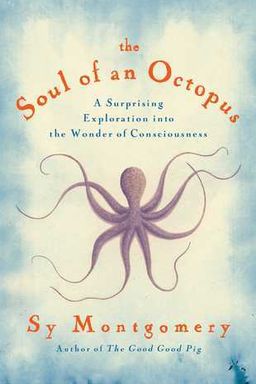
Have you ever wondered what it feels like to be someone—or something—completely different from yourself? This is the question at the heart of The Soul of an Octopus by Sy Montgomery, a naturalist and journalist who invites you into one of the most unexpected and astonishing relationships in the animal kingdom. Montgomery’s central claim challenges our deepest assumptions about intelligence and consciousness: even a creature as alien as an octopus—boneless, blue-blooded, three-hearted—can think, feel, and perhaps even possess a soul.
Through her friendship with several Pacific giant octopuses—Athena, Octavia, Kali, Karma—Montgomery explores how these animals bridge the vast evolutionary gulf separating humans from invertebrates. In doing so, she offers something more than a nature study: a meditation on empathy, transformation, and what it means to know another mind. Much like Jane Goodall’s chimpanzees or Carl Safina’s whales, her octopuses reveal an intelligence that forces us to rethink consciousness itself.
Entering an Alien Mind
Montgomery begins her journey at the New England Aquarium in Boston, where she first meets Athena, a massive female octopus whose touch—via thousands of taste-sensing suckers—feels like a communion. The encounter is intimate, even erotic, but also unnerving. An octopus, Montgomery reminds us, is a creature so distant from us evolutionarily that the last ancestor we shared lived more than half a billion years ago. And yet, Athena looks at her with unmistakable curiosity. That mutual gaze sets in motion the book’s guiding mystery: how can two lives, built from such different architectures, recognize something of themselves in the other?
Each chapter deepens that question, blending storytelling with neuroscience and philosophy. Montgomery follows the passionate caretakers—Bill Murphy, Wilson Menashi, and others—who raise, feed, and play with these luminous mollusks. Their relationships unfold like friendships, complete with affection, mischief, and grief. When an octopus dies, the emotional aftermath feels like losing a family member. Through such encounters, the reader begins to sense that intelligence may take many forms, and that understanding might come more through touch and empathy than through language or logic.
A Mirror for Human Consciousness
Montgomery’s quest is as much philosophical as biological. She draws on thinkers such as Thomas Nagel (“What is it like to be a bat?”) and Ludwig Wittgenstein (“If a lion could talk, we couldn’t understand him”), asking how far empathy can reach beyond our species. Her answer comes not from theory but from direct experience. The octopus’s distributed nervous system—three-fifths of its neurons in its arms—forces us to rethink what a unified self might mean. Can an animal that literally spreads its mind through eight limbs also feel emotion, curiosity, or joy? Montgomery concludes that yes—it not only can, but does. The octopus becomes a living metaphor for consciousness itself: fluid, embodied, and multiple.
Montgomery’s exploration widens as she learns to scuba dive, joining researchers across the world—from Boston to Cozumel to the South Pacific island of Mooréa—where she watches wild octopuses hunt, camouflage, and even play. But the most profound lessons unfold not in coral reefs, but in moments of quiet intimacy—a hand offered to a creature that can suction, taste, and decide whether to trust you.
Why It Matters
Why should the inner life of an octopus matter to you? Because, as Montgomery shows, understanding them changes how we understand ourselves. She argues that consciousness is not a human monopoly—it’s a spectrum that extends across the animal world. Learning to see intelligence in unexpected forms invites humility, compassion, and a renewed sense of belonging in nature. The octopus, she suggests, offers a “portal to an alternate reality”—one that reveals the interconnectedness of all living beings.
By the end, Montgomery’s readers have journeyed from curiosity to communion. The octopus ceases to be a monster from the deep and becomes a teacher, a mirror, and a friend. Across her encounters—with Athena’s first touch, Octavia’s fading devotion to her eggs, Kali’s mischievous intelligence, and Karma’s gentle calm—Montgomery invites us to ask the ultimate question: if consciousness can take so many shapes, what might the soul itself be?